

C hapter 4 Material Classes, structure, and properties
114
pressure), it is given the symbol C p . Heat is measured in Joules,
symbol J, so the units of specific heat are J/kg.K. In dealing with
gases, it is more usual to measure the heat capacity at constant
volume (symbol C v ), and for gases this differs from C p . For solids
the difference is so slight that it can be ignored, and we shall do
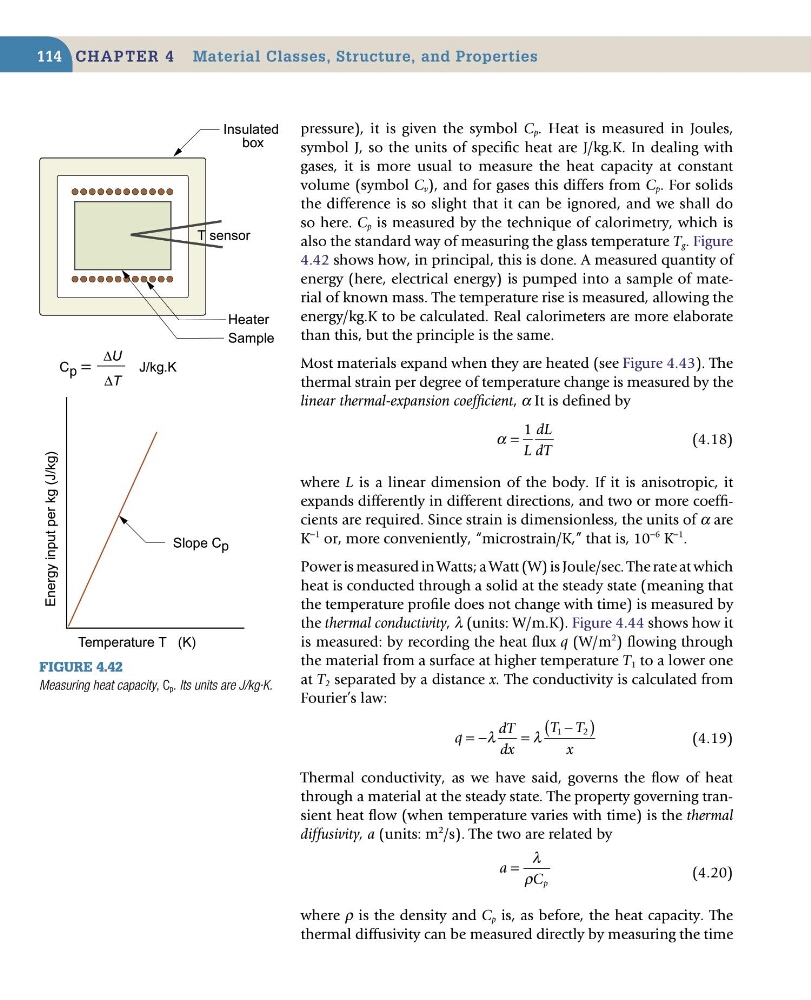
so here. C p is measured by the technique of calorimetry, which is
also the standard way of measuring the glass temperature T g . Figure
4.42 shows how, in principal, this is done. A measured quantity of
energy (here, electrical energy) is pumped into a sample of material of known mass. The temperature rise is measured, allowing the
energy/kg.K to be calculated. Real calorimeters are more elaborate
than this, but the principle is the same.
Most materials expand when they are heated (see Figure 4.43). The
thermal strain per degree of temperature change is measured by the
linear thermal-expansion coefficient, α It is defined by
α =
1
L
dL
dT
(4.18)
where L is a linear dimension of the body. If it is anisotropic, it
expands differently in different directions, and two or more coefficients are required. Since strain is dimensionless, the units of α are
K
−1 or, more conveniently, “microstrain/K,” that is, 10
−6 K
−1 .
Power is measured in Watts; a Watt (W) is Joule/sec. The rate at which
heat is conducted through a solid at the steady state (meaning that
the temperature profile does not change with time) is measured by
the thermal conductivity, λ (units: W/m.K). Figure 4.44 shows how it
is measured: by recording the heat flux q (W/m
2 ) flowing through
the material from a surface at higher temperature T 1 to a lower one
at T 2 separated by a distance x. The conductivity is calculated from
Fourier’s law:
q
dT
dx
T T
x
= −
=
−
(
)
λ
λ
1
2
(4.19)
Thermal conductivity, as we have said, governs the flow of heat
through a material at the steady state. The property governing transient heat flow (when temperature varies with time) is the thermal
diffusivity, a (units: m
2 /s). The two are related by
a
C p
=
λ
ρ
(4.20)
where ρ is the density and C p is, as before, the heat capacity. The
thermal diffusivity can be measured directly by measuring the time
Figure 4.42
Measuring heat capacity, C p . Its units are J/kg·K.
Temperature T (K)
Slope C p
Energy input per kg (J/kg)
C p =
∆U
∆T
Heater
Sample
Insulated
box
T sensor
J/kg.K
114
pressure), it is given the symbol C p . Heat is measured in Joules,
symbol J, so the units of specific heat are J/kg.K. In dealing with
gases, it is more usual to measure the heat capacity at constant
volume (symbol C v ), and for gases this differs from C p . For solids
the difference is so slight that it can be ignored, and we shall do
so here. C p is measured by the technique of calorimetry, which is
also the standard way of measuring the glass temperature T g . Figure
4.42 shows how, in principal, this is done. A measured quantity of
energy (here, electrical energy) is pumped into a sample of material of known mass. The temperature rise is measured, allowing the
energy/kg.K to be calculated. Real calorimeters are more elaborate
than this, but the principle is the same.
Most materials expand when they are heated (see Figure 4.43). The
thermal strain per degree of temperature change is measured by the
linear thermal-expansion coefficient, α It is defined by
α =
1
L
dL
dT
(4.18)
where L is a linear dimension of the body. If it is anisotropic, it
expands differently in different directions, and two or more coefficients are required. Since strain is dimensionless, the units of α are
K
−1 or, more conveniently, “microstrain/K,” that is, 10
−6 K
−1 .
Power is measured in Watts; a Watt (W) is Joule/sec. The rate at which
heat is conducted through a solid at the steady state (meaning that
the temperature profile does not change with time) is measured by
the thermal conductivity, λ (units: W/m.K). Figure 4.44 shows how it
is measured: by recording the heat flux q (W/m
2 ) flowing through
the material from a surface at higher temperature T 1 to a lower one
at T 2 separated by a distance x. The conductivity is calculated from
Fourier’s law:
q
dT
dx
T T
x
= −
=
−
(
)
λ
λ
1
2
(4.19)
Thermal conductivity, as we have said, governs the flow of heat
through a material at the steady state. The property governing transient heat flow (when temperature varies with time) is the thermal
diffusivity, a (units: m
2 /s). The two are related by
a
C p
=
λ
ρ
(4.20)
where ρ is the density and C p is, as before, the heat capacity. The
thermal diffusivity can be measured directly by measuring the time
Figure 4.42
Measuring heat capacity, C p . Its units are J/kg·K.
Temperature T (K)
Slope C p
Energy input per kg (J/kg)
C p =
∆U
∆T
Heater
Sample
Insulated
box
T sensor
J/kg.K