

109
the origins of strength
In thinking of ways to make materials stronger, it is worth first
asking: Is there an upper limiting strength that, for fundamental
reasons, cannot be exceeded? If there is, then the proper measure of
success in achieving high strength is proximity to this limit.
perfection: the ideal strength
Physicists calculate the greatest strength a material could, in theory,
have from their understanding of the bonds that hold atoms
together. The bonds in iron, titanium, and most other metals are
strong. Those in diamond, silicon carbide, and other ceramics
are even stronger. But those that attach one polymer molecule to
another are weak—weaker by far than those of metals or ceramics.
The most obvious consequence of this is in a material’s stiffness:
The elastic modulus, E, is a direct measure of the strength of the
interatomic bonds. Physicists calculate that the greatest strength a
material could have—the “ideal strength”—is also proportional to
bond strength. The argument goes like this:
The bonds between atoms act like little springs, and like any other
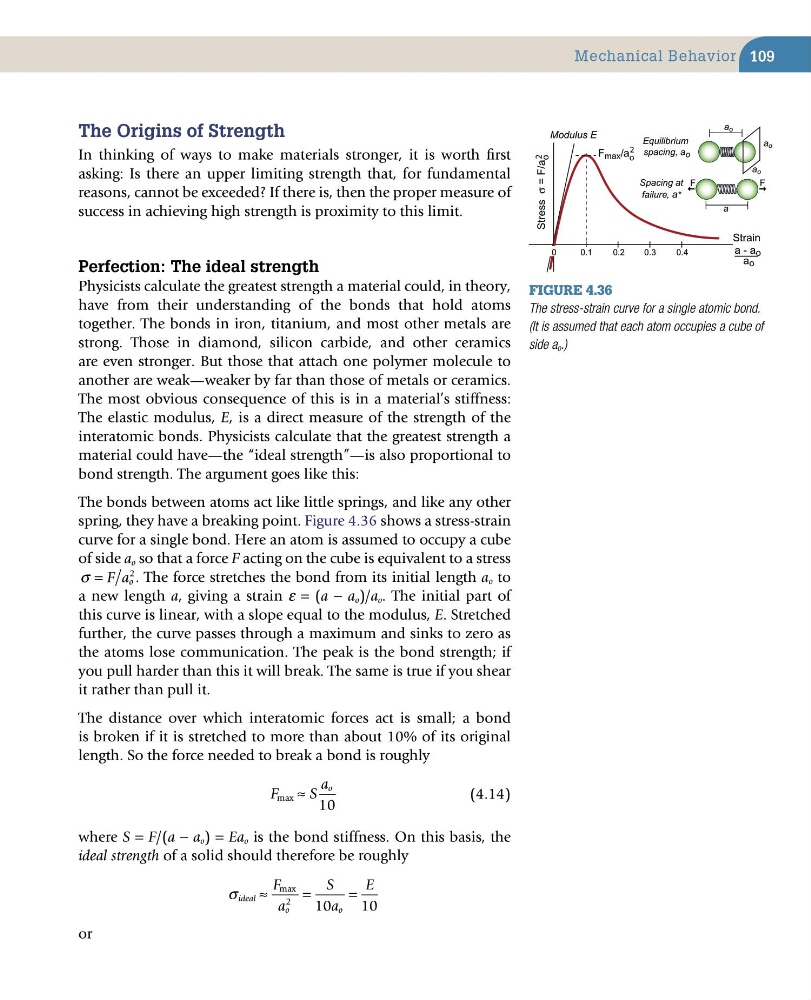
spring, they have a breaking point. Figure 4.36 shows a stress-strain
curve for a single bond. Here an atom is assumed to occupy a cube
of side a o so that a force F acting on the cube is equivalent to a stress
σ = F a o
2
. The force stretches the bond from its initial length a o to
a new length a, giving a strain ε = (a − a o )/a o . The initial part of
this curve is linear, with a slope equal to the modulus, E. Stretched
further, the curve passes through a maximum and sinks to zero as
the atoms lose communication. The peak is the bond strength; if
you pull harder than this it will break. The same is true if you shear
it rather than pull it.
The distance over which interatomic forces act is small; a bond
is broken if it is stretched to more than about 10% of its original
length. So the force needed to break a bond is roughly
F
S
a o
max ≈ 10
(4.14)
where S = F/(a − a o ) = Ea o is the bond stiffness. On this basis, the
ideal strength of a solid should therefore be roughly
σ ideal
o
o
F
a
S
a
E
≈
=
=
max
2
10
10
or
Mechanical Behavior
Figure 4.36
The stress-strain curve for a single atomic bond.
(It is assumed that each atom occupies a cube of
side a o .)
a o
a
F
F
Strain
Equilibrium
spacing, a o
Spacing at
failure, a*
Modulus E
a o
a o
Stress
σ = F/a
o
2
a - a o
a o
0.2
0.3
0.4
0
0.1
F max /a o
2
the origins of strength
In thinking of ways to make materials stronger, it is worth first
asking: Is there an upper limiting strength that, for fundamental
reasons, cannot be exceeded? If there is, then the proper measure of
success in achieving high strength is proximity to this limit.
perfection: the ideal strength
Physicists calculate the greatest strength a material could, in theory,
have from their understanding of the bonds that hold atoms
together. The bonds in iron, titanium, and most other metals are
strong. Those in diamond, silicon carbide, and other ceramics
are even stronger. But those that attach one polymer molecule to
another are weak—weaker by far than those of metals or ceramics.
The most obvious consequence of this is in a material’s stiffness:
The elastic modulus, E, is a direct measure of the strength of the
interatomic bonds. Physicists calculate that the greatest strength a
material could have—the “ideal strength”—is also proportional to
bond strength. The argument goes like this:
The bonds between atoms act like little springs, and like any other
spring, they have a breaking point. Figure 4.36 shows a stress-strain
curve for a single bond. Here an atom is assumed to occupy a cube
of side a o so that a force F acting on the cube is equivalent to a stress
σ = F a o
2
. The force stretches the bond from its initial length a o to
a new length a, giving a strain ε = (a − a o )/a o . The initial part of
this curve is linear, with a slope equal to the modulus, E. Stretched
further, the curve passes through a maximum and sinks to zero as
the atoms lose communication. The peak is the bond strength; if
you pull harder than this it will break. The same is true if you shear
it rather than pull it.
The distance over which interatomic forces act is small; a bond
is broken if it is stretched to more than about 10% of its original
length. So the force needed to break a bond is roughly
F
S
a o
max ≈ 10
(4.14)
where S = F/(a − a o ) = Ea o is the bond stiffness. On this basis, the
ideal strength of a solid should therefore be roughly
σ ideal
o
o
F
a
S
a
E
≈
=
=
max
2
10
10
or
Mechanical Behavior
Figure 4.36
The stress-strain curve for a single atomic bond.
(It is assumed that each atom occupies a cube of
side a o .)
a o
a
F
F
Strain
Equilibrium
spacing, a o
Spacing at
failure, a*
Modulus E
a o
a o
Stress
σ = F/a
o
2
a - a o
a o
0.2
0.3
0.4
0
0.1
F max /a o
2