

C hapter 4 Material Classes, structure, and properties
106
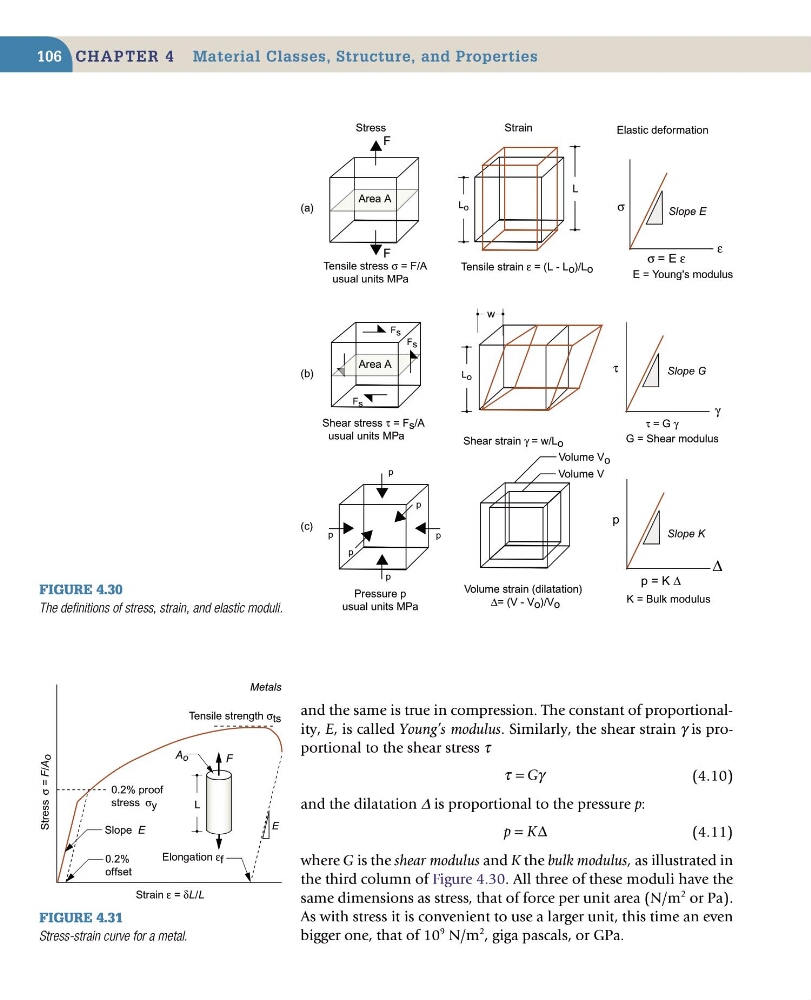
and the same is true in compression. The constant of proportionality, E, is called Young’s modulus. Similarly, the shear strain γ is proportional to the shear stress τ
τ
γ
= G
(4.10)
and the dilatation Δ is proportional to the pressure p:
p K
= ∆
(4.11)
where G is the shear modulus and K the bulk modulus, as illustrated in
the third column of Figure 4.30. All three of these moduli have the
same dimensions as stress, that of force per unit area (N/m
2 or Pa).
As with stress it is convenient to use a larger unit, this time an even
bigger one, that of 10
9 N/m
2 , giga pascals, or GPa.
Figure 4.30
The definitions of stress, strain, and elastic moduli.
∆
F
F
Elastic deformation
Stress
Strain
σ = E ε
p = K ∆
σ
ε
τ
γ
p
(a)
(b)
(c)
F s
F s
F s
Area A
L o
L o
Area A
p
p
p
p
p
p
Tensile stress σ = F/A
usual units MPa
Shear stress τ = F s /A
usual units MPa
Pressure p
usual units MPa
Tensile strain ε = (L - L o )/L o
Shear strain γ = w/L o
Volume strain (dilatation)
∆= (V - V o )/V o
E = Young's modulus
τ = G γ
G = Shear modulus
K = Bulk modulus
Slope E
Slope G
Slope K
Volume V
Volume V o
L
w
Figure 4.31
Stress-strain curve for a metal.
Stress
σ = F/A
o
Strain ε = δL/L
Slope E
0.2%
offset
F
A o
0.2% proof
stress σ y
Tensile strength σ ts
Metals
Elongation ε f
E
L
106
and the same is true in compression. The constant of proportionality, E, is called Young’s modulus. Similarly, the shear strain γ is proportional to the shear stress τ
τ
γ
= G
(4.10)
and the dilatation Δ is proportional to the pressure p:
p K
= ∆
(4.11)
where G is the shear modulus and K the bulk modulus, as illustrated in
the third column of Figure 4.30. All three of these moduli have the
same dimensions as stress, that of force per unit area (N/m
2 or Pa).
As with stress it is convenient to use a larger unit, this time an even
bigger one, that of 10
9 N/m
2 , giga pascals, or GPa.
Figure 4.30
The definitions of stress, strain, and elastic moduli.
∆
F
F
Elastic deformation
Stress
Strain
σ = E ε
p = K ∆
σ
ε
τ
γ
p
(a)
(b)
(c)
F s
F s
F s
Area A
L o
L o
Area A
p
p
p
p
p
p
Tensile stress σ = F/A
usual units MPa
Shear stress τ = F s /A
usual units MPa
Pressure p
usual units MPa
Tensile strain ε = (L - L o )/L o
Shear strain γ = w/L o
Volume strain (dilatation)
∆= (V - V o )/V o
E = Young's modulus
τ = G γ
G = Shear modulus
K = Bulk modulus
Slope E
Slope G
Slope K
Volume V
Volume V o
L
w
Figure 4.31
Stress-strain curve for a metal.
Stress
σ = F/A
o
Strain ε = δL/L
Slope E
0.2%
offset
F
A o
0.2% proof
stress σ y
Tensile strength σ ts
Metals
Elongation ε f
E
L