

105
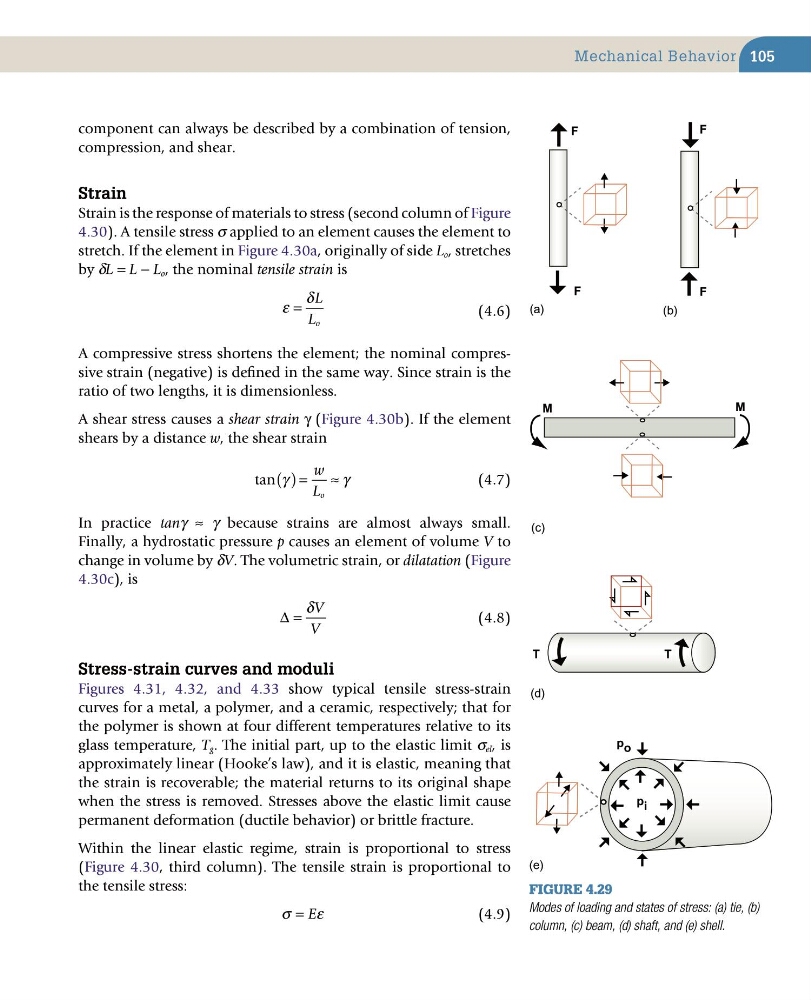
component can always be described by a combination of tension,
compression, and shear.
strain
Strain is the response of materials to stress (second column of Figure
4.30). A tensile stress σ applied to an element causes the element to
stretch. If the element in Figure 4.30a, originally of side L o , stretches
by δL = L − L o , the nominal tensile strain is
ε
δ
=
L
L o
(4.6)
A compressive stress shortens the element; the nominal compressive strain (negative) is defined in the same way. Since strain is the
ratio of two lengths, it is dimensionless.
A shear stress causes a shear strain γ (Figure 4.30b). If the element
shears by a distance w, the shear strain
tan γ
γ
( ) = ≈
w
L o
(4.7)
In practice tanγ ≈ γ because strains are almost always small.
Finally, a hydrostatic pressure p causes an element of volume V to
change in volume by δV. The volumetric strain, or dilatation (Figure
4.30c), is
∆ =
δV
V
(4.8)
stress-strain curves and moduli
Figures 4.31, 4.32, and 4.33 show typical tensile stress-strain
curves for a metal, a polymer, and a ceramic, respectively; that for
the polymer is shown at four different temperatures relative to its
glass temperature, T g . The initial part, up to the elastic limit σ el , is
approximately linear (Hooke’s law), and it is elastic, meaning that
the strain is recoverable; the material returns to its original shape
when the stress is removed. Stresses above the elastic limit cause
permanent deformation (ductile behavior) or brittle fracture.
Within the linear elastic regime, strain is proportional to stress
(Figure 4.30, third column). The tensile strain is proportional to
the tensile stress:
σ
ε
= E
(4.9)
Mechanical Behavior
Figure 4.29
Modes of loading and states of stress: (a) tie, (b)
column, (c) beam, (d) shaft, and (e) shell.
F
F
F
F
M
M
p o
p i
T
T
(a)
(b)
(c)
(d)
(e)
component can always be described by a combination of tension,
compression, and shear.
strain
Strain is the response of materials to stress (second column of Figure
4.30). A tensile stress σ applied to an element causes the element to
stretch. If the element in Figure 4.30a, originally of side L o , stretches
by δL = L − L o , the nominal tensile strain is
ε
δ
=
L
L o
(4.6)
A compressive stress shortens the element; the nominal compressive strain (negative) is defined in the same way. Since strain is the
ratio of two lengths, it is dimensionless.
A shear stress causes a shear strain γ (Figure 4.30b). If the element
shears by a distance w, the shear strain
tan γ
γ
( ) = ≈
w
L o
(4.7)
In practice tanγ ≈ γ because strains are almost always small.
Finally, a hydrostatic pressure p causes an element of volume V to
change in volume by δV. The volumetric strain, or dilatation (Figure
4.30c), is
∆ =
δV
V
(4.8)
stress-strain curves and moduli
Figures 4.31, 4.32, and 4.33 show typical tensile stress-strain
curves for a metal, a polymer, and a ceramic, respectively; that for
the polymer is shown at four different temperatures relative to its
glass temperature, T g . The initial part, up to the elastic limit σ el , is
approximately linear (Hooke’s law), and it is elastic, meaning that
the strain is recoverable; the material returns to its original shape
when the stress is removed. Stresses above the elastic limit cause
permanent deformation (ductile behavior) or brittle fracture.
Within the linear elastic regime, strain is proportional to stress
(Figure 4.30, third column). The tensile strain is proportional to
the tensile stress:
σ
ε
= E
(4.9)
Mechanical Behavior
Figure 4.29
Modes of loading and states of stress: (a) tie, (b)
column, (c) beam, (d) shaft, and (e) shell.
F
F
F
F
M
M
p o
p i
T
T
(a)
(b)
(c)
(d)
(e)