

C hapter 4 Material Classes, structure, and properties
100
In general, we can classify the defects as point defects, linear
defects, planar defects (interfacial defects), or volume defects (bulk
defects), for which the scale of each class is shown in Figure 4.21.
Let’s examine each class of defect in more detail.
The simplest point defect is called a vacancy, which is a lattice point
from which an atom is missing (see Figure 4.22). Vacancies are
introduced into a material during solidification or heat treatments
or by radiation of atomic particles. In fact, in a nuclear power plant,
where radiation is continuously being produced, the monitoring of
the formation of vacancies is crucial for the safety of the plant. The
presence of vacancies in a crystal is a necessity because the presence
of vacancies will increase the entropy (randomness) of the crystal.
In addition, the presence of a vacancy changes the stress field of
the crystal. As shown in Figure 4.22, the vacancy induces a tensile
stress field around the neighboring atoms. In addition, the equilibrium number of vacancies increases exponentially with temperature. Typically, at room temperature, there is one vacancy per 1
million atoms, whereas at the melting temperature, there are 1000
vacancies per million atoms.
A self-interstitial point defect can also form in materials. This occurs
when an atom from the lattice goes into an interstitial position, a
small space that is not usually occupied by any atom (see Figure
4.23). The self-interstitial atom creates large distortions in the
lattice because the initial available space is smaller than the atom
dimensions.
In ionic structures, such as ceramic materials, because of neutrality,
there are two types of point defects: (1) the Schottky defect, which
is a pair of defects formed by a vacancy of one cation and a
vacancy of one anion (see Figure 4.24), and (2) the Frenkel defect,
which is formed by a vacancy of one cation and a self-interstitial
cation (Figure 4.24) or a vacancy of one anion and a self-interstitial
anion.
So far we have only discussed defects in pure solids or compounds.
However, as mentioned before, impurities must exist. Even if the
metal is almost (99.9999%) pure, there are still 10
23 impurities in
1 m
3 . Therefore the following question arises: Where do the impurities go? That all depends on the impurity and the host material.
The final result will be a consequence of (1) the kind of impurity,
(2) the impurity concentration, and (3) the temperature and pressure. However, in general, impurities can go to a substitutional site,
that is, a site occupied by the host atom. In this case they will be
called substitutional atoms. Or impurities can go to an interstitial site
(d)
(b)
(a)
(c)
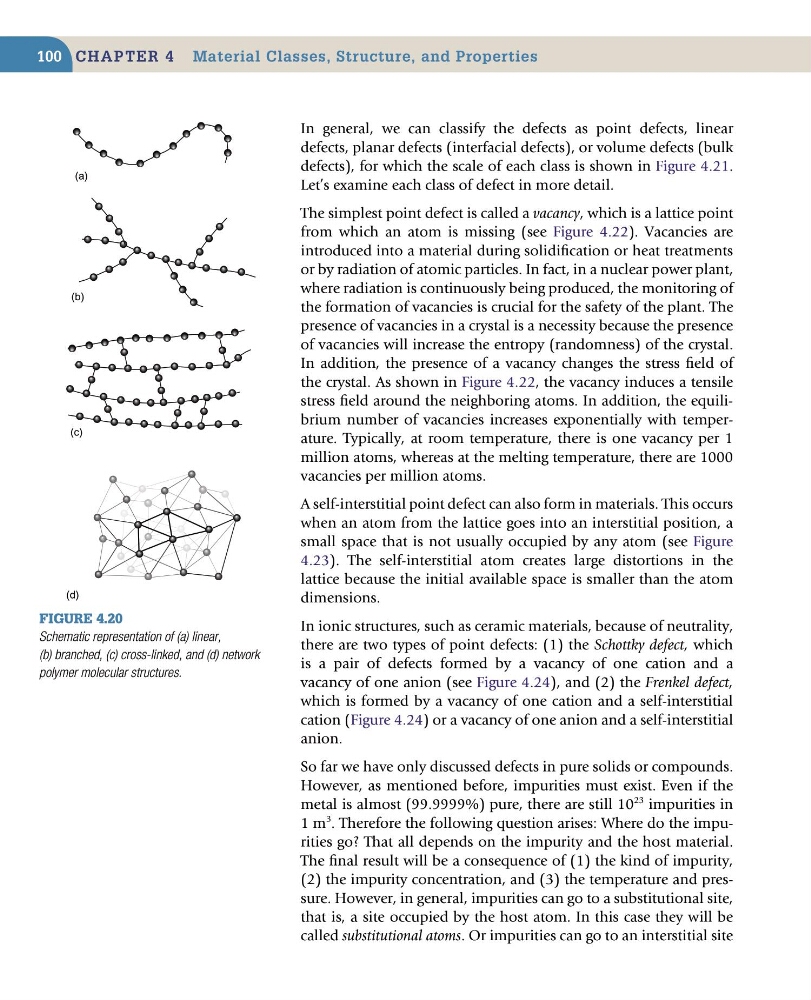
Figure 4.20
Schematic representation of (a) linear,
(b) branched, (c) cross-linked, and (d) network
polymer molecular structures.
100
In general, we can classify the defects as point defects, linear
defects, planar defects (interfacial defects), or volume defects (bulk
defects), for which the scale of each class is shown in Figure 4.21.
Let’s examine each class of defect in more detail.
The simplest point defect is called a vacancy, which is a lattice point
from which an atom is missing (see Figure 4.22). Vacancies are
introduced into a material during solidification or heat treatments
or by radiation of atomic particles. In fact, in a nuclear power plant,
where radiation is continuously being produced, the monitoring of
the formation of vacancies is crucial for the safety of the plant. The
presence of vacancies in a crystal is a necessity because the presence
of vacancies will increase the entropy (randomness) of the crystal.
In addition, the presence of a vacancy changes the stress field of
the crystal. As shown in Figure 4.22, the vacancy induces a tensile
stress field around the neighboring atoms. In addition, the equilibrium number of vacancies increases exponentially with temperature. Typically, at room temperature, there is one vacancy per 1
million atoms, whereas at the melting temperature, there are 1000
vacancies per million atoms.
A self-interstitial point defect can also form in materials. This occurs
when an atom from the lattice goes into an interstitial position, a
small space that is not usually occupied by any atom (see Figure
4.23). The self-interstitial atom creates large distortions in the
lattice because the initial available space is smaller than the atom
dimensions.
In ionic structures, such as ceramic materials, because of neutrality,
there are two types of point defects: (1) the Schottky defect, which
is a pair of defects formed by a vacancy of one cation and a
vacancy of one anion (see Figure 4.24), and (2) the Frenkel defect,
which is formed by a vacancy of one cation and a self-interstitial
cation (Figure 4.24) or a vacancy of one anion and a self-interstitial
anion.
So far we have only discussed defects in pure solids or compounds.
However, as mentioned before, impurities must exist. Even if the
metal is almost (99.9999%) pure, there are still 10
23 impurities in
1 m
3 . Therefore the following question arises: Where do the impurities go? That all depends on the impurity and the host material.
The final result will be a consequence of (1) the kind of impurity,
(2) the impurity concentration, and (3) the temperature and pressure. However, in general, impurities can go to a substitutional site,
that is, a site occupied by the host atom. In this case they will be
called substitutional atoms. Or impurities can go to an interstitial site
(d)
(b)
(a)
(c)
Figure 4.20
Schematic representation of (a) linear,
(b) branched, (c) cross-linked, and (d) network
polymer molecular structures.