

The Internal Structure of Materials 99
characterize the types of polymers by observing the repeating unit.
Hence, when all the repeating units along a chain are of the same
type, the resulting polymer is called a homopolymer. However, if
chains are composed of two or more different units, the polymer is
called a copolymer. In addition, if the different units are arranged in
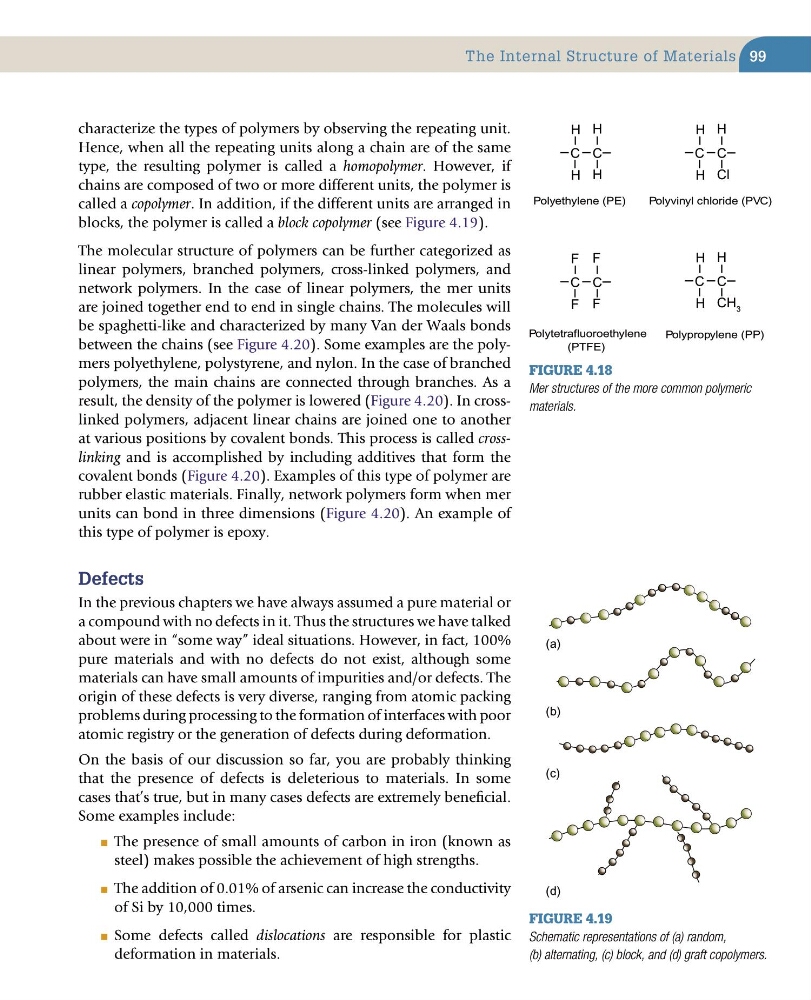
blocks, the polymer is called a block copolymer (see Figure 4.19).
The molecular structure of polymers can be further categorized as
linear polymers, branched polymers, cross-linked polymers, and
network polymers. In the case of linear polymers, the mer units
are joined together end to end in single chains. The molecules will
be spaghetti-like and characterized by many Van der Waals bonds
between the chains (see Figure 4.20). Some examples are the polymers polyethylene, polystyrene, and nylon. In the case of branched
polymers, the main chains are connected through branches. As a
result, the density of the polymer is lowered (Figure 4.20). In crosslinked polymers, adjacent linear chains are joined one to another
at various positions by covalent bonds. This process is called crosslinking and is accomplished by including additives that form the
covalent bonds (Figure 4.20). Examples of this type of polymer are
rubber elastic materials. Finally, network polymers form when mer
units can bond in three dimensions (Figure 4.20). An example of
this type of polymer is epoxy.
Defects
In the previous chapters we have always assumed a pure material or
a compound with no defects in it. Thus the structures we have talked
about were in “some way” ideal situations. However, in fact, 100%
pure materials and with no defects do not exist, although some
materials can have small amounts of impurities and/or defects. The
origin of these defects is very diverse, ranging from atomic packing
problems during processing to the formation of interfaces with poor
atomic registry or the generation of defects during deformation.
On the basis of our discussion so far, you are probably thinking
that the presence of defects is deleterious to materials. In some
cases that’s true, but in many cases defects are extremely beneficial.
Some examples include:
■ The presence of small amounts of carbon in iron (known as
steel) makes possible the achievement of high strengths.
■ The addition of 0.01% of arsenic can increase the conductivity
of Si by 10,000 times.
■ Some defects called dislocations are responsible for plastic
deformation in materials.
Figure 4.18
Mer structures of the more common polymeric
materials.
C
H
C
H
H H
C
F
C
F
F F
C
H
C
H
H Cl
C
H
C
H
H CH 3
Polyethylene (PE)
Polyvinyl chloride (PVC)
Polytetrafluoroethylene
(PTFE)
Polypropylene (PP)
Figure 4.19
Schematic representations of (a) random,
(b) alternating, (c) block, and (d) graft copolymers.
(c)
(d)
(a)
(b)
characterize the types of polymers by observing the repeating unit.
Hence, when all the repeating units along a chain are of the same
type, the resulting polymer is called a homopolymer. However, if
chains are composed of two or more different units, the polymer is
called a copolymer. In addition, if the different units are arranged in
blocks, the polymer is called a block copolymer (see Figure 4.19).
The molecular structure of polymers can be further categorized as
linear polymers, branched polymers, cross-linked polymers, and
network polymers. In the case of linear polymers, the mer units
are joined together end to end in single chains. The molecules will
be spaghetti-like and characterized by many Van der Waals bonds
between the chains (see Figure 4.20). Some examples are the polymers polyethylene, polystyrene, and nylon. In the case of branched
polymers, the main chains are connected through branches. As a
result, the density of the polymer is lowered (Figure 4.20). In crosslinked polymers, adjacent linear chains are joined one to another
at various positions by covalent bonds. This process is called crosslinking and is accomplished by including additives that form the
covalent bonds (Figure 4.20). Examples of this type of polymer are
rubber elastic materials. Finally, network polymers form when mer
units can bond in three dimensions (Figure 4.20). An example of
this type of polymer is epoxy.
Defects
In the previous chapters we have always assumed a pure material or
a compound with no defects in it. Thus the structures we have talked
about were in “some way” ideal situations. However, in fact, 100%
pure materials and with no defects do not exist, although some
materials can have small amounts of impurities and/or defects. The
origin of these defects is very diverse, ranging from atomic packing
problems during processing to the formation of interfaces with poor
atomic registry or the generation of defects during deformation.
On the basis of our discussion so far, you are probably thinking
that the presence of defects is deleterious to materials. In some
cases that’s true, but in many cases defects are extremely beneficial.
Some examples include:
■ The presence of small amounts of carbon in iron (known as
steel) makes possible the achievement of high strengths.
■ The addition of 0.01% of arsenic can increase the conductivity
of Si by 10,000 times.
■ Some defects called dislocations are responsible for plastic
deformation in materials.
Figure 4.18
Mer structures of the more common polymeric
materials.
C
H
C
H
H H
C
F
C
F
F F
C
H
C
H
H Cl
C
H
C
H
H CH 3
Polyethylene (PE)
Polyvinyl chloride (PVC)
Polytetrafluoroethylene
(PTFE)
Polypropylene (PP)
Figure 4.19
Schematic representations of (a) random,
(b) alternating, (c) block, and (d) graft copolymers.
(c)
(d)
(a)
(b)