

C hapter 4 Material Classes, structure, and properties
98
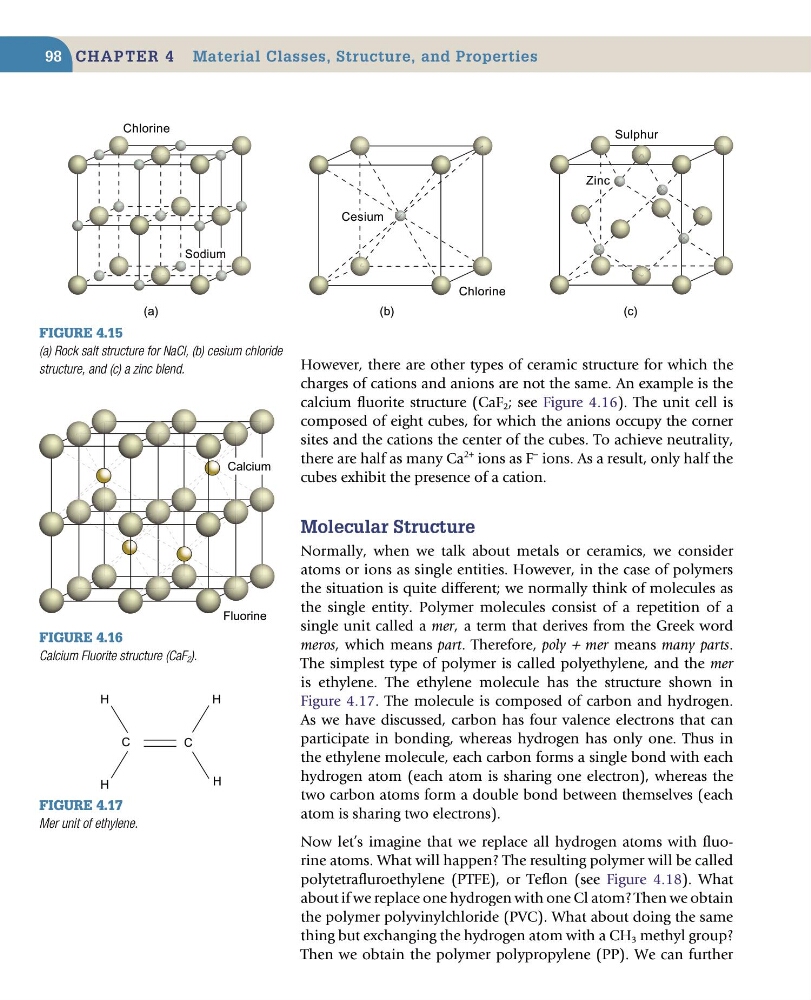
However, there are other types of ceramic structure for which the
charges of cations and anions are not the same. An example is the
calcium fluorite structure (CaF 2 ; see Figure 4.16). The unit cell is
composed of eight cubes, for which the anions occupy the corner
sites and the cations the center of the cubes. To achieve neutrality,
there are half as many Ca
2+ ions as F
− ions. As a result, only half the
cubes exhibit the presence of a cation.
Molecular structure
Normally, when we talk about metals or ceramics, we consider
atoms or ions as single entities. However, in the case of polymers
the situation is quite different; we normally think of molecules as
the single entity. Polymer molecules consist of a repetition of a
single unit called a mer, a term that derives from the Greek word
meros, which means part. Therefore, poly + mer means many parts.
The simplest type of polymer is called polyethylene, and the mer
is ethylene. The ethylene molecule has the structure shown in
Figure 4.17. The molecule is composed of carbon and hydrogen.
As we have discussed, carbon has four valence electrons that can
participate in bonding, whereas hydrogen has only one. Thus in
the ethylene molecule, each carbon forms a single bond with each
hydrogen atom (each atom is sharing one electron), whereas the
two carbon atoms form a double bond between themselves (each
atom is sharing two electrons).
Now let’s imagine that we replace all hydrogen atoms with fluorine atoms. What will happen? The resulting polymer will be called
polytetrafluroethylene (PTFE), or Teflon (see Figure 4.18). What
about if we replace one hydrogen with one Cl atom? Then we obtain
the polymer polyvinylchloride (PVC). What about doing the same
thing but exchanging the hydrogen atom with a CH 3 methyl group?
Then we obtain the polymer polypropylene (PP). We can further
Figure 4.15
(a) Rock salt structure for NaCl, (b) cesium chloride
structure, and (c) a zinc blend.
(a)
(b)
(c)
Chlorine
Sodium
Cesium
Chlorine
Sulphur
Zinc
Figure 4.16
Calcium Fluorite structure (CaF 2 ).
Calcium
Fluorine
Figure 4.17
Mer unit of ethylene.
H
C
H
H
H
C
98
However, there are other types of ceramic structure for which the
charges of cations and anions are not the same. An example is the
calcium fluorite structure (CaF 2 ; see Figure 4.16). The unit cell is
composed of eight cubes, for which the anions occupy the corner
sites and the cations the center of the cubes. To achieve neutrality,
there are half as many Ca
2+ ions as F
− ions. As a result, only half the
cubes exhibit the presence of a cation.
Molecular structure
Normally, when we talk about metals or ceramics, we consider
atoms or ions as single entities. However, in the case of polymers
the situation is quite different; we normally think of molecules as
the single entity. Polymer molecules consist of a repetition of a
single unit called a mer, a term that derives from the Greek word
meros, which means part. Therefore, poly + mer means many parts.
The simplest type of polymer is called polyethylene, and the mer
is ethylene. The ethylene molecule has the structure shown in
Figure 4.17. The molecule is composed of carbon and hydrogen.
As we have discussed, carbon has four valence electrons that can
participate in bonding, whereas hydrogen has only one. Thus in
the ethylene molecule, each carbon forms a single bond with each
hydrogen atom (each atom is sharing one electron), whereas the
two carbon atoms form a double bond between themselves (each
atom is sharing two electrons).
Now let’s imagine that we replace all hydrogen atoms with fluorine atoms. What will happen? The resulting polymer will be called
polytetrafluroethylene (PTFE), or Teflon (see Figure 4.18). What
about if we replace one hydrogen with one Cl atom? Then we obtain
the polymer polyvinylchloride (PVC). What about doing the same
thing but exchanging the hydrogen atom with a CH 3 methyl group?
Then we obtain the polymer polypropylene (PP). We can further
Figure 4.15
(a) Rock salt structure for NaCl, (b) cesium chloride
structure, and (c) a zinc blend.
(a)
(b)
(c)
Chlorine
Sodium
Cesium
Chlorine
Sulphur
Zinc
Figure 4.16
Calcium Fluorite structure (CaF 2 ).
Calcium
Fluorine
Figure 4.17
Mer unit of ethylene.
H
C
H
H
H
C