

The Internal Structure of Materials 97
hexagon, one atom in the center of the basal plane of the hexagon,
and three atoms in the center of the cell, off-centered from the caxis. Some examples of elements with this structure are the metals
zinc, cobalt, and titanium.
One important aspect to point out is that some elements can assume
more than one crystal structure. It all depends on certain thermodynamic conditions, such as temperature, pressure, stress, magnetic field,
and electric field. These changes in crystal structure in a pure element
are called allotropic transformations. A good example of this behavior
is iron (Fe), an element that undergoes several changes in crystal
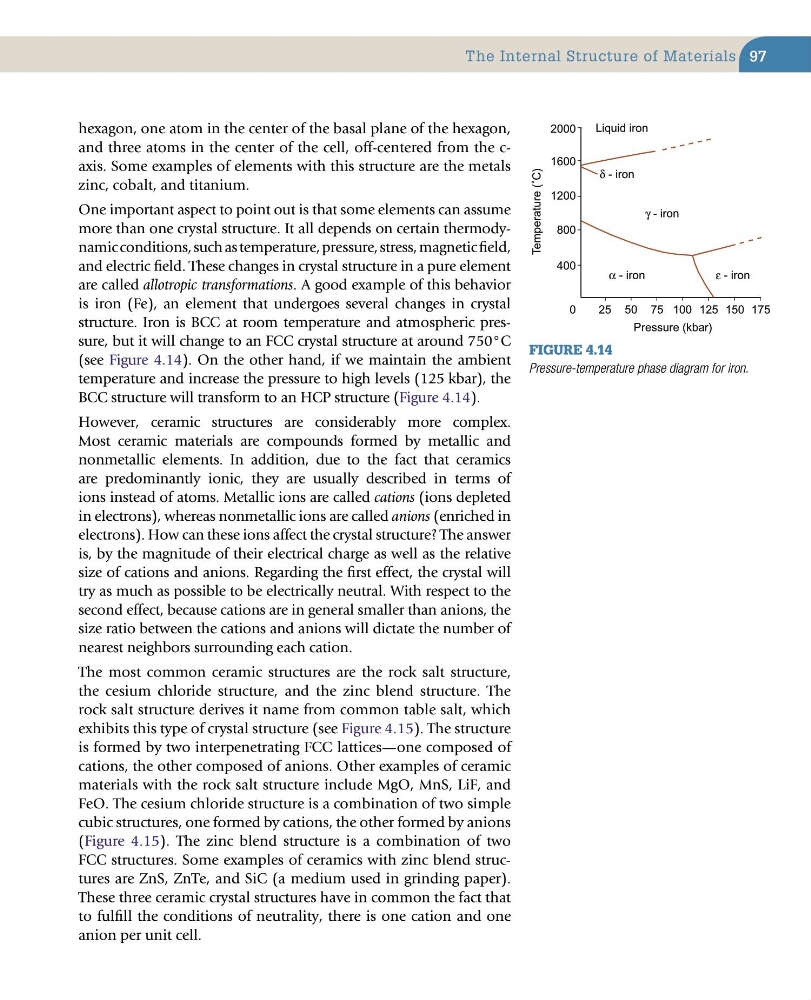
structure. Iron is BCC at room temperature and atmospheric pressure, but it will change to an FCC crystal structure at around 750°C
(see Figure 4.14). On the other hand, if we maintain the ambient
temperature and increase the pressure to high levels (125 kbar), the
BCC structure will transform to an HCP structure (Figure 4.14).
However, ceramic structures are considerably more complex.
Most ceramic materials are compounds formed by metallic and
nonmetallic elements. In addition, due to the fact that ceramics
are predominantly ionic, they are usually described in terms of
ions instead of atoms. Metallic ions are called cations (ions depleted
in electrons), whereas nonmetallic ions are called anions (enriched in
electrons). How can these ions affect the crystal structure? The answer
is, by the magnitude of their electrical charge as well as the relative
size of cations and anions. Regarding the first effect, the crystal will
try as much as possible to be electrically neutral. With respect to the
second effect, because cations are in general smaller than anions, the
size ratio between the cations and anions will dictate the number of
nearest neighbors surrounding each cation.
The most common ceramic structures are the rock salt structure,
the cesium chloride structure, and the zinc blend structure. The
rock salt structure derives it name from common table salt, which
exhibits this type of crystal structure (see Figure 4.15). The structure
is formed by two interpenetrating FCC lattices—one composed of
cations, the other composed of anions. Other examples of ceramic
materials with the rock salt structure include MgO, MnS, LiF, and
FeO. The cesium chloride structure is a combination of two simple
cubic structures, one formed by cations, the other formed by anions
(Figure 4.15). The zinc blend structure is a combination of two
FCC structures. Some examples of ceramics with zinc blend structures are ZnS, ZnTe, and SiC (a medium used in grinding paper).
These three ceramic crystal structures have in common the fact that
to fulfill the conditions of neutrality, there is one cation and one
anion per unit cell.
Pressure (kbar)
0
400
800
1200
1600
25 50 75 100 125 150 175
2000
Liquid iron
δ - iron
α - iron
ε - iron
γ - iron
Temperature (˚C)
Figure 4.14
Pressure-temperature phase diagram for iron.
hexagon, one atom in the center of the basal plane of the hexagon,
and three atoms in the center of the cell, off-centered from the caxis. Some examples of elements with this structure are the metals
zinc, cobalt, and titanium.
One important aspect to point out is that some elements can assume
more than one crystal structure. It all depends on certain thermodynamic conditions, such as temperature, pressure, stress, magnetic field,
and electric field. These changes in crystal structure in a pure element
are called allotropic transformations. A good example of this behavior
is iron (Fe), an element that undergoes several changes in crystal
structure. Iron is BCC at room temperature and atmospheric pressure, but it will change to an FCC crystal structure at around 750°C
(see Figure 4.14). On the other hand, if we maintain the ambient
temperature and increase the pressure to high levels (125 kbar), the
BCC structure will transform to an HCP structure (Figure 4.14).
However, ceramic structures are considerably more complex.
Most ceramic materials are compounds formed by metallic and
nonmetallic elements. In addition, due to the fact that ceramics
are predominantly ionic, they are usually described in terms of
ions instead of atoms. Metallic ions are called cations (ions depleted
in electrons), whereas nonmetallic ions are called anions (enriched in
electrons). How can these ions affect the crystal structure? The answer
is, by the magnitude of their electrical charge as well as the relative
size of cations and anions. Regarding the first effect, the crystal will
try as much as possible to be electrically neutral. With respect to the
second effect, because cations are in general smaller than anions, the
size ratio between the cations and anions will dictate the number of
nearest neighbors surrounding each cation.
The most common ceramic structures are the rock salt structure,
the cesium chloride structure, and the zinc blend structure. The
rock salt structure derives it name from common table salt, which
exhibits this type of crystal structure (see Figure 4.15). The structure
is formed by two interpenetrating FCC lattices—one composed of
cations, the other composed of anions. Other examples of ceramic
materials with the rock salt structure include MgO, MnS, LiF, and
FeO. The cesium chloride structure is a combination of two simple
cubic structures, one formed by cations, the other formed by anions
(Figure 4.15). The zinc blend structure is a combination of two
FCC structures. Some examples of ceramics with zinc blend structures are ZnS, ZnTe, and SiC (a medium used in grinding paper).
These three ceramic crystal structures have in common the fact that
to fulfill the conditions of neutrality, there is one cation and one
anion per unit cell.
Pressure (kbar)
0
400
800
1200
1600
25 50 75 100 125 150 175
2000
Liquid iron
δ - iron
α - iron
ε - iron
γ - iron
Temperature (˚C)
Figure 4.14
Pressure-temperature phase diagram for iron.