

C hapter 4 Material Classes, structure, and properties
92
All elements can be classified in which the position of the elements
enables the prediction of the element’s properties. The periodic
table is subdivided into horizontal periods and vertical groups. The
group indicates the number of electrons in its outermost shell. This
property is very important because the outer electrons, being less
tightly held to the nucleus than the inner ones, play the most important role in bonding. These are called the valence electrons. Thus, all
atoms in Group I have one valence electron; those in Group II have
two, and so on. On the other hand, the Period indicates the outermost energy shell containing electrons. Thus, all atoms in Period 3
have electrons in the third shell; atoms in Period 4 have electrons
in the fourth, and so on.
atomic Bonding
In the last section, we looked at the elements one by one. Now,
based on the information we have acquired, we can imagine that it
is possible to form a large variety of materials simply by combining
different atoms with each other. How is that possible? If an atom is
electrically neutral, why will an atom combine with other atoms?
Remember what we have discussed before! When an electron is
closest to the nucleus it will possess the least amount of energy.
Hence, the closer it is to the nucleus, the more tightly it is held. In
this context, we might now understand why atoms can combine
with each other.
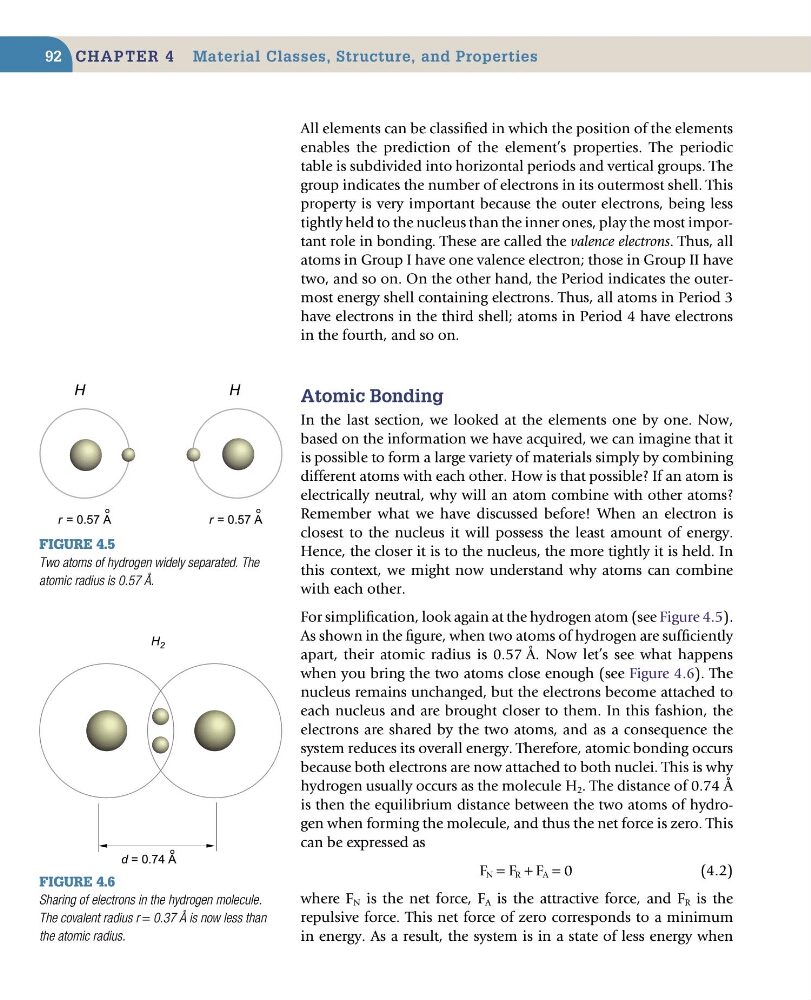
For simplification, look again at the hydrogen atom (see Figure 4.5).
As shown in the figure, when two atoms of hydrogen are sufficiently
apart, their atomic radius is 0.57 Å. Now let’s see what happens
when you bring the two atoms close enough (see Figure 4.6). The
nucleus remains unchanged, but the electrons become attached to
each nucleus and are brought closer to them. In this fashion, the
electrons are shared by the two atoms, and as a consequence the
system reduces its overall energy. Therefore, atomic bonding occurs
because both electrons are now attached to both nuclei. This is why
hydrogen usually occurs as the molecule H 2 . The distance of 0.74 Å
is then the equilibrium distance between the two atoms of hydrogen when forming the molecule, and thus the net force is zero. This
can be expressed as
F F F
N
R
A
= + = 0
(4.2)
where F N is the net force, F A is the attractive force, and F R is the
repulsive force. This net force of zero corresponds to a minimum
in energy. As a result, the system is in a state of less energy when
Figure 4.5
Two atoms of hydrogen widely separated. The
atomic radius is 0.57 Å.
H
r = 0.57 A
r = 0.57 A
H
Figure 4.6
Sharing of electrons in the hydrogen molecule.
The covalent radius r = 0.37 Å is now less than
the atomic radius.
H 2
d = 0.74 A
92
All elements can be classified in which the position of the elements
enables the prediction of the element’s properties. The periodic
table is subdivided into horizontal periods and vertical groups. The
group indicates the number of electrons in its outermost shell. This
property is very important because the outer electrons, being less
tightly held to the nucleus than the inner ones, play the most important role in bonding. These are called the valence electrons. Thus, all
atoms in Group I have one valence electron; those in Group II have
two, and so on. On the other hand, the Period indicates the outermost energy shell containing electrons. Thus, all atoms in Period 3
have electrons in the third shell; atoms in Period 4 have electrons
in the fourth, and so on.
atomic Bonding
In the last section, we looked at the elements one by one. Now,
based on the information we have acquired, we can imagine that it
is possible to form a large variety of materials simply by combining
different atoms with each other. How is that possible? If an atom is
electrically neutral, why will an atom combine with other atoms?
Remember what we have discussed before! When an electron is
closest to the nucleus it will possess the least amount of energy.
Hence, the closer it is to the nucleus, the more tightly it is held. In
this context, we might now understand why atoms can combine
with each other.
For simplification, look again at the hydrogen atom (see Figure 4.5).
As shown in the figure, when two atoms of hydrogen are sufficiently
apart, their atomic radius is 0.57 Å. Now let’s see what happens
when you bring the two atoms close enough (see Figure 4.6). The
nucleus remains unchanged, but the electrons become attached to
each nucleus and are brought closer to them. In this fashion, the
electrons are shared by the two atoms, and as a consequence the
system reduces its overall energy. Therefore, atomic bonding occurs
because both electrons are now attached to both nuclei. This is why
hydrogen usually occurs as the molecule H 2 . The distance of 0.74 Å
is then the equilibrium distance between the two atoms of hydrogen when forming the molecule, and thus the net force is zero. This
can be expressed as
F F F
N
R
A
= + = 0
(4.2)
where F N is the net force, F A is the attractive force, and F R is the
repulsive force. This net force of zero corresponds to a minimum
in energy. As a result, the system is in a state of less energy when
Figure 4.5
Two atoms of hydrogen widely separated. The
atomic radius is 0.57 Å.
H
r = 0.57 A
r = 0.57 A
H
Figure 4.6
Sharing of electrons in the hydrogen molecule.
The covalent radius r = 0.37 Å is now less than
the atomic radius.
H 2
d = 0.74 A