

The Internal Structure of Materials 93
the atoms are bonded together than when the energy used in each
individual atom is added. In other words, the hydrogen molecule is
more stable than each individual hydrogen atom. Thus, the hydrogen molecule is the result of overlapping electron orbitals. This
overlapping of orbitals is called a chemical bond. Despite the fact
that chemical bonds can be formed by atoms of the same kind,
when atoms bond chemically, the properties are very different from
those of the individual atom. For example, atoms of sodium (Na)
and chlorine (Cl) bond to form NaCl, which is common table salt;
however, individually, Na burns exposed to air, and Cl is a poisonous gas.
The reason we are so interested in chemical bonding is because the
material properties and the processing of materials will depend
strongly on the kind of chemical bonding that exists between the
atoms. For example, materials that exhibit different bonding energies between their atoms will possess very different melting temperatures. Hence, high melting temperatures are associated with strong
bonding energies. What about materials with high stiffness properties? By the same token, these materials also possess high bonding
energies. The same applies for the coefficient of thermal expansion.
It is now evident that materials with large bonding energies will
possess smaller atomic vibrations and thus lower coefficients of
thermal expansion.
Let’s look at the types of chemical bonding that exist in nature.
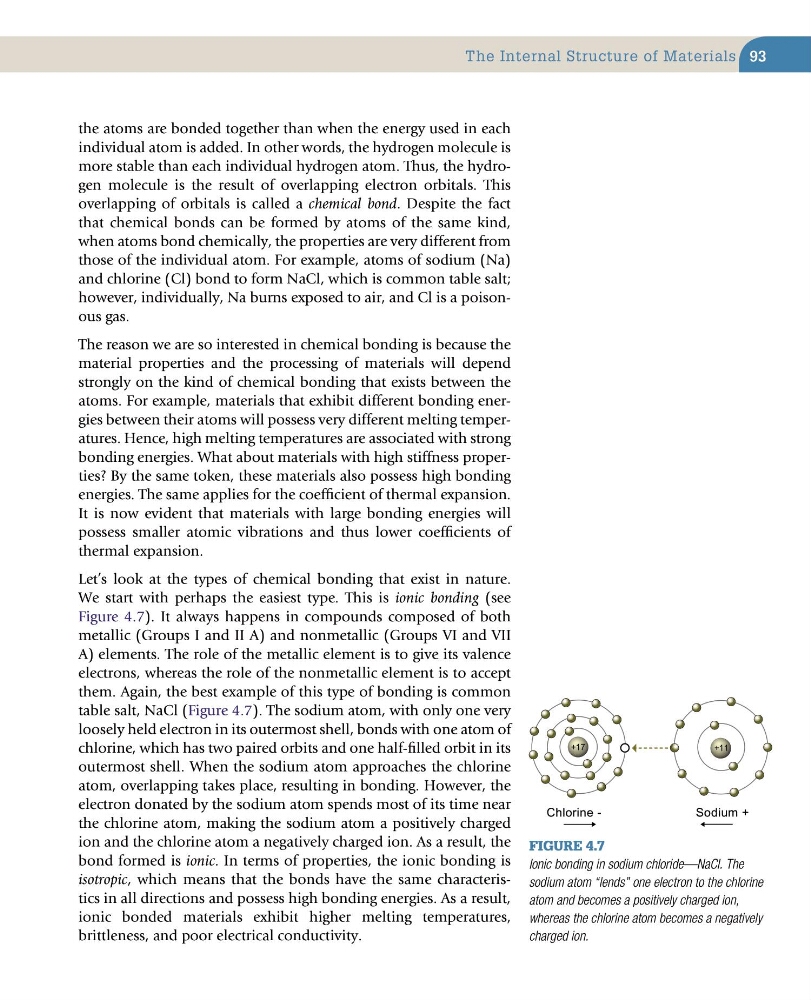
We start with perhaps the easiest type. This is ionic bonding (see
Figure 4.7). It always happens in compounds composed of both
metallic (Groups I and II A) and nonmetallic (Groups VI and VII
A) elements. The role of the metallic element is to give its valence
electrons, whereas the role of the nonmetallic element is to accept
them. Again, the best example of this type of bonding is common
table salt, NaCl (Figure 4.7). The sodium atom, with only one very
loosely held electron in its outermost shell, bonds with one atom of
chlorine, which has two paired orbits and one half-filled orbit in its
outermost shell. When the sodium atom approaches the chlorine
atom, overlapping takes place, resulting in bonding. However, the
electron donated by the sodium atom spends most of its time near
the chlorine atom, making the sodium atom a positively charged
ion and the chlorine atom a negatively charged ion. As a result, the
bond formed is ionic. In terms of properties, the ionic bonding is
isotropic, which means that the bonds have the same characteristics in all directions and possess high bonding energies. As a result,
ionic bonded materials exhibit higher melting temperatures,
brittleness, and poor electrical conductivity.
Figure 4.7
Ionic bonding in sodium chloride—NaCl. The
sodium atom “lends” one electron to the chlorine
atom and becomes a positively charged ion,
whereas the chlorine atom becomes a negatively
charged ion.
Sodium +
Chlorine -
+17
+11
the atoms are bonded together than when the energy used in each
individual atom is added. In other words, the hydrogen molecule is
more stable than each individual hydrogen atom. Thus, the hydrogen molecule is the result of overlapping electron orbitals. This
overlapping of orbitals is called a chemical bond. Despite the fact
that chemical bonds can be formed by atoms of the same kind,
when atoms bond chemically, the properties are very different from
those of the individual atom. For example, atoms of sodium (Na)
and chlorine (Cl) bond to form NaCl, which is common table salt;
however, individually, Na burns exposed to air, and Cl is a poisonous gas.
The reason we are so interested in chemical bonding is because the
material properties and the processing of materials will depend
strongly on the kind of chemical bonding that exists between the
atoms. For example, materials that exhibit different bonding energies between their atoms will possess very different melting temperatures. Hence, high melting temperatures are associated with strong
bonding energies. What about materials with high stiffness properties? By the same token, these materials also possess high bonding
energies. The same applies for the coefficient of thermal expansion.
It is now evident that materials with large bonding energies will
possess smaller atomic vibrations and thus lower coefficients of
thermal expansion.
Let’s look at the types of chemical bonding that exist in nature.
We start with perhaps the easiest type. This is ionic bonding (see
Figure 4.7). It always happens in compounds composed of both
metallic (Groups I and II A) and nonmetallic (Groups VI and VII
A) elements. The role of the metallic element is to give its valence
electrons, whereas the role of the nonmetallic element is to accept
them. Again, the best example of this type of bonding is common
table salt, NaCl (Figure 4.7). The sodium atom, with only one very
loosely held electron in its outermost shell, bonds with one atom of
chlorine, which has two paired orbits and one half-filled orbit in its
outermost shell. When the sodium atom approaches the chlorine
atom, overlapping takes place, resulting in bonding. However, the
electron donated by the sodium atom spends most of its time near
the chlorine atom, making the sodium atom a positively charged
ion and the chlorine atom a negatively charged ion. As a result, the
bond formed is ionic. In terms of properties, the ionic bonding is
isotropic, which means that the bonds have the same characteristics in all directions and possess high bonding energies. As a result,
ionic bonded materials exhibit higher melting temperatures,
brittleness, and poor electrical conductivity.
Figure 4.7
Ionic bonding in sodium chloride—NaCl. The
sodium atom “lends” one electron to the chlorine
atom and becomes a positively charged ion,
whereas the chlorine atom becomes a negatively
charged ion.
Sodium +
Chlorine -
+17
+11