

The Internal Structure of Materials 91
The reason is because electrons have less energy when located in
the atom than when outside the atom. Therefore, −13.6 eV is the
energy required to remove the electron from the ground energy
level. If an atom is in one of the excited states E 1 , E 2 , and so on, it
does not remain in that state forever. Sooner or later it drops to a
lower state and radiates energy in the form of light. The frequency
of light υ that is liberated in a transition, for example, from energy
E 3 to energy E 1 , is given by
υ =
−
(
)
E E h
3
1
(4.1)
where h is Planck’s constant. Each energy level or shell is represented by the principal quantum number n, as shown in Figure 4.3.
However, if we have equipment of very high resolution, we will see
that what we thought was a single shell actually consists of several
subshells close together in energy (Figure 4.3). In fact, for each value
of n there are n possible subshells. In addition, in each subshell, it is
possible that different energy states may coexist.
We are still left with one thing to worry about, and that is:
How many electrons can we have in each state? To understand this
problem, we should consider that electrons not only move around
the nucleus but also spin while moving. In addition, we should
consider a fundamental principle of atomic science, which is the
exclusion principle. The exclusion principle says that two electrons
cannot get into exactly the same energy state. In other words, it is
not possible for two electrons to have the same momentum, be
at the same location, and spin in the same direction. What is the
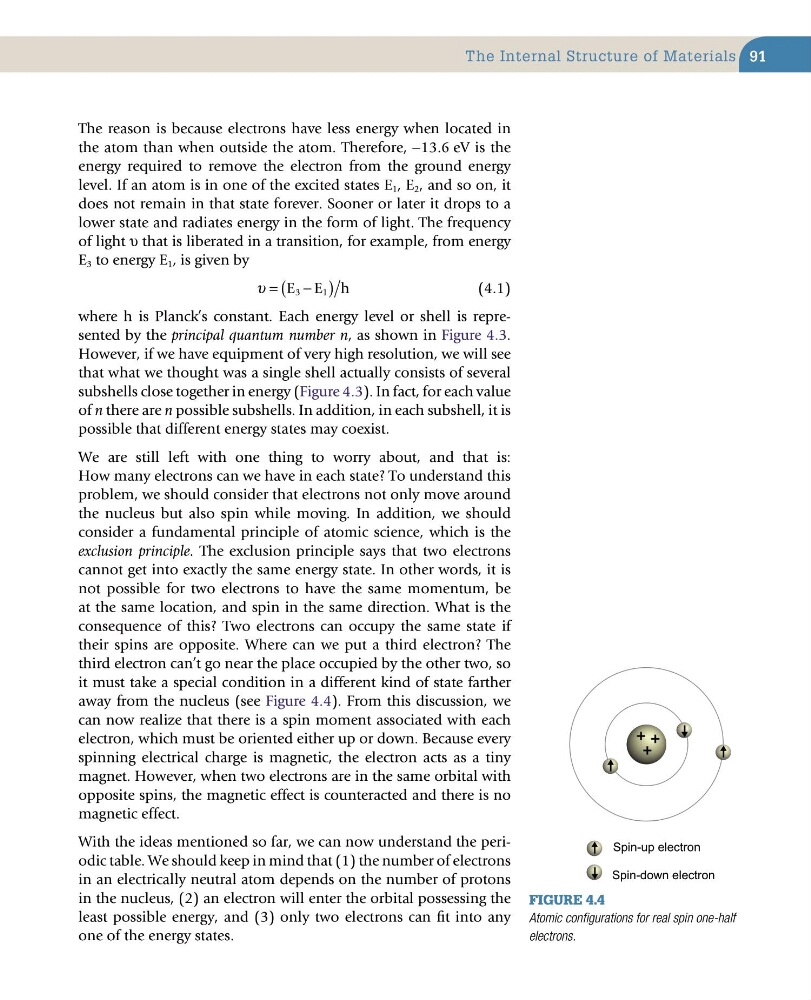
consequence of this? Two electrons can occupy the same state if
their spins are opposite. Where can we put a third electron? The
third electron can’t go near the place occupied by the other two, so
it must take a special condition in a different kind of state farther
away from the nucleus (see Figure 4.4). From this discussion, we
can now realize that there is a spin moment associated with each
electron, which must be oriented either up or down. Because every
spinning electrical charge is magnetic, the electron acts as a tiny
magnet. However, when two electrons are in the same orbital with
opposite spins, the magnetic effect is counteracted and there is no
magnetic effect.
With the ideas mentioned so far, we can now understand the periodic table. We should keep in mind that (1) the number of electrons
in an electrically neutral atom depends on the number of protons
in the nucleus, (2) an electron will enter the orbital possessing the
least possible energy, and (3) only two electrons can fit into any
one of the energy states.
Figure 4.4
Atomic configurations for real spin one-half
electrons.
+
+
+
Spin-up electron
Spin-down electron
The reason is because electrons have less energy when located in
the atom than when outside the atom. Therefore, −13.6 eV is the
energy required to remove the electron from the ground energy
level. If an atom is in one of the excited states E 1 , E 2 , and so on, it
does not remain in that state forever. Sooner or later it drops to a
lower state and radiates energy in the form of light. The frequency
of light υ that is liberated in a transition, for example, from energy
E 3 to energy E 1 , is given by
υ =
−
(
)
E E h
3
1
(4.1)
where h is Planck’s constant. Each energy level or shell is represented by the principal quantum number n, as shown in Figure 4.3.
However, if we have equipment of very high resolution, we will see
that what we thought was a single shell actually consists of several
subshells close together in energy (Figure 4.3). In fact, for each value
of n there are n possible subshells. In addition, in each subshell, it is
possible that different energy states may coexist.
We are still left with one thing to worry about, and that is:
How many electrons can we have in each state? To understand this
problem, we should consider that electrons not only move around
the nucleus but also spin while moving. In addition, we should
consider a fundamental principle of atomic science, which is the
exclusion principle. The exclusion principle says that two electrons
cannot get into exactly the same energy state. In other words, it is
not possible for two electrons to have the same momentum, be
at the same location, and spin in the same direction. What is the
consequence of this? Two electrons can occupy the same state if
their spins are opposite. Where can we put a third electron? The
third electron can’t go near the place occupied by the other two, so
it must take a special condition in a different kind of state farther
away from the nucleus (see Figure 4.4). From this discussion, we
can now realize that there is a spin moment associated with each
electron, which must be oriented either up or down. Because every
spinning electrical charge is magnetic, the electron acts as a tiny
magnet. However, when two electrons are in the same orbital with
opposite spins, the magnetic effect is counteracted and there is no
magnetic effect.
With the ideas mentioned so far, we can now understand the periodic table. We should keep in mind that (1) the number of electrons
in an electrically neutral atom depends on the number of protons
in the nucleus, (2) an electron will enter the orbital possessing the
least possible energy, and (3) only two electrons can fit into any
one of the energy states.
Figure 4.4
Atomic configurations for real spin one-half
electrons.
+
+
+
Spin-up electron
Spin-down electron