

having a coordination of a neutral phosphine ligand is synthesized, which involves
the formation of a P-C bond (1.824(2) Å) with a phenyl group migrated from BPh 4
–
at room temperature.
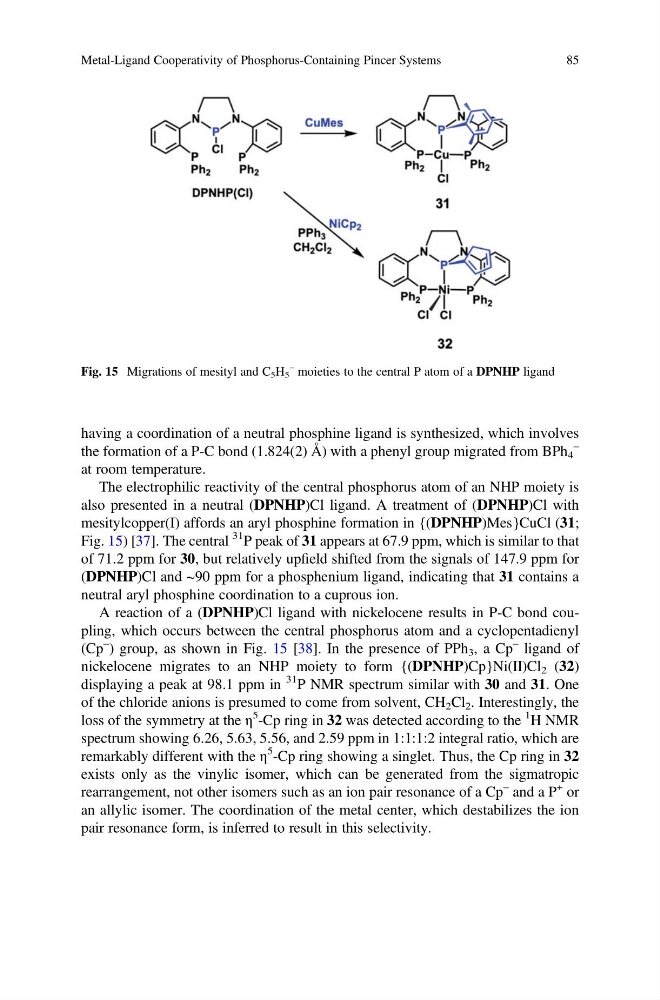
The electrophilic reactivity of the central phosphorus atom of an NHP moiety is
also presented in a neutral (DPNHP)Cl ligand. A treatment of (DPNHP)Cl with
mesitylcopper(I) affords an aryl phosphine formation in {(DPNHP)Mes}CuCl (31;
Fig. 15) [37]. The central
31 P peak of 31 appears at 67.9 ppm, which is similar to that
of 71.2 ppm for 30, but relatively upfield shifted from the signals of 147.9 ppm for
(DPNHP)Cl and ~90 ppm for a phosphenium ligand, indicating that 31 contains a
neutral aryl phosphine coordination to a cuprous ion.
A reaction of a (DPNHP)Cl ligand with nickelocene results in P-C bond coupling, which occurs between the central phosphorus atom and a cyclopentadienyl
(Cp
– ) group, as shown in Fig. 15 [38]. In the presence of PPh 3 , a Cp
– ligand of
nickelocene migrates to an NHP moiety to form {(DPNHP)Cp}Ni(II)Cl 2 (32)
displaying a peak at 98.1 ppm in
31 P NMR spectrum similar with 30 and 31. One
of the chloride anions is presumed to come from solvent, CH 2 Cl 2 . Interestingly, the
loss of the symmetry at the η
5 -Cp ring in 32 was detected according to the
1 H NMR
spectrum showing 6.26, 5.63, 5.56, and 2.59 ppm in 1:1:1:2 integral ratio, which are
remarkably different with the η
5 -Cp ring showing a singlet. Thus, the Cp ring in 32
exists only as the vinylic isomer, which can be generated from the sigmatropic
rearrangement, not other isomers such as an ion pair resonance of a Cp
– and a P
+ or
an allylic isomer. The coordination of the metal center, which destabilizes the ion
pair resonance form, is inferred to result in this selectivity.
Fig. 15 Migrations of mesityl and C 5 H 5
– moieties to the central P atom of a DPNHP ligand
Metal-Ligand Cooperativity of Phosphorus-Containing Pincer Systems
85
the formation of a P-C bond (1.824(2) Å) with a phenyl group migrated from BPh 4
–
at room temperature.
The electrophilic reactivity of the central phosphorus atom of an NHP moiety is
also presented in a neutral (DPNHP)Cl ligand. A treatment of (DPNHP)Cl with
mesitylcopper(I) affords an aryl phosphine formation in {(DPNHP)Mes}CuCl (31;
Fig. 15) [37]. The central
31 P peak of 31 appears at 67.9 ppm, which is similar to that
of 71.2 ppm for 30, but relatively upfield shifted from the signals of 147.9 ppm for
(DPNHP)Cl and ~90 ppm for a phosphenium ligand, indicating that 31 contains a
neutral aryl phosphine coordination to a cuprous ion.
A reaction of a (DPNHP)Cl ligand with nickelocene results in P-C bond coupling, which occurs between the central phosphorus atom and a cyclopentadienyl
(Cp
– ) group, as shown in Fig. 15 [38]. In the presence of PPh 3 , a Cp
– ligand of
nickelocene migrates to an NHP moiety to form {(DPNHP)Cp}Ni(II)Cl 2 (32)
displaying a peak at 98.1 ppm in
31 P NMR spectrum similar with 30 and 31. One
of the chloride anions is presumed to come from solvent, CH 2 Cl 2 . Interestingly, the
loss of the symmetry at the η
5 -Cp ring in 32 was detected according to the
1 H NMR
spectrum showing 6.26, 5.63, 5.56, and 2.59 ppm in 1:1:1:2 integral ratio, which are
remarkably different with the η
5 -Cp ring showing a singlet. Thus, the Cp ring in 32
exists only as the vinylic isomer, which can be generated from the sigmatropic
rearrangement, not other isomers such as an ion pair resonance of a Cp
– and a P
+ or
an allylic isomer. The coordination of the metal center, which destabilizes the ion
pair resonance form, is inferred to result in this selectivity.
Fig. 15 Migrations of mesityl and C 5 H 5
– moieties to the central P atom of a DPNHP ligand
Metal-Ligand Cooperativity of Phosphorus-Containing Pincer Systems
85