

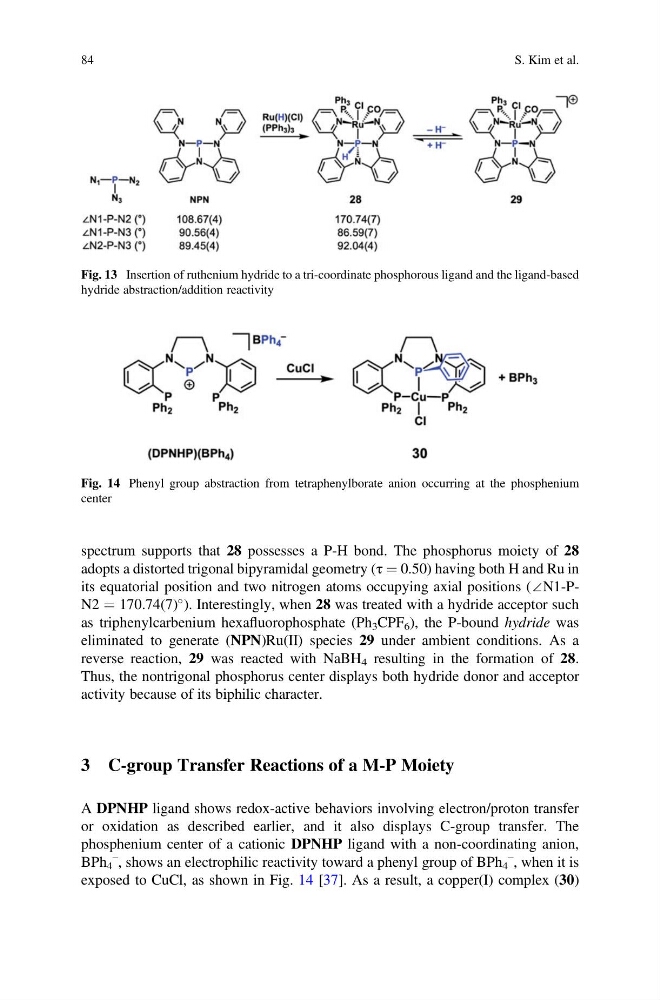
spectrum supports that 28 possesses a P-H bond. The phosphorus moiety of 28
adopts a distorted trigonal bipyramidal geometry (τ ¼ 0.50) having both H and Ru in
its equatorial position and two nitrogen atoms occupying axial positions (∠N1-PN2 ¼ 170.74(7)
). Interestingly, when 28 was treated with a hydride acceptor such
as triphenylcarbenium hexafluorophosphate (Ph 3 CPF 6 ), the P-bound hydride was
eliminated to generate (NPN)Ru(II) species 29 under ambient conditions. As a
reverse reaction, 29 was reacted with NaBH 4 resulting in the formation of 28.
Thus, the nontrigonal phosphorus center displays both hydride donor and acceptor
activity because of its biphilic character.
3 C-group Transfer Reactions of a M-P Moiety
A DPNHP ligand shows redox-active behaviors involving electron/proton transfer
or oxidation as described earlier, and it also displays C-group transfer. The
phosphenium center of a cationic DPNHP ligand with a non-coordinating anion,
BPh 4
– , shows an electrophilic reactivity toward a phenyl group of BPh 4
–
, when it is
exposed to CuCl, as shown in Fig. 14 [37]. As a result, a copper(I) complex (30)
Fig. 13 Insertion of ruthenium hydride to a tri-coordinate phosphorous ligand and the ligand-based
hydride abstraction/addition reactivity
Fig. 14 Phenyl group abstraction from tetraphenylborate anion occurring at the phosphenium
center
84
S. Kim et al.
adopts a distorted trigonal bipyramidal geometry (τ ¼ 0.50) having both H and Ru in
its equatorial position and two nitrogen atoms occupying axial positions (∠N1-PN2 ¼ 170.74(7)
). Interestingly, when 28 was treated with a hydride acceptor such
as triphenylcarbenium hexafluorophosphate (Ph 3 CPF 6 ), the P-bound hydride was
eliminated to generate (NPN)Ru(II) species 29 under ambient conditions. As a
reverse reaction, 29 was reacted with NaBH 4 resulting in the formation of 28.
Thus, the nontrigonal phosphorus center displays both hydride donor and acceptor
activity because of its biphilic character.
3 C-group Transfer Reactions of a M-P Moiety
A DPNHP ligand shows redox-active behaviors involving electron/proton transfer
or oxidation as described earlier, and it also displays C-group transfer. The
phosphenium center of a cationic DPNHP ligand with a non-coordinating anion,
BPh 4
– , shows an electrophilic reactivity toward a phenyl group of BPh 4
–
, when it is
exposed to CuCl, as shown in Fig. 14 [37]. As a result, a copper(I) complex (30)
Fig. 13 Insertion of ruthenium hydride to a tri-coordinate phosphorous ligand and the ligand-based
hydride abstraction/addition reactivity
Fig. 14 Phenyl group abstraction from tetraphenylborate anion occurring at the phosphenium
center
84
S. Kim et al.