

Similar to transition metal, the three-coordinate P
III compound cleaves the N-H
bond of RNH 2 via oxidative addition (Fig. 11) [34]. According to the DFT analysis,
the reaction enthalpy for the proton transfer from an amine to P
III (ΔH ¼ 87.7 kcal/
mol) is unfavorable. The presence of low-lying LUMO (–1.0 eV) and electron
affinity (EA ¼ –2.2 eV) of P
III suggest that P
III initially forms a P-N bond with
amine, which is subsequently followed by P-H bond formation [34]. The DFT
analysis on P(NH 2 ) 3 as a model compound of P
III reveals that a lowest energy of
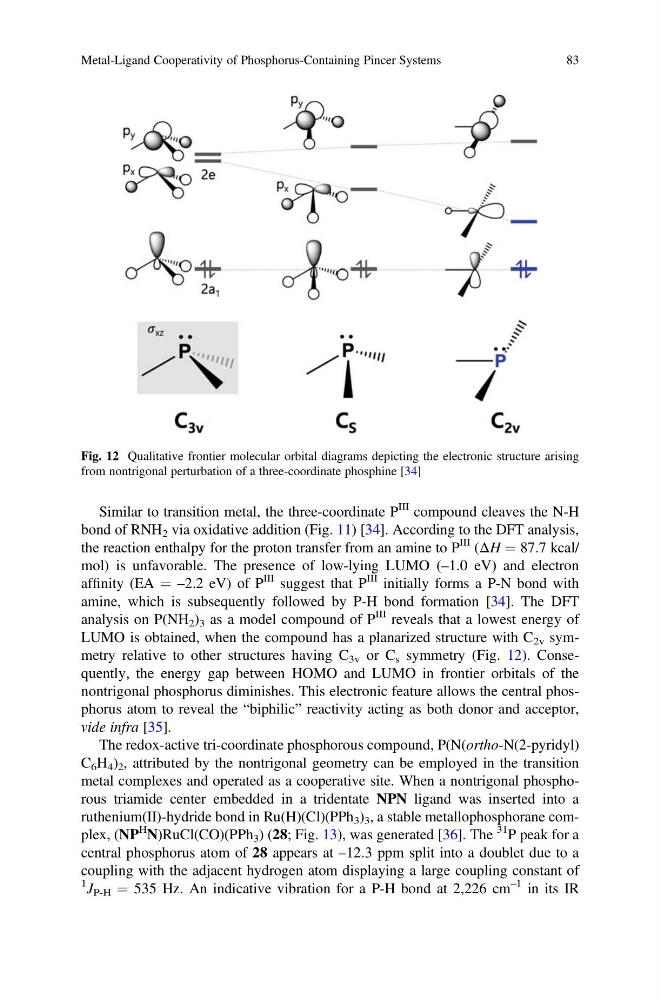
LUMO is obtained, when the compound has a planarized structure with C 2v symmetry relative to other structures having C 3v or C s symmetry (Fig. 12). Consequently, the energy gap between HOMO and LUMO in frontier orbitals of the
nontrigonal phosphorus diminishes. This electronic feature allows the central phosphorus atom to reveal the “biphilic” reactivity acting as both donor and acceptor,
vide infra [35].
The redox-active tri-coordinate phosphorous compound, P(N(ortho-N(2-pyridyl)
C 6 H 4 ) 2 , attributed by the nontrigonal geometry can be employed in the transition
metal complexes and operated as a cooperative site. When a nontrigonal phosphorous triamide center embedded in a tridentate NPN ligand was inserted into a
ruthenium(II)-hydride bond in Ru(H)(Cl)(PPh 3 ) 3 , a stable metallophosphorane complex, (NP
H N)RuCl(CO)(PPh 3 ) (28; Fig. 13), was generated [36]. The
31 P peak for a
central phosphorus atom of 28 appears at –12.3 ppm split into a doublet due to a
coupling with the adjacent hydrogen atom displaying a large coupling constant of
1 J P-H ¼ 535 Hz. An indicative vibration for a P-H bond at 2,226 cm
–1 in its IR
Fig. 12 Qualitative frontier molecular orbital diagrams depicting the electronic structure arising
from nontrigonal perturbation of a three-coordinate phosphine [34]
Metal-Ligand Cooperativity of Phosphorus-Containing Pincer Systems
83
III compound cleaves the N-H
bond of RNH 2 via oxidative addition (Fig. 11) [34]. According to the DFT analysis,
the reaction enthalpy for the proton transfer from an amine to P
III (ΔH ¼ 87.7 kcal/
mol) is unfavorable. The presence of low-lying LUMO (–1.0 eV) and electron
affinity (EA ¼ –2.2 eV) of P
III suggest that P
III initially forms a P-N bond with
amine, which is subsequently followed by P-H bond formation [34]. The DFT
analysis on P(NH 2 ) 3 as a model compound of P
III reveals that a lowest energy of
LUMO is obtained, when the compound has a planarized structure with C 2v symmetry relative to other structures having C 3v or C s symmetry (Fig. 12). Consequently, the energy gap between HOMO and LUMO in frontier orbitals of the
nontrigonal phosphorus diminishes. This electronic feature allows the central phosphorus atom to reveal the “biphilic” reactivity acting as both donor and acceptor,
vide infra [35].
The redox-active tri-coordinate phosphorous compound, P(N(ortho-N(2-pyridyl)
C 6 H 4 ) 2 , attributed by the nontrigonal geometry can be employed in the transition
metal complexes and operated as a cooperative site. When a nontrigonal phosphorous triamide center embedded in a tridentate NPN ligand was inserted into a
ruthenium(II)-hydride bond in Ru(H)(Cl)(PPh 3 ) 3 , a stable metallophosphorane complex, (NP
H N)RuCl(CO)(PPh 3 ) (28; Fig. 13), was generated [36]. The
31 P peak for a
central phosphorus atom of 28 appears at –12.3 ppm split into a doublet due to a
coupling with the adjacent hydrogen atom displaying a large coupling constant of
1 J P-H ¼ 535 Hz. An indicative vibration for a P-H bond at 2,226 cm
–1 in its IR
Fig. 12 Qualitative frontier molecular orbital diagrams depicting the electronic structure arising
from nontrigonal perturbation of a three-coordinate phosphine [34]
Metal-Ligand Cooperativity of Phosphorus-Containing Pincer Systems
83