

reactive toward H 2 and phenol, suggesting that the cooperativity of a DPNHP ligand
with group 9 metals can be effectively accomplished with first row transition metal.
A reversible phosphorus-based two-electron redox cycle without metal
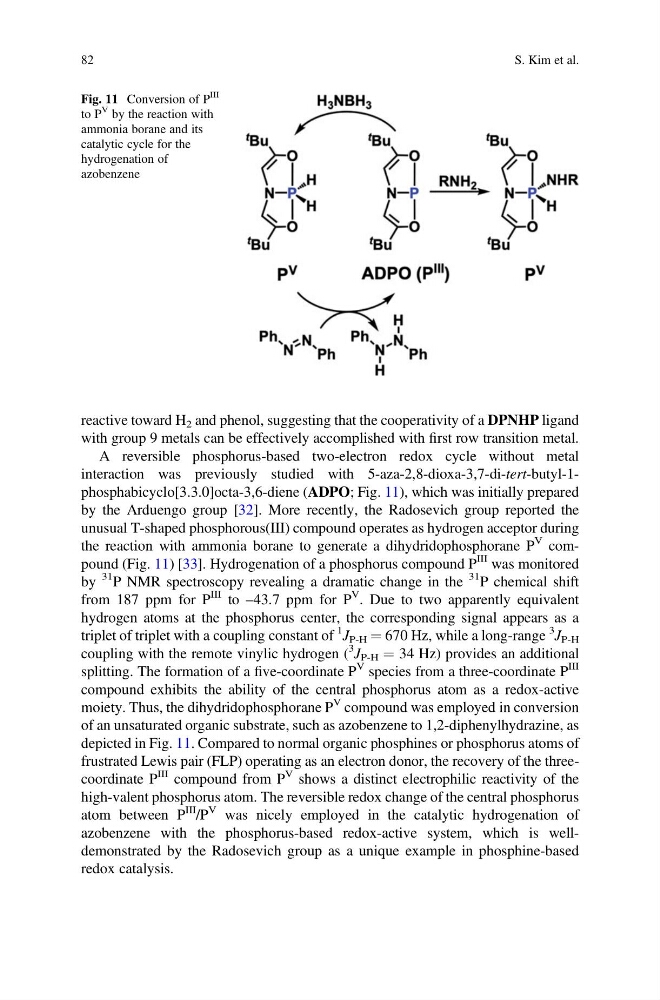
interaction was previously studied with 5-aza-2,8-dioxa-3,7-di-tert-butyl-1phosphabicyclo[3.3.0]octa-3,6-diene (ADPO; Fig. 11), which was initially prepared
by the Arduengo group [32]. More recently, the Radosevich group reported the
unusual T-shaped phosphorous(III) compound operates as hydrogen acceptor during
the reaction with ammonia borane to generate a dihydridophosphorane P
V compound (Fig. 11) [33]. Hydrogenation of a phosphorus compound P
III was monitored
by
31 P NMR spectroscopy revealing a dramatic change in the
31 P chemical shift
from 187 ppm for P
III to –43.7 ppm for P
V . Due to two apparently equivalent
hydrogen atoms at the phosphorus center, the corresponding signal appears as a
triplet of triplet with a coupling constant of
1 J P-H ¼ 670 Hz, while a long-range
3 J P-H
coupling with the remote vinylic hydrogen (
3 J P-H ¼ 34 Hz) provides an additional
splitting. The formation of a five-coordinate P
V species from a three-coordinate P
III
compound exhibits the ability of the central phosphorus atom as a redox-active
moiety. Thus, the dihydridophosphorane P
V compound was employed in conversion
of an unsaturated organic substrate, such as azobenzene to 1,2-diphenylhydrazine, as
depicted in Fig. 11. Compared to normal organic phosphines or phosphorus atoms of
frustrated Lewis pair (FLP) operating as an electron donor, the recovery of the threecoordinate P
III compound from P
V shows a distinct electrophilic reactivity of the
high-valent phosphorus atom. The reversible redox change of the central phosphorus
atom between P
III
/P
V was nicely employed in the catalytic hydrogenation of
azobenzene with the phosphorus-based redox-active system, which is welldemonstrated by the Radosevich group as a unique example in phosphine-based
redox catalysis.
Fig. 11 Conversion of P
III
to P
V by the reaction with
ammonia borane and its
catalytic cycle for the
hydrogenation of
azobenzene
82
S. Kim et al.
with group 9 metals can be effectively accomplished with first row transition metal.
A reversible phosphorus-based two-electron redox cycle without metal
interaction was previously studied with 5-aza-2,8-dioxa-3,7-di-tert-butyl-1phosphabicyclo[3.3.0]octa-3,6-diene (ADPO; Fig. 11), which was initially prepared
by the Arduengo group [32]. More recently, the Radosevich group reported the
unusual T-shaped phosphorous(III) compound operates as hydrogen acceptor during
the reaction with ammonia borane to generate a dihydridophosphorane P
V compound (Fig. 11) [33]. Hydrogenation of a phosphorus compound P
III was monitored
by
31 P NMR spectroscopy revealing a dramatic change in the
31 P chemical shift
from 187 ppm for P
III to –43.7 ppm for P
V . Due to two apparently equivalent
hydrogen atoms at the phosphorus center, the corresponding signal appears as a
triplet of triplet with a coupling constant of
1 J P-H ¼ 670 Hz, while a long-range
3 J P-H
coupling with the remote vinylic hydrogen (
3 J P-H ¼ 34 Hz) provides an additional
splitting. The formation of a five-coordinate P
V species from a three-coordinate P
III
compound exhibits the ability of the central phosphorus atom as a redox-active
moiety. Thus, the dihydridophosphorane P
V compound was employed in conversion
of an unsaturated organic substrate, such as azobenzene to 1,2-diphenylhydrazine, as
depicted in Fig. 11. Compared to normal organic phosphines or phosphorus atoms of
frustrated Lewis pair (FLP) operating as an electron donor, the recovery of the threecoordinate P
III compound from P
V shows a distinct electrophilic reactivity of the
high-valent phosphorus atom. The reversible redox change of the central phosphorus
atom between P
III
/P
V was nicely employed in the catalytic hydrogenation of
azobenzene with the phosphorus-based redox-active system, which is welldemonstrated by the Radosevich group as a unique example in phosphine-based
redox catalysis.
Fig. 11 Conversion of P
III
to P
V by the reaction with
ammonia borane and its
catalytic cycle for the
hydrogenation of
azobenzene
82
S. Kim et al.