

donor having a nonbonding lone pair can participate in the activation of H 2 . While a
cobalt(I) hydride species is generated, a new P-H bond also forms displaying a P
signal at 134 ppm with a P-H coupling (
1 J P-H ¼ 320 Hz) in its
31 P NMR spectrum,
which is largely upfield shifted from the signal of 17 appearing 251 ppm. During the
heterolysis of H 2 occurring at a Co-P moiety, a phosphide moiety clearly acts as an
internal base to give {(DPNHP)H}Co(H)(PMe 3 ) (21).
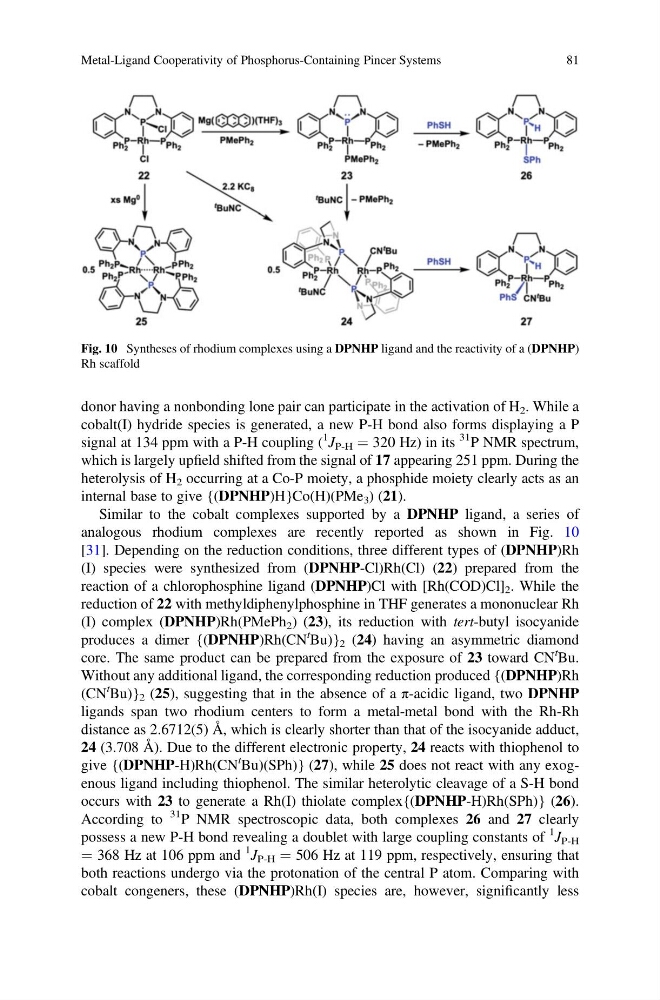
Similar to the cobalt complexes supported by a DPNHP ligand, a series of
analogous rhodium complexes are recently reported as shown in Fig. 10
[31]. Depending on the reduction conditions, three different types of (DPNHP)Rh
(I) species were synthesized from (DPNHP-Cl)Rh(Cl) (22) prepared from the
reaction of a chlorophosphine ligand (DPNHP)Cl with [Rh(COD)Cl] 2 . While the
reduction of 22 with methyldiphenylphosphine in THF generates a mononuclear Rh
(I) complex (DPNHP)Rh(PMePh 2 ) (23), its reduction with tert-butyl isocyanide
produces a dimer {(DPNHP)Rh(CN
t Bu)} 2 (24) having an asymmetric diamond
core. The same product can be prepared from the exposure of 23 toward CN
t Bu.
Without any additional ligand, the corresponding reduction produced {(DPNHP)Rh
(CN
t Bu)} 2 (25), suggesting that in the absence of a π-acidic ligand, two DPNHP
ligands span two rhodium centers to form a metal-metal bond with the Rh-Rh
distance as 2.6712(5) Å, which is clearly shorter than that of the isocyanide adduct,
24 (3.708 Å). Due to the different electronic property, 24 reacts with thiophenol to
give {(DPNHP-H)Rh(CN
t Bu)(SPh)} (27), while 25 does not react with any exogenous ligand including thiophenol. The similar heterolytic cleavage of a S-H bond
occurs with 23 to generate a Rh(I) thiolate complex{(DPNHP-H)Rh(SPh)} (26).
According to
31 P NMR spectroscopic data, both complexes 26 and 27 clearly
possess a new P-H bond revealing a doublet with large coupling constants of
1 J P-H
¼ 368 Hz at 106 ppm and
1 J P-H ¼ 506 Hz at 119 ppm, respectively, ensuring that
both reactions undergo via the protonation of the central P atom. Comparing with
cobalt congeners, these (DPNHP)Rh(I) species are, however, significantly less
Fig. 10 Syntheses of rhodium complexes using a DPNHP ligand and the reactivity of a (DPNHP)
Rh scaffold
Metal-Ligand Cooperativity of Phosphorus-Containing Pincer Systems
81
cobalt(I) hydride species is generated, a new P-H bond also forms displaying a P
signal at 134 ppm with a P-H coupling (
1 J P-H ¼ 320 Hz) in its
31 P NMR spectrum,
which is largely upfield shifted from the signal of 17 appearing 251 ppm. During the
heterolysis of H 2 occurring at a Co-P moiety, a phosphide moiety clearly acts as an
internal base to give {(DPNHP)H}Co(H)(PMe 3 ) (21).
Similar to the cobalt complexes supported by a DPNHP ligand, a series of
analogous rhodium complexes are recently reported as shown in Fig. 10
[31]. Depending on the reduction conditions, three different types of (DPNHP)Rh
(I) species were synthesized from (DPNHP-Cl)Rh(Cl) (22) prepared from the
reaction of a chlorophosphine ligand (DPNHP)Cl with [Rh(COD)Cl] 2 . While the
reduction of 22 with methyldiphenylphosphine in THF generates a mononuclear Rh
(I) complex (DPNHP)Rh(PMePh 2 ) (23), its reduction with tert-butyl isocyanide
produces a dimer {(DPNHP)Rh(CN
t Bu)} 2 (24) having an asymmetric diamond
core. The same product can be prepared from the exposure of 23 toward CN
t Bu.
Without any additional ligand, the corresponding reduction produced {(DPNHP)Rh
(CN
t Bu)} 2 (25), suggesting that in the absence of a π-acidic ligand, two DPNHP
ligands span two rhodium centers to form a metal-metal bond with the Rh-Rh
distance as 2.6712(5) Å, which is clearly shorter than that of the isocyanide adduct,
24 (3.708 Å). Due to the different electronic property, 24 reacts with thiophenol to
give {(DPNHP-H)Rh(CN
t Bu)(SPh)} (27), while 25 does not react with any exogenous ligand including thiophenol. The similar heterolytic cleavage of a S-H bond
occurs with 23 to generate a Rh(I) thiolate complex{(DPNHP-H)Rh(SPh)} (26).
According to
31 P NMR spectroscopic data, both complexes 26 and 27 clearly
possess a new P-H bond revealing a doublet with large coupling constants of
1 J P-H
¼ 368 Hz at 106 ppm and
1 J P-H ¼ 506 Hz at 119 ppm, respectively, ensuring that
both reactions undergo via the protonation of the central P atom. Comparing with
cobalt congeners, these (DPNHP)Rh(I) species are, however, significantly less
Fig. 10 Syntheses of rhodium complexes using a DPNHP ligand and the reactivity of a (DPNHP)
Rh scaffold
Metal-Ligand Cooperativity of Phosphorus-Containing Pincer Systems
81