

corresponding reduction occurs at one of the two nickel(0) ions. A two-electron
reduced dinickel species, {(DPNHP)Ni} 2 (16), is structurally different from that of
15. Although it is also a dimer, compound 16 has a symmetrical core having the
Ni-Ni bond length of 2.5144(5) Å and a P-Ni distance of 2.1191(7) Å, which are in
the ranges of reported phosphido-bridged Ni
I complexes (Ni-Ni ¼ 2.37–2.56 Å and
Ni-P ¼ 2.16–2.26 Å). Thus, a neutral dinickel compound 16 can be assigned as a Ni
(I) dimer bridged by two phosphido NHP
– ligands. This is clearly an interesting
transformation of a dinickel(0) species 14 induced by the chemical reduction, which
involves two electron reduction of a phosphenium ion to a bridging phosphide
moiety accompanying a single-electron oxidation of two nickel ions. The reverse
one- or two-electron oxidations of a neutral dinickel species 16 result in a formation
of a mono- and dicationic species. Compound 15 can be also generated from the 1:1
mixture of 14 and 16.
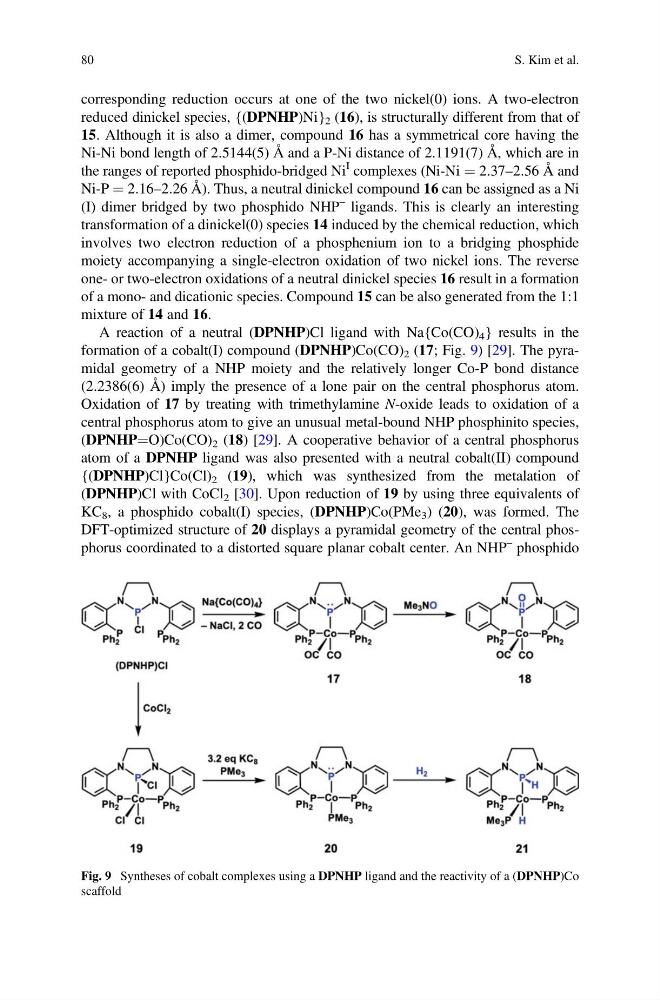
A reaction of a neutral (DPNHP)Cl ligand with Na{Co(CO) 4 } results in the
formation of a cobalt(I) compound (DPNHP)Co(CO) 2 (17; Fig. 9) [29]. The pyramidal geometry of a NHP moiety and the relatively longer Co-P bond distance
(2.2386(6) Å) imply the presence of a lone pair on the central phosphorus atom.
Oxidation of 17 by treating with trimethylamine N-oxide leads to oxidation of a
central phosphorus atom to give an unusual metal-bound NHP phosphinito species,
(DPNHP¼O)Co(CO) 2 (18) [29]. A cooperative behavior of a central phosphorus
atom of a DPNHP ligand was also presented with a neutral cobalt(II) compound
{(DPNHP)Cl}Co(Cl) 2 (19), which was synthesized from the metalation of
(DPNHP)Cl with CoCl 2 [30]. Upon reduction of 19 by using three equivalents of
KC 8 , a phosphido cobalt(I) species, (DPNHP)Co(PMe 3 ) (20), was formed. The
DFT-optimized structure of 20 displays a pyramidal geometry of the central phosphorus coordinated to a distorted square planar cobalt center. An NHP
– phosphido
Fig. 9 Syntheses of cobalt complexes using a DPNHP ligand and the reactivity of a (DPNHP)Co
scaffold
80
S. Kim et al.
reduced dinickel species, {(DPNHP)Ni} 2 (16), is structurally different from that of
15. Although it is also a dimer, compound 16 has a symmetrical core having the
Ni-Ni bond length of 2.5144(5) Å and a P-Ni distance of 2.1191(7) Å, which are in
the ranges of reported phosphido-bridged Ni
I complexes (Ni-Ni ¼ 2.37–2.56 Å and
Ni-P ¼ 2.16–2.26 Å). Thus, a neutral dinickel compound 16 can be assigned as a Ni
(I) dimer bridged by two phosphido NHP
– ligands. This is clearly an interesting
transformation of a dinickel(0) species 14 induced by the chemical reduction, which
involves two electron reduction of a phosphenium ion to a bridging phosphide
moiety accompanying a single-electron oxidation of two nickel ions. The reverse
one- or two-electron oxidations of a neutral dinickel species 16 result in a formation
of a mono- and dicationic species. Compound 15 can be also generated from the 1:1
mixture of 14 and 16.
A reaction of a neutral (DPNHP)Cl ligand with Na{Co(CO) 4 } results in the
formation of a cobalt(I) compound (DPNHP)Co(CO) 2 (17; Fig. 9) [29]. The pyramidal geometry of a NHP moiety and the relatively longer Co-P bond distance
(2.2386(6) Å) imply the presence of a lone pair on the central phosphorus atom.
Oxidation of 17 by treating with trimethylamine N-oxide leads to oxidation of a
central phosphorus atom to give an unusual metal-bound NHP phosphinito species,
(DPNHP¼O)Co(CO) 2 (18) [29]. A cooperative behavior of a central phosphorus
atom of a DPNHP ligand was also presented with a neutral cobalt(II) compound
{(DPNHP)Cl}Co(Cl) 2 (19), which was synthesized from the metalation of
(DPNHP)Cl with CoCl 2 [30]. Upon reduction of 19 by using three equivalents of
KC 8 , a phosphido cobalt(I) species, (DPNHP)Co(PMe 3 ) (20), was formed. The
DFT-optimized structure of 20 displays a pyramidal geometry of the central phosphorus coordinated to a distorted square planar cobalt center. An NHP
– phosphido
Fig. 9 Syntheses of cobalt complexes using a DPNHP ligand and the reactivity of a (DPNHP)Co
scaffold
80
S. Kim et al.