

delocalization of the lone pair electrons of the nitrogen atoms through the aromatic
rings and thus stabilize the anionic phosphide coordination [26]. Since the central
phosphide donor of the anionic NHP moiety has a reasonable basicity, (DPNHP)Pt
(II) species, 10 reveals a cooperative behavior, when HX was added. During its
reaction with HCl or PhSH, phosphide accepts a proton, while an anionic ligand
coordinates to a Pt(II) ion to give a product {(DPNHP)H}Pt(II)X (12, X ¼ Cl or 13,
X ¼ SPh) [27].
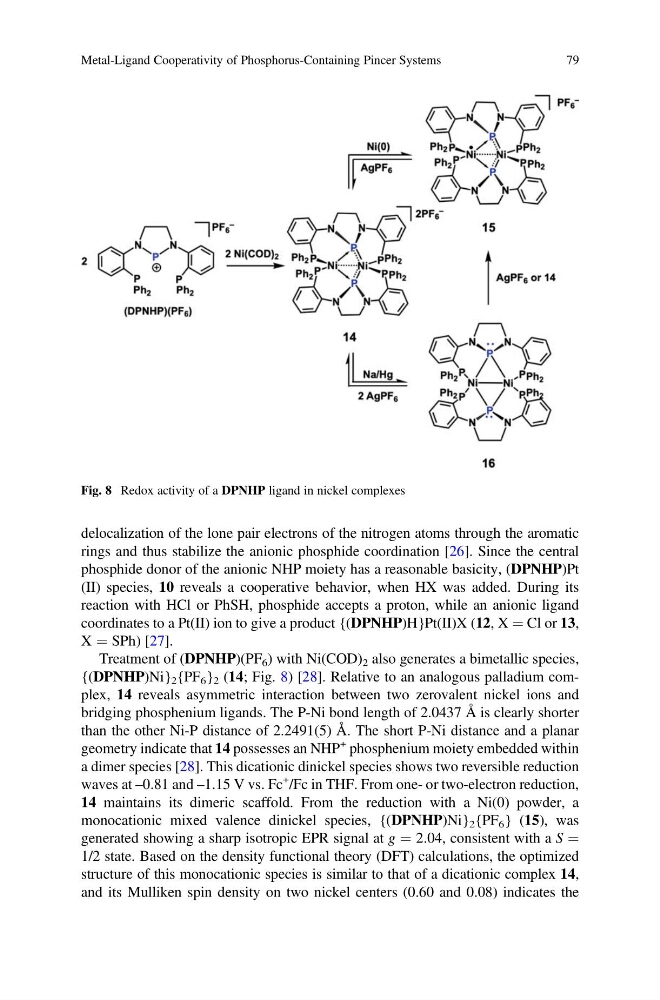
Treatment of (DPNHP)(PF 6 ) with Ni(COD) 2 also generates a bimetallic species,
{(DPNHP)Ni} 2 {PF 6 } 2 (14; Fig. 8) [28]. Relative to an analogous palladium complex, 14 reveals asymmetric interaction between two zerovalent nickel ions and
bridging phosphenium ligands. The P-Ni bond length of 2.0437 Å is clearly shorter
than the other Ni-P distance of 2.2491(5) Å. The short P-Ni distance and a planar
geometry indicate that 14 possesses an NHP
+ phosphenium moiety embedded within
a dimer species [28]. This dicationic dinickel species shows two reversible reduction
waves at –0.81 and –1.15 V vs. Fc
+
/Fc in THF. From one- or two-electron reduction,
14 maintains its dimeric scaffold. From the reduction with a Ni(0) powder, a
monocationic mixed valence dinickel species, {(DPNHP)Ni} 2 {PF 6 } (15), was
generated showing a sharp isotropic EPR signal at g ¼ 2.04, consistent with a S ¼
1/2 state. Based on the density functional theory (DFT) calculations, the optimized
structure of this monocationic species is similar to that of a dicationic complex 14,
and its Mulliken spin density on two nickel centers (0.60 and 0.08) indicates the
Fig. 8 Redox activity of a DPNHP ligand in nickel complexes
Metal-Ligand Cooperativity of Phosphorus-Containing Pincer Systems
79
rings and thus stabilize the anionic phosphide coordination [26]. Since the central
phosphide donor of the anionic NHP moiety has a reasonable basicity, (DPNHP)Pt
(II) species, 10 reveals a cooperative behavior, when HX was added. During its
reaction with HCl or PhSH, phosphide accepts a proton, while an anionic ligand
coordinates to a Pt(II) ion to give a product {(DPNHP)H}Pt(II)X (12, X ¼ Cl or 13,
X ¼ SPh) [27].
Treatment of (DPNHP)(PF 6 ) with Ni(COD) 2 also generates a bimetallic species,
{(DPNHP)Ni} 2 {PF 6 } 2 (14; Fig. 8) [28]. Relative to an analogous palladium complex, 14 reveals asymmetric interaction between two zerovalent nickel ions and
bridging phosphenium ligands. The P-Ni bond length of 2.0437 Å is clearly shorter
than the other Ni-P distance of 2.2491(5) Å. The short P-Ni distance and a planar
geometry indicate that 14 possesses an NHP
+ phosphenium moiety embedded within
a dimer species [28]. This dicationic dinickel species shows two reversible reduction
waves at –0.81 and –1.15 V vs. Fc
+
/Fc in THF. From one- or two-electron reduction,
14 maintains its dimeric scaffold. From the reduction with a Ni(0) powder, a
monocationic mixed valence dinickel species, {(DPNHP)Ni} 2 {PF 6 } (15), was
generated showing a sharp isotropic EPR signal at g ¼ 2.04, consistent with a S ¼
1/2 state. Based on the density functional theory (DFT) calculations, the optimized
structure of this monocationic species is similar to that of a dicationic complex 14,
and its Mulliken spin density on two nickel centers (0.60 and 0.08) indicates the
Fig. 8 Redox activity of a DPNHP ligand in nickel complexes
Metal-Ligand Cooperativity of Phosphorus-Containing Pincer Systems
79