

[25]. Interestingly, its metalation with a zerovalent platinum precursor, Pt(PPh 3 ) 4 ,
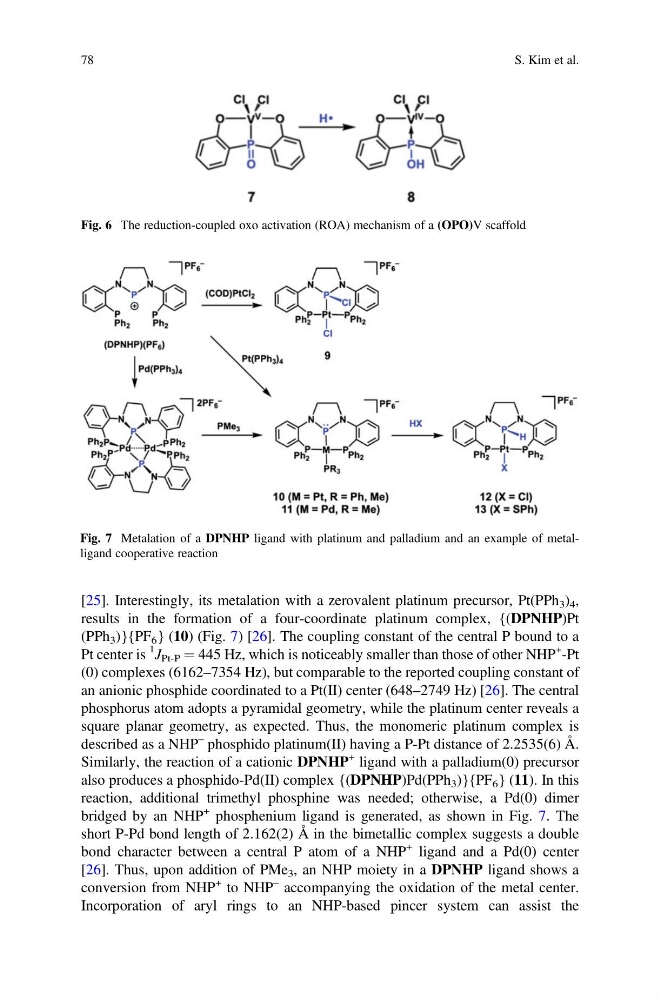
results in the formation of a four-coordinate platinum complex, {(DPNHP)Pt
(PPh 3 )}{PF 6 } (10) (Fig. 7) [26]. The coupling constant of the central P bound to a
Pt center is
1 J Pt-P ¼ 445 Hz, which is noticeably smaller than those of other NHP
+
-Pt
(0) complexes (6162–7354 Hz), but comparable to the reported coupling constant of
an anionic phosphide coordinated to a Pt(II) center (648–2749 Hz) [26]. The central
phosphorus atom adopts a pyramidal geometry, while the platinum center reveals a
square planar geometry, as expected. Thus, the monomeric platinum complex is
described as a NHP
– phosphido platinum(II) having a P-Pt distance of 2.2535(6) Å.
Similarly, the reaction of a cationic DPNHP
+ ligand with a palladium(0) precursor
also produces a phosphido-Pd(II) complex {(DPNHP)Pd(PPh 3 )}{PF 6 } (11). In this
reaction, additional trimethyl phosphine was needed; otherwise, a Pd(0) dimer
bridged by an NHP
+ phosphenium ligand is generated, as shown in Fig. 7. The
short P-Pd bond length of 2.162(2) Å in the bimetallic complex suggests a double
bond character between a central P atom of a NHP
+ ligand and a Pd(0) center
[26]. Thus, upon addition of PMe 3 , an NHP moiety in a DPNHP ligand shows a
conversion from NHP
+ to NHP
– accompanying the oxidation of the metal center.
Incorporation of aryl rings to an NHP-based pincer system can assist the
Fig. 6 The reduction-coupled oxo activation (ROA) mechanism of a (OPO)V scaffold
Fig. 7 Metalation of a DPNHP ligand with platinum and palladium and an example of metalligand cooperative reaction
78
S. Kim et al.
results in the formation of a four-coordinate platinum complex, {(DPNHP)Pt
(PPh 3 )}{PF 6 } (10) (Fig. 7) [26]. The coupling constant of the central P bound to a
Pt center is
1 J Pt-P ¼ 445 Hz, which is noticeably smaller than those of other NHP
+
-Pt
(0) complexes (6162–7354 Hz), but comparable to the reported coupling constant of
an anionic phosphide coordinated to a Pt(II) center (648–2749 Hz) [26]. The central
phosphorus atom adopts a pyramidal geometry, while the platinum center reveals a
square planar geometry, as expected. Thus, the monomeric platinum complex is
described as a NHP
– phosphido platinum(II) having a P-Pt distance of 2.2535(6) Å.
Similarly, the reaction of a cationic DPNHP
+ ligand with a palladium(0) precursor
also produces a phosphido-Pd(II) complex {(DPNHP)Pd(PPh 3 )}{PF 6 } (11). In this
reaction, additional trimethyl phosphine was needed; otherwise, a Pd(0) dimer
bridged by an NHP
+ phosphenium ligand is generated, as shown in Fig. 7. The
short P-Pd bond length of 2.162(2) Å in the bimetallic complex suggests a double
bond character between a central P atom of a NHP
+ ligand and a Pd(0) center
[26]. Thus, upon addition of PMe 3 , an NHP moiety in a DPNHP ligand shows a
conversion from NHP
+ to NHP
– accompanying the oxidation of the metal center.
Incorporation of aryl rings to an NHP-based pincer system can assist the
Fig. 6 The reduction-coupled oxo activation (ROA) mechanism of a (OPO)V scaffold
Fig. 7 Metalation of a DPNHP ligand with platinum and palladium and an example of metalligand cooperative reaction
78
S. Kim et al.