

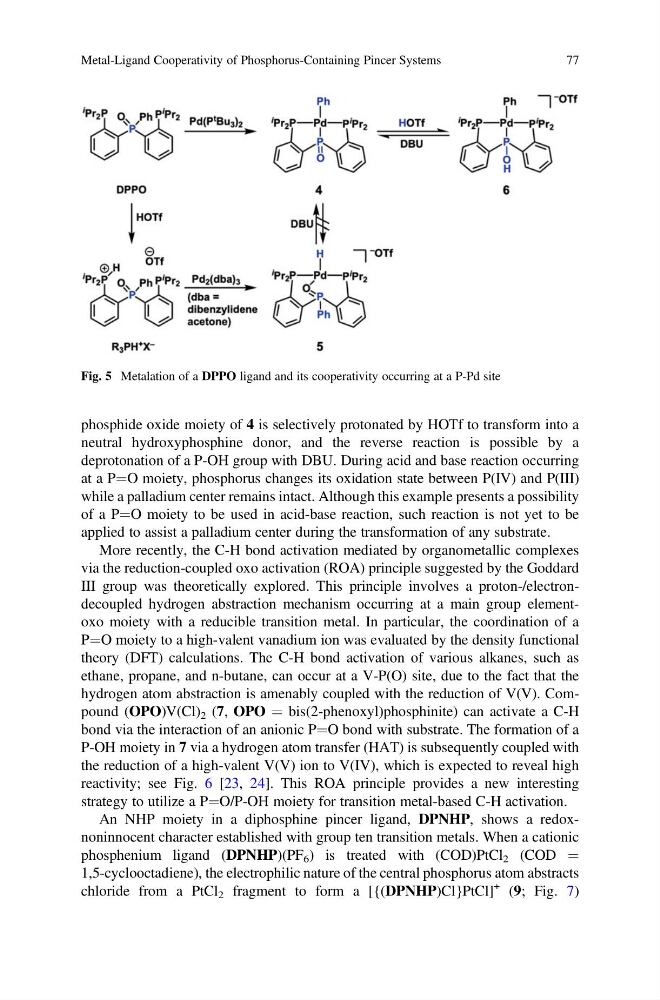
phosphide oxide moiety of 4 is selectively protonated by HOTf to transform into a
neutral hydroxyphosphine donor, and the reverse reaction is possible by a
deprotonation of a P-OH group with DBU. During acid and base reaction occurring
at a P¼O moiety, phosphorus changes its oxidation state between P(IV) and P(III)
while a palladium center remains intact. Although this example presents a possibility
of a P¼O moiety to be used in acid-base reaction, such reaction is not yet to be
applied to assist a palladium center during the transformation of any substrate.
More recently, the C-H bond activation mediated by organometallic complexes
via the reduction-coupled oxo activation (ROA) principle suggested by the Goddard
III group was theoretically explored. This principle involves a proton-/electrondecoupled hydrogen abstraction mechanism occurring at a main group elementoxo moiety with a reducible transition metal. In particular, the coordination of a
P¼O moiety to a high-valent vanadium ion was evaluated by the density functional
theory (DFT) calculations. The C-H bond activation of various alkanes, such as
ethane, propane, and n-butane, can occur at a V-P(O) site, due to the fact that the
hydrogen atom abstraction is amenably coupled with the reduction of V(V). Compound (OPO)V(Cl) 2 (7, OPO ¼ bis(2-phenoxyl)phosphinite) can activate a C-H
bond via the interaction of an anionic P¼O bond with substrate. The formation of a
P-OH moiety in 7 via a hydrogen atom transfer (HAT) is subsequently coupled with
the reduction of a high-valent V(V) ion to V(IV), which is expected to reveal high
reactivity; see Fig. 6 [23, 24]. This ROA principle provides a new interesting
strategy to utilize a P¼O/P-OH moiety for transition metal-based C-H activation.
An NHP moiety in a diphosphine pincer ligand, DPNHP, shows a redoxnoninnocent character established with group ten transition metals. When a cationic
phosphenium ligand (DPNHP)(PF 6 ) is treated with (COD)PtCl 2 (COD ¼
1,5-cyclooctadiene), the electrophilic nature of the central phosphorus atom abstracts
chloride from a PtCl 2 fragment to form a [{(DPNHP)Cl}PtCl]
+ (9; Fig. 7)
Fig. 5 Metalation of a DPPO ligand and its cooperativity occurring at a P-Pd site
Metal-Ligand Cooperativity of Phosphorus-Containing Pincer Systems
77
neutral hydroxyphosphine donor, and the reverse reaction is possible by a
deprotonation of a P-OH group with DBU. During acid and base reaction occurring
at a P¼O moiety, phosphorus changes its oxidation state between P(IV) and P(III)
while a palladium center remains intact. Although this example presents a possibility
of a P¼O moiety to be used in acid-base reaction, such reaction is not yet to be
applied to assist a palladium center during the transformation of any substrate.
More recently, the C-H bond activation mediated by organometallic complexes
via the reduction-coupled oxo activation (ROA) principle suggested by the Goddard
III group was theoretically explored. This principle involves a proton-/electrondecoupled hydrogen abstraction mechanism occurring at a main group elementoxo moiety with a reducible transition metal. In particular, the coordination of a
P¼O moiety to a high-valent vanadium ion was evaluated by the density functional
theory (DFT) calculations. The C-H bond activation of various alkanes, such as
ethane, propane, and n-butane, can occur at a V-P(O) site, due to the fact that the
hydrogen atom abstraction is amenably coupled with the reduction of V(V). Compound (OPO)V(Cl) 2 (7, OPO ¼ bis(2-phenoxyl)phosphinite) can activate a C-H
bond via the interaction of an anionic P¼O bond with substrate. The formation of a
P-OH moiety in 7 via a hydrogen atom transfer (HAT) is subsequently coupled with
the reduction of a high-valent V(V) ion to V(IV), which is expected to reveal high
reactivity; see Fig. 6 [23, 24]. This ROA principle provides a new interesting
strategy to utilize a P¼O/P-OH moiety for transition metal-based C-H activation.
An NHP moiety in a diphosphine pincer ligand, DPNHP, shows a redoxnoninnocent character established with group ten transition metals. When a cationic
phosphenium ligand (DPNHP)(PF 6 ) is treated with (COD)PtCl 2 (COD ¼
1,5-cyclooctadiene), the electrophilic nature of the central phosphorus atom abstracts
chloride from a PtCl 2 fragment to form a [{(DPNHP)Cl}PtCl]
+ (9; Fig. 7)
Fig. 5 Metalation of a DPPO ligand and its cooperativity occurring at a P-Pd site
Metal-Ligand Cooperativity of Phosphorus-Containing Pincer Systems
77