

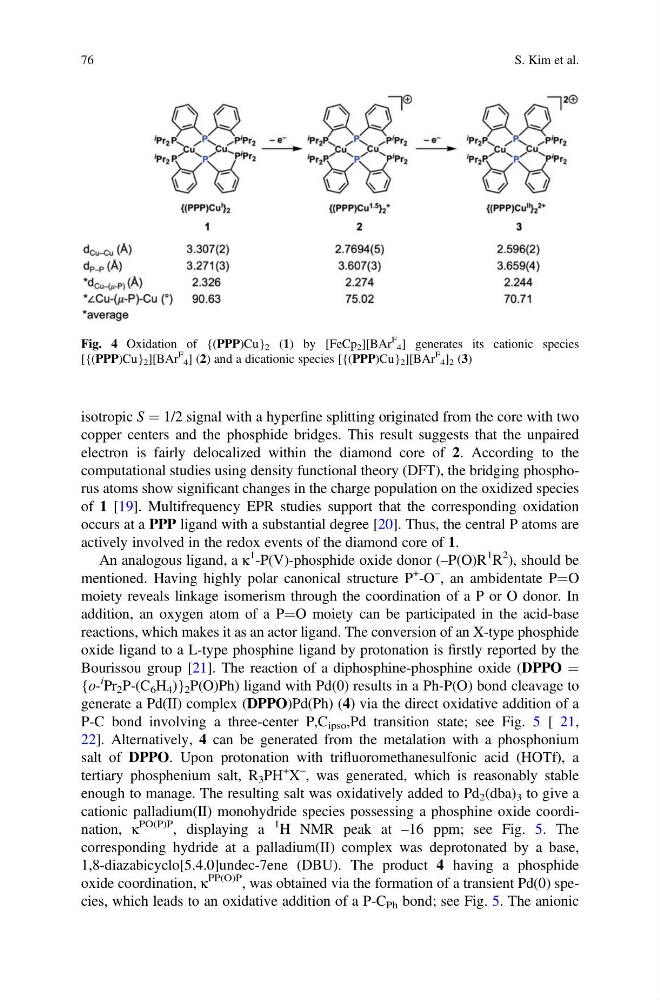
isotropic S ¼ 1/2 signal with a hyperfine splitting originated from the core with two
copper centers and the phosphide bridges. This result suggests that the unpaired
electron is fairly delocalized within the diamond core of 2. According to the
computational studies using density functional theory (DFT), the bridging phosphorus atoms show significant changes in the charge population on the oxidized species
of 1 [19]. Multifrequency EPR studies support that the corresponding oxidation
occurs at a PPP ligand with a substantial degree [20]. Thus, the central P atoms are
actively involved in the redox events of the diamond core of 1.
An analogous ligand, a κ
1 -P(V)-phosphide oxide donor (–P(O)R
1 R
2 ), should be
mentioned. Having highly polar canonical structure P
+
-O
– , an ambidentate P¼O
moiety reveals linkage isomerism through the coordination of a P or O donor. In
addition, an oxygen atom of a P¼O moiety can be participated in the acid-base
reactions, which makes it as an actor ligand. The conversion of an X-type phosphide
oxide ligand to a L-type phosphine ligand by protonation is firstly reported by the
Bourissou group [21]. The reaction of a diphosphine-phosphine oxide (DPPO ¼
{oi Pr 2 P-(C 6 H 4 )} 2 P(O)Ph) ligand with Pd(0) results in a Ph-P(O) bond cleavage to
generate a Pd(II) complex (DPPO)Pd(Ph) (4) via the direct oxidative addition of a
P-C bond involving a three-center P,C ipso ,Pd transition state; see Fig. 5 [ 21,
22]. Alternatively, 4 can be generated from the metalation with a phosphonium
salt of DPPO. Upon protonation with trifluoromethanesulfonic acid (HOTf), a
tertiary phosphenium salt, R 3 PH
+
X
– , was generated, which is reasonably stable
enough to manage. The resulting salt was oxidatively added to Pd 2 (dba) 3 to give a
cationic palladium(II) monohydride species possessing a phosphine oxide coordination, κ
PO(P)P , displaying a
1 H NMR peak at –16 ppm; see Fig. 5. The
corresponding hydride at a palladium(II) complex was deprotonated by a base,
1,8-diazabicyclo[5.4.0]undec-7ene (DBU). The product 4 having a phosphide
oxide coordination, κ
PP(O)P , was obtained via the formation of a transient Pd(0) species, which leads to an oxidative addition of a P-C Ph bond; see Fig. 5. The anionic
Fig. 4 Oxidation of {(PPP)Cu} 2 (1) by [FeCp 2 ][BAr
F
4 ] generates its cationic species
[{(PPP)Cu} 2 ][BAr
F
4 ] (2) and a dicationic species [{(PPP)Cu} 2 ][BAr
F
4 ] 2 (3)
76
S. Kim et al.
copper centers and the phosphide bridges. This result suggests that the unpaired
electron is fairly delocalized within the diamond core of 2. According to the
computational studies using density functional theory (DFT), the bridging phosphorus atoms show significant changes in the charge population on the oxidized species
of 1 [19]. Multifrequency EPR studies support that the corresponding oxidation
occurs at a PPP ligand with a substantial degree [20]. Thus, the central P atoms are
actively involved in the redox events of the diamond core of 1.
An analogous ligand, a κ
1 -P(V)-phosphide oxide donor (–P(O)R
1 R
2 ), should be
mentioned. Having highly polar canonical structure P
+
-O
– , an ambidentate P¼O
moiety reveals linkage isomerism through the coordination of a P or O donor. In
addition, an oxygen atom of a P¼O moiety can be participated in the acid-base
reactions, which makes it as an actor ligand. The conversion of an X-type phosphide
oxide ligand to a L-type phosphine ligand by protonation is firstly reported by the
Bourissou group [21]. The reaction of a diphosphine-phosphine oxide (DPPO ¼
{oi Pr 2 P-(C 6 H 4 )} 2 P(O)Ph) ligand with Pd(0) results in a Ph-P(O) bond cleavage to
generate a Pd(II) complex (DPPO)Pd(Ph) (4) via the direct oxidative addition of a
P-C bond involving a three-center P,C ipso ,Pd transition state; see Fig. 5 [ 21,
22]. Alternatively, 4 can be generated from the metalation with a phosphonium
salt of DPPO. Upon protonation with trifluoromethanesulfonic acid (HOTf), a
tertiary phosphenium salt, R 3 PH
+
X
– , was generated, which is reasonably stable
enough to manage. The resulting salt was oxidatively added to Pd 2 (dba) 3 to give a
cationic palladium(II) monohydride species possessing a phosphine oxide coordination, κ
PO(P)P , displaying a
1 H NMR peak at –16 ppm; see Fig. 5. The
corresponding hydride at a palladium(II) complex was deprotonated by a base,
1,8-diazabicyclo[5.4.0]undec-7ene (DBU). The product 4 having a phosphide
oxide coordination, κ
PP(O)P , was obtained via the formation of a transient Pd(0) species, which leads to an oxidative addition of a P-C Ph bond; see Fig. 5. The anionic
Fig. 4 Oxidation of {(PPP)Cu} 2 (1) by [FeCp 2 ][BAr
F
4 ] generates its cationic species
[{(PPP)Cu} 2 ][BAr
F
4 ] (2) and a dicationic species [{(PPP)Cu} 2 ][BAr
F
4 ] 2 (3)
76
S. Kim et al.