

is nicely sited within the plane defined by two carbon atoms and a metal ion, while a
P atom of a PPP ligand is located noticeably away from the plane: θ ¼ 1
vs. 34
found in analogous nickel and palladium complexes showing significantly distorted
structures. A similar structural feature can be seen from phosphide-containing
ligands such as DPNHP. Such structural distortion can affect the reactivity of a
metal ion, which can be coupled with a redox change and/or bond formation and
cleavage occurring at a P site.
Since phosphorus is prone to reveal hypervalency, another class of anionic
phosphorus-containing ligands should be mentioned. Analogous to the pentavalent
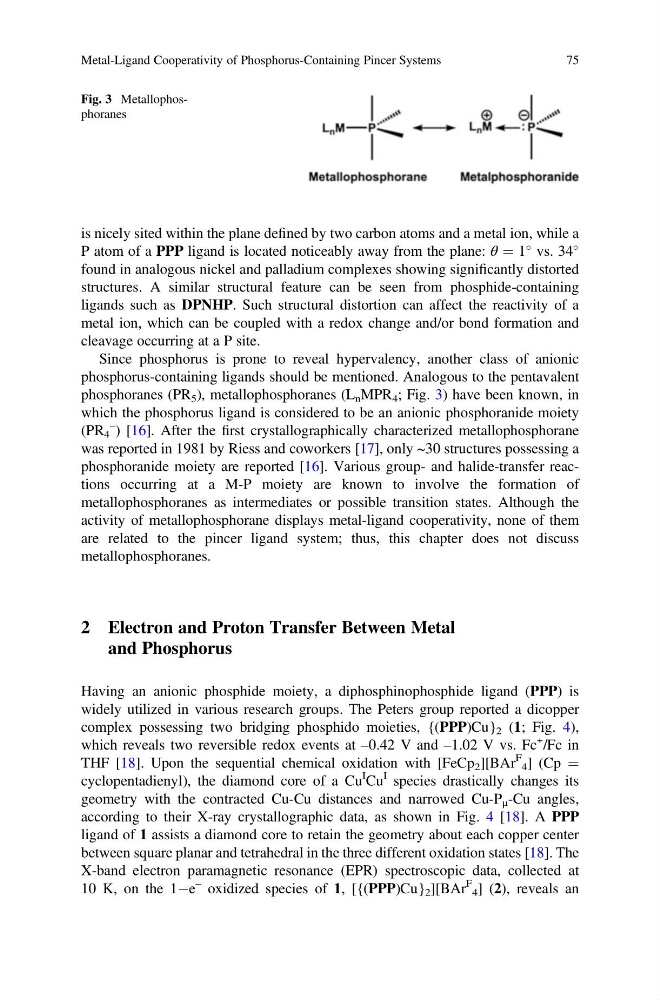
phosphoranes (PR 5 ), metallophosphoranes (L n MPR 4 ; Fig. 3) have been known, in
which the phosphorus ligand is considered to be an anionic phosphoranide moiety
(PR 4
– ) [16]. After the first crystallographically characterized metallophosphorane
was reported in 1981 by Riess and coworkers [17], only ~30 structures possessing a
phosphoranide moiety are reported [16]. Various group- and halide-transfer reactions occurring at a M-P moiety are known to involve the formation of
metallophosphoranes as intermediates or possible transition states. Although the
activity of metallophosphorane displays metal-ligand cooperativity, none of them
are related to the pincer ligand system; thus, this chapter does not discuss
metallophosphoranes.
2 Electron and Proton Transfer Between Metal
and Phosphorus
Having an anionic phosphide moiety, a diphosphinophosphide ligand (PPP) is
widely utilized in various research groups. The Peters group reported a dicopper
complex possessing two bridging phosphido moieties, {(PPP)Cu} 2 (1; Fig. 4),
which reveals two reversible redox events at –0.42 V and –1.02 V vs. Fc
+
/Fc in
THF [18]. Upon the sequential chemical oxidation with [FeCp 2 ][BAr
F
4 ] (Cp ¼
cyclopentadienyl), the diamond core of a Cu
I Cu
I species drastically changes its
geometry with the contracted Cu-Cu distances and narrowed Cu-P μ -Cu angles,
according to their X-ray crystallographic data, as shown in Fig. 4 [18]. A PPP
ligand of 1 assists a diamond core to retain the geometry about each copper center
between square planar and tetrahedral in the three different oxidation states [18]. The
X-band electron paramagnetic resonance (EPR) spectroscopic data, collected at
10 K, on the 1Àe
– oxidized species of 1, [{(PPP)Cu} 2 ][BAr
F
4 ] (2), reveals an
Fig. 3 Metallophosphoranes
Metal-Ligand Cooperativity of Phosphorus-Containing Pincer Systems
75
P atom of a PPP ligand is located noticeably away from the plane: θ ¼ 1
vs. 34
found in analogous nickel and palladium complexes showing significantly distorted
structures. A similar structural feature can be seen from phosphide-containing
ligands such as DPNHP. Such structural distortion can affect the reactivity of a
metal ion, which can be coupled with a redox change and/or bond formation and
cleavage occurring at a P site.
Since phosphorus is prone to reveal hypervalency, another class of anionic
phosphorus-containing ligands should be mentioned. Analogous to the pentavalent
phosphoranes (PR 5 ), metallophosphoranes (L n MPR 4 ; Fig. 3) have been known, in
which the phosphorus ligand is considered to be an anionic phosphoranide moiety
(PR 4
– ) [16]. After the first crystallographically characterized metallophosphorane
was reported in 1981 by Riess and coworkers [17], only ~30 structures possessing a
phosphoranide moiety are reported [16]. Various group- and halide-transfer reactions occurring at a M-P moiety are known to involve the formation of
metallophosphoranes as intermediates or possible transition states. Although the
activity of metallophosphorane displays metal-ligand cooperativity, none of them
are related to the pincer ligand system; thus, this chapter does not discuss
metallophosphoranes.
2 Electron and Proton Transfer Between Metal
and Phosphorus
Having an anionic phosphide moiety, a diphosphinophosphide ligand (PPP) is
widely utilized in various research groups. The Peters group reported a dicopper
complex possessing two bridging phosphido moieties, {(PPP)Cu} 2 (1; Fig. 4),
which reveals two reversible redox events at –0.42 V and –1.02 V vs. Fc
+
/Fc in
THF [18]. Upon the sequential chemical oxidation with [FeCp 2 ][BAr
F
4 ] (Cp ¼
cyclopentadienyl), the diamond core of a Cu
I Cu
I species drastically changes its
geometry with the contracted Cu-Cu distances and narrowed Cu-P μ -Cu angles,
according to their X-ray crystallographic data, as shown in Fig. 4 [18]. A PPP
ligand of 1 assists a diamond core to retain the geometry about each copper center
between square planar and tetrahedral in the three different oxidation states [18]. The
X-band electron paramagnetic resonance (EPR) spectroscopic data, collected at
10 K, on the 1Àe
– oxidized species of 1, [{(PPP)Cu} 2 ][BAr
F
4 ] (2), reveals an
Fig. 3 Metallophosphoranes
Metal-Ligand Cooperativity of Phosphorus-Containing Pincer Systems
75