

C 6 H 4 ) 2 ) (Scheme 1). Owing to their resonance stabilization and the structural
flexibility to adopt either planar or pyramidal geometry, the potential noninnocent
character of a new phosphorus-containing ligand has been recently recognized.
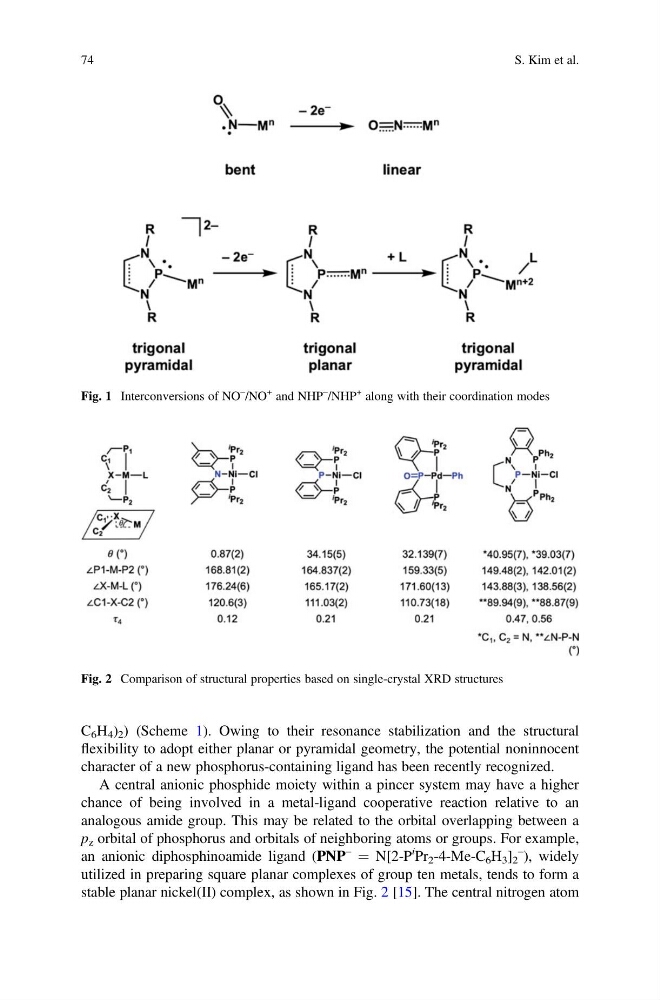
A central anionic phosphide moiety within a pincer system may have a higher
chance of being involved in a metal-ligand cooperative reaction relative to an
analogous amide group. This may be related to the orbital overlapping between a
p z orbital of phosphorus and orbitals of neighboring atoms or groups. For example,
an anionic diphosphinoamide ligand (PNP
–
¼ N[2-P
i Pr 2 -4-Me-C 6 H 3 ] 2
– ), widely
utilized in preparing square planar complexes of group ten metals, tends to form a
stable planar nickel(II) complex, as shown in Fig. 2 [15]. The central nitrogen atom
Fig. 1 Interconversions of NO
–
/NO
+ and NHP
–
/NHP
+ along with their coordination modes
Fig. 2 Comparison of structural properties based on single-crystal XRD structures
74
S. Kim et al.
flexibility to adopt either planar or pyramidal geometry, the potential noninnocent
character of a new phosphorus-containing ligand has been recently recognized.
A central anionic phosphide moiety within a pincer system may have a higher
chance of being involved in a metal-ligand cooperative reaction relative to an
analogous amide group. This may be related to the orbital overlapping between a
p z orbital of phosphorus and orbitals of neighboring atoms or groups. For example,
an anionic diphosphinoamide ligand (PNP
–
¼ N[2-P
i Pr 2 -4-Me-C 6 H 3 ] 2
– ), widely
utilized in preparing square planar complexes of group ten metals, tends to form a
stable planar nickel(II) complex, as shown in Fig. 2 [15]. The central nitrogen atom
Fig. 1 Interconversions of NO
–
/NO
+ and NHP
–
/NHP
+ along with their coordination modes
Fig. 2 Comparison of structural properties based on single-crystal XRD structures
74
S. Kim et al.