

pincer-type ligands based on pyridine, acridine, and phenanthroline scaffolds
[12]. In their system, a noninnocent moiety of ligands is a π-conjugated system
of mostly pyridine and its analogues. There are few phosphorus-containing ligands
revealing MLC.
In this chapter, various metal-ligand cooperative sites embedded in a tridentate
pincer scaffold operating with anionic phosphide ligands and their analogous will be
primarily discussed. Electron-rich anionic phosphide ligands are relatively uncommon, while a wide range of neutral alkyl and aryl phosphine ligands are generally
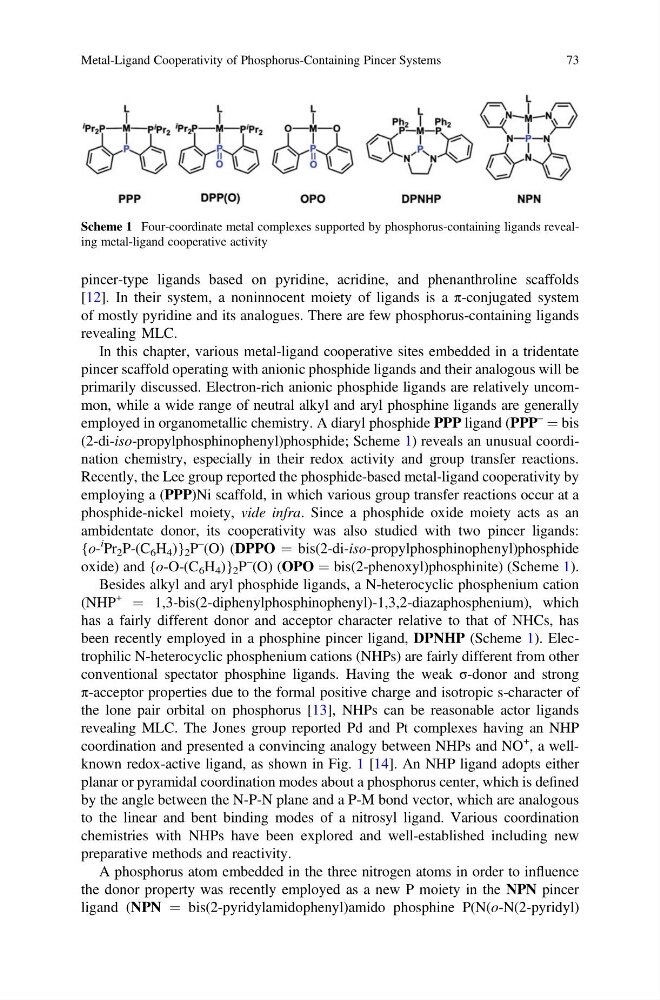
employed in organometallic chemistry. A diaryl phosphide PPP ligand (PPP
–
¼ bis
(2-di-iso-propylphosphinophenyl)phosphide; Scheme 1) reveals an unusual coordination chemistry, especially in their redox activity and group transfer reactions.
Recently, the Lee group reported the phosphide-based metal-ligand cooperativity by
employing a (PPP)Ni scaffold, in which various group transfer reactions occur at a
phosphide-nickel moiety, vide infra. Since a phosphide oxide moiety acts as an
ambidentate donor, its cooperativity was also studied with two pincer ligands:
{oi Pr 2 P-(C 6 H 4 )} 2 P
– (O) (DPPO ¼ bis(2-di-iso-propylphosphinophenyl)phosphide
oxide) and {o-O-(C 6 H 4 )} 2 P
– (O) (OPO ¼ bis(2-phenoxyl)phosphinite) (Scheme 1).
Besides alkyl and aryl phosphide ligands, a N-heterocyclic phosphenium cation
(NHP
+
¼ 1,3-bis(2-diphenylphosphinophenyl)-1,3,2-diazaphosphenium), which
has a fairly different donor and acceptor character relative to that of NHCs, has
been recently employed in a phosphine pincer ligand, DPNHP (Scheme 1). Electrophilic N-heterocyclic phosphenium cations (NHPs) are fairly different from other
conventional spectator phosphine ligands. Having the weak σ-donor and strong
π-acceptor properties due to the formal positive charge and isotropic s-character of
the lone pair orbital on phosphorus [13], NHPs can be reasonable actor ligands
revealing MLC. The Jones group reported Pd and Pt complexes having an NHP
coordination and presented a convincing analogy between NHPs and NO
+
, a wellknown redox-active ligand, as shown in Fig. 1 [14]. An NHP ligand adopts either
planar or pyramidal coordination modes about a phosphorus center, which is defined
by the angle between the N-P-N plane and a P-M bond vector, which are analogous
to the linear and bent binding modes of a nitrosyl ligand. Various coordination
chemistries with NHPs have been explored and well-established including new
preparative methods and reactivity.
A phosphorus atom embedded in the three nitrogen atoms in order to influence
the donor property was recently employed as a new P moiety in the NPN pincer
ligand (NPN ¼ bis(2-pyridylamidophenyl)amido phosphine P(N(o-N(2-pyridyl)
Scheme 1 Four-coordinate metal complexes supported by phosphorus-containing ligands revealing metal-ligand cooperative activity
Metal-Ligand Cooperativity of Phosphorus-Containing Pincer Systems
73
[12]. In their system, a noninnocent moiety of ligands is a π-conjugated system
of mostly pyridine and its analogues. There are few phosphorus-containing ligands
revealing MLC.
In this chapter, various metal-ligand cooperative sites embedded in a tridentate
pincer scaffold operating with anionic phosphide ligands and their analogous will be
primarily discussed. Electron-rich anionic phosphide ligands are relatively uncommon, while a wide range of neutral alkyl and aryl phosphine ligands are generally
employed in organometallic chemistry. A diaryl phosphide PPP ligand (PPP
–
¼ bis
(2-di-iso-propylphosphinophenyl)phosphide; Scheme 1) reveals an unusual coordination chemistry, especially in their redox activity and group transfer reactions.
Recently, the Lee group reported the phosphide-based metal-ligand cooperativity by
employing a (PPP)Ni scaffold, in which various group transfer reactions occur at a
phosphide-nickel moiety, vide infra. Since a phosphide oxide moiety acts as an
ambidentate donor, its cooperativity was also studied with two pincer ligands:
{oi Pr 2 P-(C 6 H 4 )} 2 P
– (O) (DPPO ¼ bis(2-di-iso-propylphosphinophenyl)phosphide
oxide) and {o-O-(C 6 H 4 )} 2 P
– (O) (OPO ¼ bis(2-phenoxyl)phosphinite) (Scheme 1).
Besides alkyl and aryl phosphide ligands, a N-heterocyclic phosphenium cation
(NHP
+
¼ 1,3-bis(2-diphenylphosphinophenyl)-1,3,2-diazaphosphenium), which
has a fairly different donor and acceptor character relative to that of NHCs, has
been recently employed in a phosphine pincer ligand, DPNHP (Scheme 1). Electrophilic N-heterocyclic phosphenium cations (NHPs) are fairly different from other
conventional spectator phosphine ligands. Having the weak σ-donor and strong
π-acceptor properties due to the formal positive charge and isotropic s-character of
the lone pair orbital on phosphorus [13], NHPs can be reasonable actor ligands
revealing MLC. The Jones group reported Pd and Pt complexes having an NHP
coordination and presented a convincing analogy between NHPs and NO
+
, a wellknown redox-active ligand, as shown in Fig. 1 [14]. An NHP ligand adopts either
planar or pyramidal coordination modes about a phosphorus center, which is defined
by the angle between the N-P-N plane and a P-M bond vector, which are analogous
to the linear and bent binding modes of a nitrosyl ligand. Various coordination
chemistries with NHPs have been explored and well-established including new
preparative methods and reactivity.
A phosphorus atom embedded in the three nitrogen atoms in order to influence
the donor property was recently employed as a new P moiety in the NPN pincer
ligand (NPN ¼ bis(2-pyridylamidophenyl)amido phosphine P(N(o-N(2-pyridyl)
Scheme 1 Four-coordinate metal complexes supported by phosphorus-containing ligands revealing metal-ligand cooperative activity
Metal-Ligand Cooperativity of Phosphorus-Containing Pincer Systems
73