

3.4 Imine Side-On Coordination: Synthesis and Metal-Ligand
Cooperative Reactivity
Imines can also act as π-acceptor ligands when coordinating side-on to a transition
metal center. As for ketones, the π(C, N) and the π*(C, N) orbitals of an imine are
generally lower in energy compared to olefins, making a side-bound imine motif a
stronger π-acceptor and a weaker donor ligand. Furthermore, the lone pair on the
nitrogen atom in the imine motif represents an extra position for additional reactivity
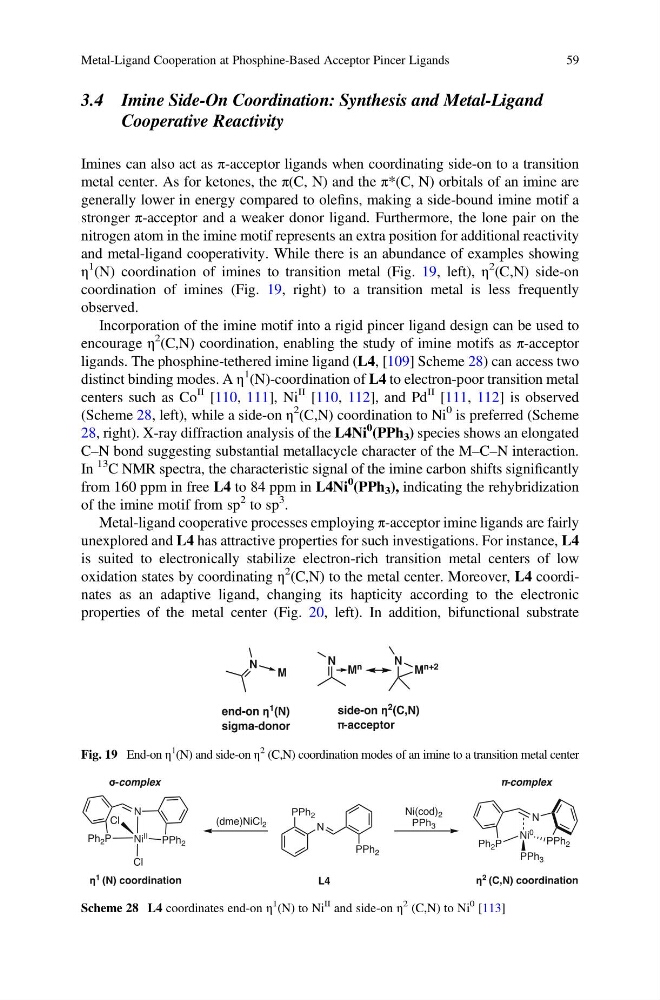
and metal-ligand cooperativity. While there is an abundance of examples showing
η
1 (N) coordination of imines to transition metal (Fig. 19, left), η
2 (C,N) side-on
coordination of imines (Fig. 19, right) to a transition metal is less frequently
observed.
Incorporation of the imine motif into a rigid pincer ligand design can be used to
encourage η
2 (C,N) coordination, enabling the study of imine motifs as π-acceptor
ligands. The phosphine-tethered imine ligand (L4, [109] Scheme 28) can access two
distinct binding modes. A η
1 (N)-coordination of L4 to electron-poor transition metal
centers such as Co
II [110, 111], Ni
II [110, 112], and Pd
II [111, 112] is observed
(Scheme 28, left), while a side-on η
2 (C,N) coordination to Ni
0 is preferred (Scheme
28, right). X-ray diffraction analysis of the L4Ni
0 (PPh 3 ) species shows an elongated
C–N bond suggesting substantial metallacycle character of the M–C–N interaction.
In
13 C NMR spectra, the characteristic signal of the imine carbon shifts significantly
from 160 ppm in free L4 to 84 ppm in L4Ni
0 (PPh 3 ), indicating the rehybridization
of the imine motif from sp
2 to sp
3 .
Metal-ligand cooperative processes employing π-acceptor imine ligands are fairly
unexplored and L4 has attractive properties for such investigations. For instance, L4
is suited to electronically stabilize electron-rich transition metal centers of low
oxidation states by coordinating η
2 (C,N) to the metal center. Moreover, L4 coordinates as an adaptive ligand, changing its hapticity according to the electronic
properties of the metal center (Fig. 20, left). In addition, bifunctional substrate
Fig. 19 End-on η
1
(N) and side-on η
2 (C,N) coordination modes of an imine to a transition metal center
Scheme 28 L4 coordinates end-on η
1
(N) to Ni
II and side-on η
2 (C,N) to Ni
0 [113]
Metal-Ligand Cooperation at Phosphine-Based Acceptor Pincer Ligands
59
Cooperative Reactivity
Imines can also act as π-acceptor ligands when coordinating side-on to a transition
metal center. As for ketones, the π(C, N) and the π*(C, N) orbitals of an imine are
generally lower in energy compared to olefins, making a side-bound imine motif a
stronger π-acceptor and a weaker donor ligand. Furthermore, the lone pair on the
nitrogen atom in the imine motif represents an extra position for additional reactivity
and metal-ligand cooperativity. While there is an abundance of examples showing
η
1 (N) coordination of imines to transition metal (Fig. 19, left), η
2 (C,N) side-on
coordination of imines (Fig. 19, right) to a transition metal is less frequently
observed.
Incorporation of the imine motif into a rigid pincer ligand design can be used to
encourage η
2 (C,N) coordination, enabling the study of imine motifs as π-acceptor
ligands. The phosphine-tethered imine ligand (L4, [109] Scheme 28) can access two
distinct binding modes. A η
1 (N)-coordination of L4 to electron-poor transition metal
centers such as Co
II [110, 111], Ni
II [110, 112], and Pd
II [111, 112] is observed
(Scheme 28, left), while a side-on η
2 (C,N) coordination to Ni
0 is preferred (Scheme
28, right). X-ray diffraction analysis of the L4Ni
0 (PPh 3 ) species shows an elongated
C–N bond suggesting substantial metallacycle character of the M–C–N interaction.
In
13 C NMR spectra, the characteristic signal of the imine carbon shifts significantly
from 160 ppm in free L4 to 84 ppm in L4Ni
0 (PPh 3 ), indicating the rehybridization
of the imine motif from sp
2 to sp
3 .
Metal-ligand cooperative processes employing π-acceptor imine ligands are fairly
unexplored and L4 has attractive properties for such investigations. For instance, L4
is suited to electronically stabilize electron-rich transition metal centers of low
oxidation states by coordinating η
2 (C,N) to the metal center. Moreover, L4 coordinates as an adaptive ligand, changing its hapticity according to the electronic
properties of the metal center (Fig. 20, left). In addition, bifunctional substrate
Fig. 19 End-on η
1
(N) and side-on η
2 (C,N) coordination modes of an imine to a transition metal center
Scheme 28 L4 coordinates end-on η
1
(N) to Ni
II and side-on η
2 (C,N) to Ni
0 [113]
Metal-Ligand Cooperation at Phosphine-Based Acceptor Pincer Ligands
59