

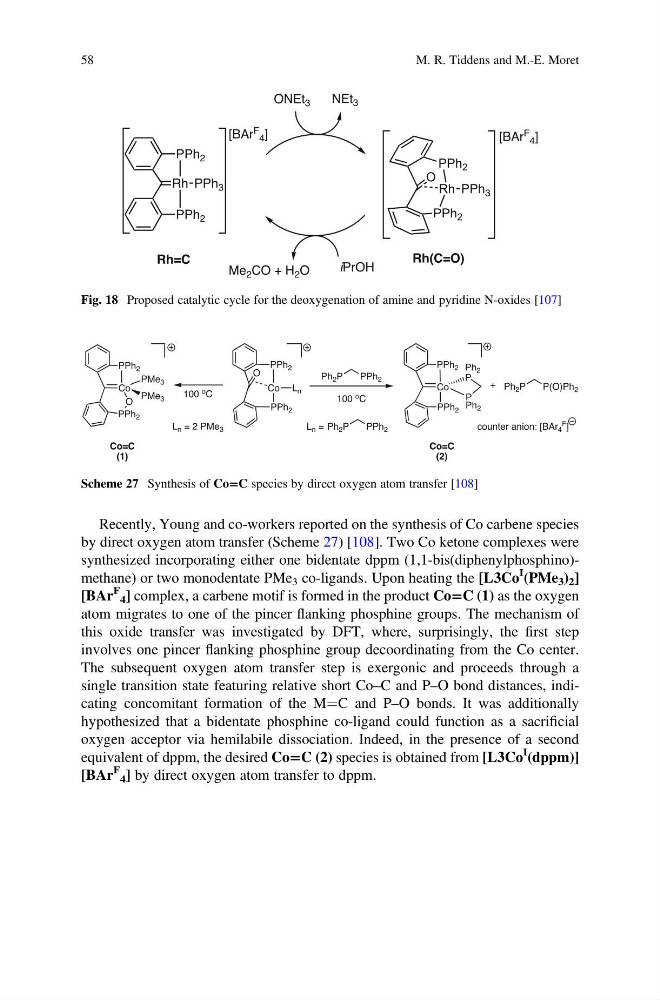
Recently, Young and co-workers reported on the synthesis of Co carbene species
by direct oxygen atom transfer (Scheme 27) [108]. Two Co ketone complexes were
synthesized incorporating either one bidentate dppm (1,1-bis(diphenylphosphino)methane) or two monodentate PMe 3 co-ligands. Upon heating the [L3Co
I (PMe 3 ) 2 ]
[BAr
F
4 ] complex, a carbene motif is formed in the product Co=C (1) as the oxygen
atom migrates to one of the pincer flanking phosphine groups. The mechanism of
this oxide transfer was investigated by DFT, where, surprisingly, the first step
involves one pincer flanking phosphine group decoordinating from the Co center.
The subsequent oxygen atom transfer step is exergonic and proceeds through a
single transition state featuring relative short Co–C and P–O bond distances, indicating concomitant formation of the M¼C and P–O bonds. It was additionally
hypothesized that a bidentate phosphine co-ligand could function as a sacrificial
oxygen acceptor via hemilabile dissociation. Indeed, in the presence of a second
equivalent of dppm, the desired Co=C (2) species is obtained from [L3Co
I (dppm)]
[BAr
F
4 ] by direct oxygen atom transfer to dppm.
Scheme 27 Synthesis of Co=C species by direct oxygen atom transfer [108]
Fig. 18 Proposed catalytic cycle for the deoxygenation of amine and pyridine N-oxides [107]
58
M. R. Tiddens and M.-E. Moret
by direct oxygen atom transfer (Scheme 27) [108]. Two Co ketone complexes were
synthesized incorporating either one bidentate dppm (1,1-bis(diphenylphosphino)methane) or two monodentate PMe 3 co-ligands. Upon heating the [L3Co
I (PMe 3 ) 2 ]
[BAr
F
4 ] complex, a carbene motif is formed in the product Co=C (1) as the oxygen
atom migrates to one of the pincer flanking phosphine groups. The mechanism of
this oxide transfer was investigated by DFT, where, surprisingly, the first step
involves one pincer flanking phosphine group decoordinating from the Co center.
The subsequent oxygen atom transfer step is exergonic and proceeds through a
single transition state featuring relative short Co–C and P–O bond distances, indicating concomitant formation of the M¼C and P–O bonds. It was additionally
hypothesized that a bidentate phosphine co-ligand could function as a sacrificial
oxygen acceptor via hemilabile dissociation. Indeed, in the presence of a second
equivalent of dppm, the desired Co=C (2) species is obtained from [L3Co
I (dppm)]
[BAr
F
4 ] by direct oxygen atom transfer to dppm.
Scheme 27 Synthesis of Co=C species by direct oxygen atom transfer [108]
Fig. 18 Proposed catalytic cycle for the deoxygenation of amine and pyridine N-oxides [107]
58
M. R. Tiddens and M.-E. Moret