

Ir-(DH) is mediated by the kinetic cis isomer [105], which was proposed to proceed
via a reversible β-hydride insertion into the ketone bond followed by activation of a
second hydrogen molecule by the resulting hydroxylalkyl/hydride compound
Ir(H)-OH. At high temperatures, the α-hydroxyl group in Ir(H)-OH is thought to
migrate to the Ir center forming Ir(OH)=C [105, 106]. A high-energy barrier is
expected for this step, which offers an explanation for the high reaction temperature
(>100
C) required for the H 2 O elimination process. The subsequent reductive
elimination of H 2 O from Ir(OH)=C occurs rapidly.
The cooperative manner in which the ketone motif operates in these examples of
oxygenation and (reductive) deoxygenation demonstrates how π-acceptors can
diversify the reactivity pathways of a transition metal complex. The stoichiometric
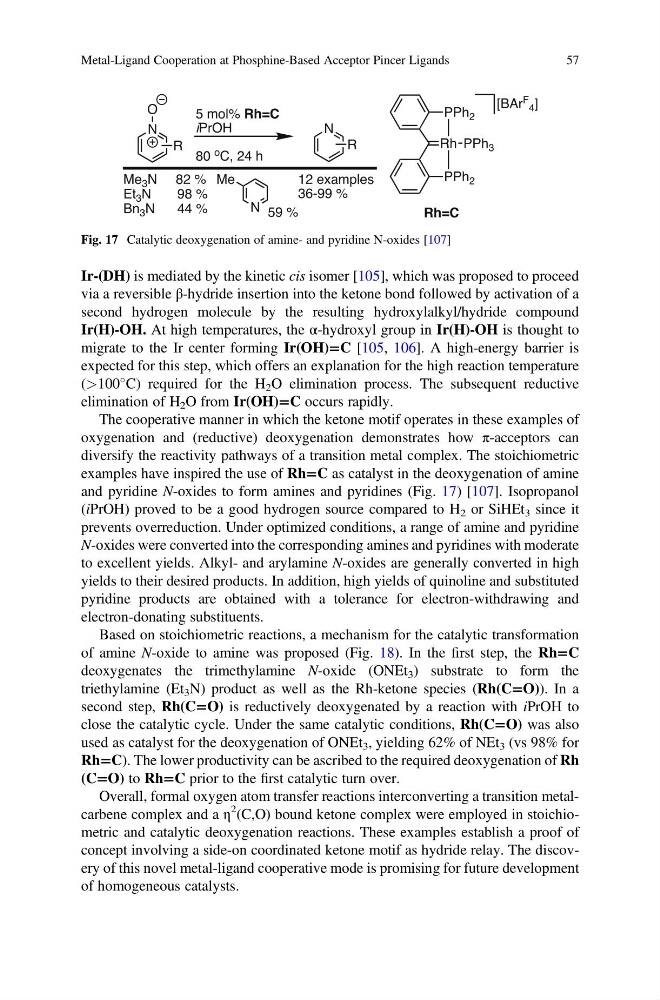
examples have inspired the use of Rh=C as catalyst in the deoxygenation of amine
and pyridine N-oxides to form amines and pyridines (Fig. 17) [107]. Isopropanol
(iPrOH) proved to be a good hydrogen source compared to H 2 or SiHEt 3 since it
prevents overreduction. Under optimized conditions, a range of amine and pyridine
N-oxides were converted into the corresponding amines and pyridines with moderate
to excellent yields. Alkyl- and arylamine N-oxides are generally converted in high
yields to their desired products. In addition, high yields of quinoline and substituted
pyridine products are obtained with a tolerance for electron-withdrawing and
electron-donating substituents.
Based on stoichiometric reactions, a mechanism for the catalytic transformation
of amine N-oxide to amine was proposed (Fig. 18). In the first step, the Rh=C
deoxygenates the trimethylamine N-oxide (ONEt 3 ) substrate to form the
triethylamine (Et 3 N) product as well as the Rh-ketone species (Rh(C=O)). In a
second step, Rh(C=O) is reductively deoxygenated by a reaction with iPrOH to
close the catalytic cycle. Under the same catalytic conditions, Rh(C=O) was also
used as catalyst for the deoxygenation of ONEt 3 , yielding 62% of NEt 3 (vs 98% for
Rh=C). The lower productivity can be ascribed to the required deoxygenation of Rh
(C=O) to Rh=C prior to the first catalytic turn over.
Overall, formal oxygen atom transfer reactions interconverting a transition metalcarbene complex and a η
2 (C,O) bound ketone complex were employed in stoichiometric and catalytic deoxygenation reactions. These examples establish a proof of
concept involving a side-on coordinated ketone motif as hydride relay. The discovery of this novel metal-ligand cooperative mode is promising for future development
of homogeneous catalysts.
Fig. 17 Catalytic deoxygenation of amine- and pyridine N-oxides [107]
Metal-Ligand Cooperation at Phosphine-Based Acceptor Pincer Ligands
57
via a reversible β-hydride insertion into the ketone bond followed by activation of a
second hydrogen molecule by the resulting hydroxylalkyl/hydride compound
Ir(H)-OH. At high temperatures, the α-hydroxyl group in Ir(H)-OH is thought to
migrate to the Ir center forming Ir(OH)=C [105, 106]. A high-energy barrier is
expected for this step, which offers an explanation for the high reaction temperature
(>100
C) required for the H 2 O elimination process. The subsequent reductive
elimination of H 2 O from Ir(OH)=C occurs rapidly.
The cooperative manner in which the ketone motif operates in these examples of
oxygenation and (reductive) deoxygenation demonstrates how π-acceptors can
diversify the reactivity pathways of a transition metal complex. The stoichiometric
examples have inspired the use of Rh=C as catalyst in the deoxygenation of amine
and pyridine N-oxides to form amines and pyridines (Fig. 17) [107]. Isopropanol
(iPrOH) proved to be a good hydrogen source compared to H 2 or SiHEt 3 since it
prevents overreduction. Under optimized conditions, a range of amine and pyridine
N-oxides were converted into the corresponding amines and pyridines with moderate
to excellent yields. Alkyl- and arylamine N-oxides are generally converted in high
yields to their desired products. In addition, high yields of quinoline and substituted
pyridine products are obtained with a tolerance for electron-withdrawing and
electron-donating substituents.
Based on stoichiometric reactions, a mechanism for the catalytic transformation
of amine N-oxide to amine was proposed (Fig. 18). In the first step, the Rh=C
deoxygenates the trimethylamine N-oxide (ONEt 3 ) substrate to form the
triethylamine (Et 3 N) product as well as the Rh-ketone species (Rh(C=O)). In a
second step, Rh(C=O) is reductively deoxygenated by a reaction with iPrOH to
close the catalytic cycle. Under the same catalytic conditions, Rh(C=O) was also
used as catalyst for the deoxygenation of ONEt 3 , yielding 62% of NEt 3 (vs 98% for
Rh=C). The lower productivity can be ascribed to the required deoxygenation of Rh
(C=O) to Rh=C prior to the first catalytic turn over.
Overall, formal oxygen atom transfer reactions interconverting a transition metalcarbene complex and a η
2 (C,O) bound ketone complex were employed in stoichiometric and catalytic deoxygenation reactions. These examples establish a proof of
concept involving a side-on coordinated ketone motif as hydride relay. The discovery of this novel metal-ligand cooperative mode is promising for future development
of homogeneous catalysts.
Fig. 17 Catalytic deoxygenation of amine- and pyridine N-oxides [107]
Metal-Ligand Cooperation at Phosphine-Based Acceptor Pincer Ligands
57