

intermediate in this reaction. More generally, α-hydroxylalkyl metal-hydride species
are proposed as intermediate in the reductive deoxygenation of L3 to form the
corresponding carbene species.
A possible mechanism for H 2 O elimination as last step in the overall reductive
deoxygenation reaction has been suggested by Piers and co-workers. For this study,
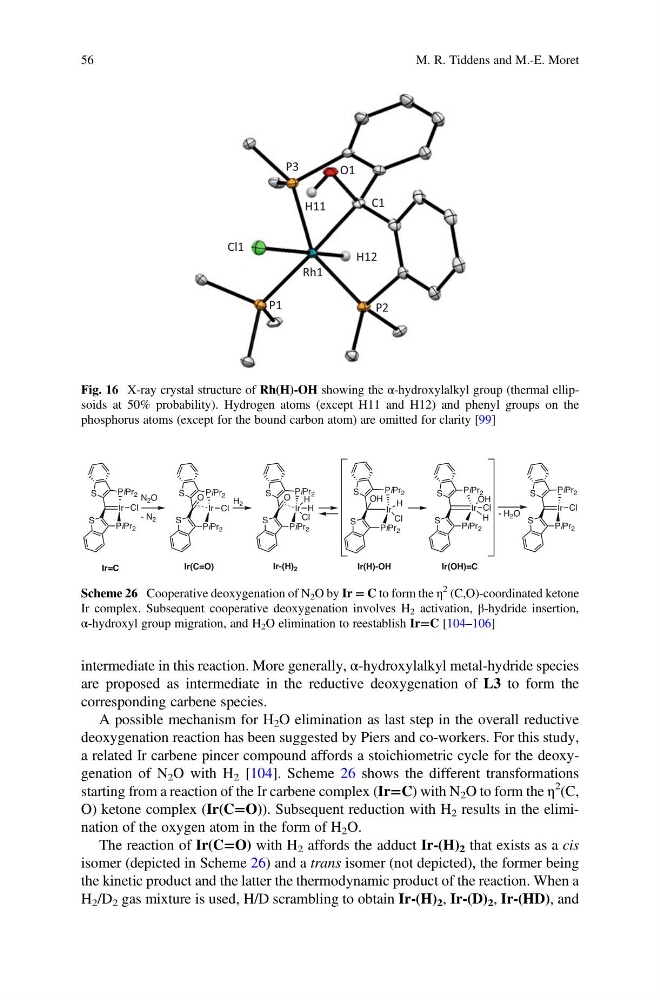
a related Ir carbene pincer compound affords a stoichiometric cycle for the deoxygenation of N 2 O with H 2 [104]. Scheme 26 shows the different transformations
starting from a reaction of the Ir carbene complex (Ir=C) with N 2 O to form the η
2 (C,
O) ketone complex (Ir(C=O)). Subsequent reduction with H 2 results in the elimination of the oxygen atom in the form of H 2 O.
The reaction of Ir(C=O) with H 2 affords the adduct Ir-(H) 2 that exists as a cis
isomer (depicted in Scheme 26) and a trans isomer (not depicted), the former being
the kinetic product and the latter the thermodynamic product of the reaction. When a
H 2 /D 2 gas mixture is used, H/D scrambling to obtain Ir-(H) 2 , Ir-(D) 2 , Ir-(HD), and
Rh1
Cl1
O1
P1
P2
C1
P3
H11
H12
Fig. 16 X-ray crystal structure of Rh(H)-OH showing the α-hydroxylalkyl group (thermal ellipsoids at 50% probability). Hydrogen atoms (except H11 and H12) and phenyl groups on the
phosphorus atoms (except for the bound carbon atom) are omitted for clarity [99]
Scheme 26 Cooperative deoxygenation of N 2 O by Ir = C to form the η
2 (C,O)-coordinated ketone
Ir complex. Subsequent cooperative deoxygenation involves H 2 activation, β-hydride insertion,
α-hydroxyl group migration, and H 2 O elimination to reestablish Ir=C [104–106]
56
M. R. Tiddens and M.-E. Moret
are proposed as intermediate in the reductive deoxygenation of L3 to form the
corresponding carbene species.
A possible mechanism for H 2 O elimination as last step in the overall reductive
deoxygenation reaction has been suggested by Piers and co-workers. For this study,
a related Ir carbene pincer compound affords a stoichiometric cycle for the deoxygenation of N 2 O with H 2 [104]. Scheme 26 shows the different transformations
starting from a reaction of the Ir carbene complex (Ir=C) with N 2 O to form the η
2 (C,
O) ketone complex (Ir(C=O)). Subsequent reduction with H 2 results in the elimination of the oxygen atom in the form of H 2 O.
The reaction of Ir(C=O) with H 2 affords the adduct Ir-(H) 2 that exists as a cis
isomer (depicted in Scheme 26) and a trans isomer (not depicted), the former being
the kinetic product and the latter the thermodynamic product of the reaction. When a
H 2 /D 2 gas mixture is used, H/D scrambling to obtain Ir-(H) 2 , Ir-(D) 2 , Ir-(HD), and
Rh1
Cl1
O1
P1
P2
C1
P3
H11
H12
Fig. 16 X-ray crystal structure of Rh(H)-OH showing the α-hydroxylalkyl group (thermal ellipsoids at 50% probability). Hydrogen atoms (except H11 and H12) and phenyl groups on the
phosphorus atoms (except for the bound carbon atom) are omitted for clarity [99]
Scheme 26 Cooperative deoxygenation of N 2 O by Ir = C to form the η
2 (C,O)-coordinated ketone
Ir complex. Subsequent cooperative deoxygenation involves H 2 activation, β-hydride insertion,
α-hydroxyl group migration, and H 2 O elimination to reestablish Ir=C [104–106]
56
M. R. Tiddens and M.-E. Moret