

proposed for this transformation based on mechanistic studies performed on the
corresponding Ir-[102] and Rh-systems [99, 103].
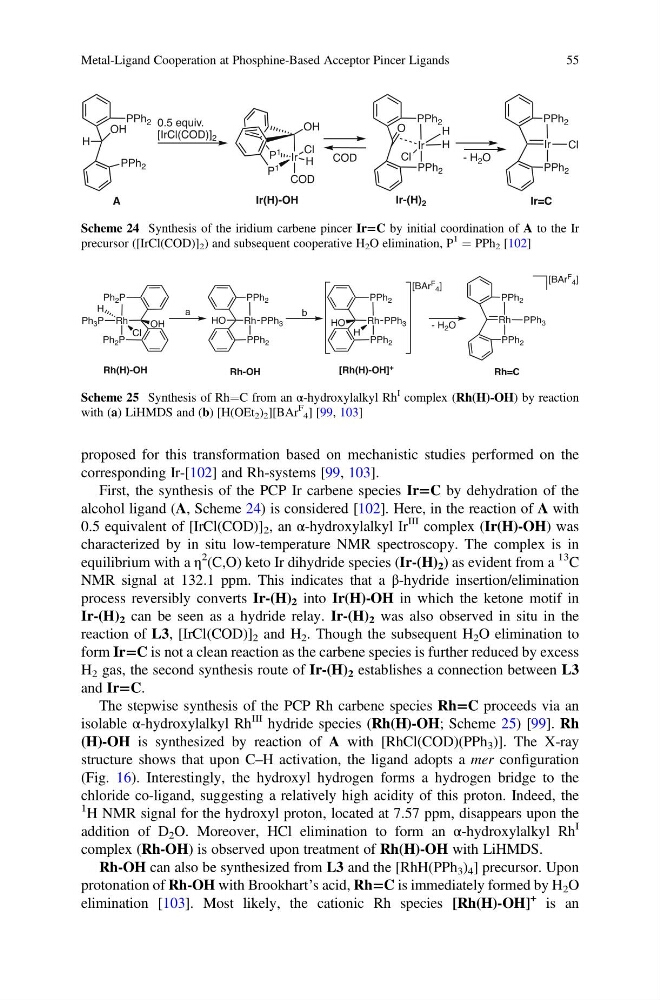
First, the synthesis of the PCP Ir carbene species Ir=C by dehydration of the
alcohol ligand (A, Scheme 24) is considered [102]. Here, in the reaction of A with
0.5 equivalent of [IrCl(COD)] 2 , an α-hydroxylalkyl Ir
III complex (Ir(H)-OH) was
characterized by in situ low-temperature NMR spectroscopy. The complex is in
equilibrium with a η
2 (C,O) keto Ir dihydride species (Ir-(H) 2 ) as evident from a
13 C
NMR signal at 132.1 ppm. This indicates that a β-hydride insertion/elimination
process reversibly converts Ir-(H) 2 into Ir(H)-OH in which the ketone motif in
Ir-(H) 2 can be seen as a hydride relay. Ir-(H) 2 was also observed in situ in the
reaction of L3, [IrCl(COD)] 2 and H 2 . Though the subsequent H 2 O elimination to
form Ir=C is not a clean reaction as the carbene species is further reduced by excess
H 2 gas, the second synthesis route of Ir-(H) 2 establishes a connection between L3
and Ir=C.
The stepwise synthesis of the PCP Rh carbene species Rh=C proceeds via an
isolable α-hydroxylalkyl Rh
III hydride species (Rh(H)-OH; Scheme 25) [99]. Rh
(H)-OH is synthesized by reaction of A with [RhCl(COD)(PPh 3 )]. The X-ray
structure shows that upon C–H activation, the ligand adopts a mer configuration
(Fig. 16). Interestingly, the hydroxyl hydrogen forms a hydrogen bridge to the
chloride co-ligand, suggesting a relatively high acidity of this proton. Indeed, the
1 H NMR signal for the hydroxyl proton, located at 7.57 ppm, disappears upon the
addition of D 2 O. Moreover, HCl elimination to form an α-hydroxylalkyl Rh
I
complex (Rh-OH) is observed upon treatment of Rh(H)-OH with LiHMDS.
Rh-OH can also be synthesized from L3 and the [RhH(PPh 3 ) 4 ] precursor. Upon
protonation of Rh-OH with Brookhart’s acid, Rh=C is immediately formed by H 2 O
elimination [103]. Most likely, the cationic Rh species [Rh(H)-OH]
+ is an
Scheme 24 Synthesis of the iridium carbene pincer Ir=C by initial coordination of A to the Ir
precursor ([IrCl(COD)] 2 ) and subsequent cooperative H 2 O elimination, P
1 ¼ PPh 2 [102]
Scheme 25 Synthesis of Rh¼C from an α-hydroxylalkyl Rh
I complex (Rh(H)-OH) by reaction
with (a) LiHMDS and (b) [H(OEt 2 ) 2 ][BAr
F
4 ] [99, 103]
Metal-Ligand Cooperation at Phosphine-Based Acceptor Pincer Ligands
55
corresponding Ir-[102] and Rh-systems [99, 103].
First, the synthesis of the PCP Ir carbene species Ir=C by dehydration of the
alcohol ligand (A, Scheme 24) is considered [102]. Here, in the reaction of A with
0.5 equivalent of [IrCl(COD)] 2 , an α-hydroxylalkyl Ir
III complex (Ir(H)-OH) was
characterized by in situ low-temperature NMR spectroscopy. The complex is in
equilibrium with a η
2 (C,O) keto Ir dihydride species (Ir-(H) 2 ) as evident from a
13 C
NMR signal at 132.1 ppm. This indicates that a β-hydride insertion/elimination
process reversibly converts Ir-(H) 2 into Ir(H)-OH in which the ketone motif in
Ir-(H) 2 can be seen as a hydride relay. Ir-(H) 2 was also observed in situ in the
reaction of L3, [IrCl(COD)] 2 and H 2 . Though the subsequent H 2 O elimination to
form Ir=C is not a clean reaction as the carbene species is further reduced by excess
H 2 gas, the second synthesis route of Ir-(H) 2 establishes a connection between L3
and Ir=C.
The stepwise synthesis of the PCP Rh carbene species Rh=C proceeds via an
isolable α-hydroxylalkyl Rh
III hydride species (Rh(H)-OH; Scheme 25) [99]. Rh
(H)-OH is synthesized by reaction of A with [RhCl(COD)(PPh 3 )]. The X-ray
structure shows that upon C–H activation, the ligand adopts a mer configuration
(Fig. 16). Interestingly, the hydroxyl hydrogen forms a hydrogen bridge to the
chloride co-ligand, suggesting a relatively high acidity of this proton. Indeed, the
1 H NMR signal for the hydroxyl proton, located at 7.57 ppm, disappears upon the
addition of D 2 O. Moreover, HCl elimination to form an α-hydroxylalkyl Rh
I
complex (Rh-OH) is observed upon treatment of Rh(H)-OH with LiHMDS.
Rh-OH can also be synthesized from L3 and the [RhH(PPh 3 ) 4 ] precursor. Upon
protonation of Rh-OH with Brookhart’s acid, Rh=C is immediately formed by H 2 O
elimination [103]. Most likely, the cationic Rh species [Rh(H)-OH]
+ is an
Scheme 24 Synthesis of the iridium carbene pincer Ir=C by initial coordination of A to the Ir
precursor ([IrCl(COD)] 2 ) and subsequent cooperative H 2 O elimination, P
1 ¼ PPh 2 [102]
Scheme 25 Synthesis of Rh¼C from an α-hydroxylalkyl Rh
I complex (Rh(H)-OH) by reaction
with (a) LiHMDS and (b) [H(OEt 2 ) 2 ][BAr
F
4 ] [99, 103]
Metal-Ligand Cooperation at Phosphine-Based Acceptor Pincer Ligands
55