

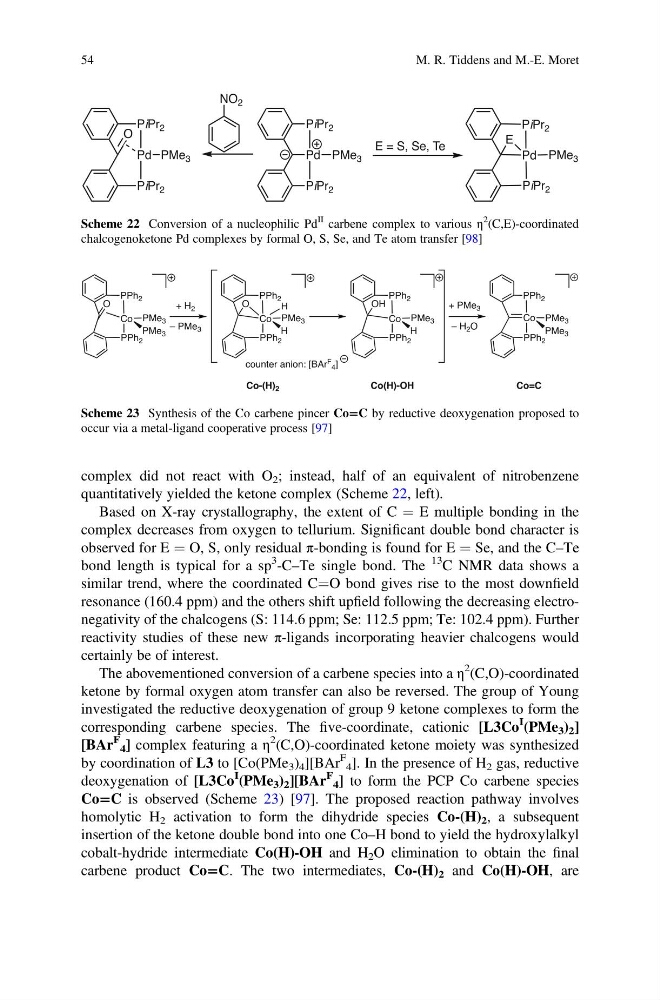
complex did not react with O 2 ; instead, half of an equivalent of nitrobenzene
quantitatively yielded the ketone complex (Scheme 22, left).
Based on X-ray crystallography, the extent of C ¼ E multiple bonding in the
complex decreases from oxygen to tellurium. Significant double bond character is
observed for E ¼ O, S, only residual π-bonding is found for E ¼ Se, and the C–Te
bond length is typical for a sp
3 -C–Te single bond. The
13 C NMR data shows a
similar trend, where the coordinated C¼O bond gives rise to the most downfield
resonance (160.4 ppm) and the others shift upfield following the decreasing electronegativity of the chalcogens (S: 114.6 ppm; Se: 112.5 ppm; Te: 102.4 ppm). Further
reactivity studies of these new π-ligands incorporating heavier chalcogens would
certainly be of interest.
The abovementioned conversion of a carbene species into a η
2 (C,O)-coordinated
ketone by formal oxygen atom transfer can also be reversed. The group of Young
investigated the reductive deoxygenation of group 9 ketone complexes to form the
corresponding carbene species. The five-coordinate, cationic [L3Co
I (PMe 3 ) 2 ]
[BAr
F
4 ] complex featuring a η
2 (C,O)-coordinated ketone moiety was synthesized
by coordination of L3 to [Co(PMe 3 ) 4 ][BAr
F
4 ]. In the presence of H 2 gas, reductive
deoxygenation of [L3Co
I (PMe 3 ) 2 ][BAr
F
4 ] to form the PCP Co carbene species
Co=C is observed (Scheme 23) [97]. The proposed reaction pathway involves
homolytic H 2 activation to form the dihydride species Co-(H) 2 , a subsequent
insertion of the ketone double bond into one Co–H bond to yield the hydroxylalkyl
cobalt-hydride intermediate Co(H)-OH and H 2 O elimination to obtain the final
carbene product Co=C. The two intermediates, Co-(H) 2 and Co(H)-OH, are
Scheme 22 Conversion of a nucleophilic Pd
II carbene complex to various η
2
(C,E)-coordinated
chalcogenoketone Pd complexes by formal O, S, Se, and Te atom transfer [98]
Scheme 23 Synthesis of the Co carbene pincer Co=C by reductive deoxygenation proposed to
occur via a metal-ligand cooperative process [97]
54
M. R. Tiddens and M.-E. Moret
quantitatively yielded the ketone complex (Scheme 22, left).
Based on X-ray crystallography, the extent of C ¼ E multiple bonding in the
complex decreases from oxygen to tellurium. Significant double bond character is
observed for E ¼ O, S, only residual π-bonding is found for E ¼ Se, and the C–Te
bond length is typical for a sp
3 -C–Te single bond. The
13 C NMR data shows a
similar trend, where the coordinated C¼O bond gives rise to the most downfield
resonance (160.4 ppm) and the others shift upfield following the decreasing electronegativity of the chalcogens (S: 114.6 ppm; Se: 112.5 ppm; Te: 102.4 ppm). Further
reactivity studies of these new π-ligands incorporating heavier chalcogens would
certainly be of interest.
The abovementioned conversion of a carbene species into a η
2 (C,O)-coordinated
ketone by formal oxygen atom transfer can also be reversed. The group of Young
investigated the reductive deoxygenation of group 9 ketone complexes to form the
corresponding carbene species. The five-coordinate, cationic [L3Co
I (PMe 3 ) 2 ]
[BAr
F
4 ] complex featuring a η
2 (C,O)-coordinated ketone moiety was synthesized
by coordination of L3 to [Co(PMe 3 ) 4 ][BAr
F
4 ]. In the presence of H 2 gas, reductive
deoxygenation of [L3Co
I (PMe 3 ) 2 ][BAr
F
4 ] to form the PCP Co carbene species
Co=C is observed (Scheme 23) [97]. The proposed reaction pathway involves
homolytic H 2 activation to form the dihydride species Co-(H) 2 , a subsequent
insertion of the ketone double bond into one Co–H bond to yield the hydroxylalkyl
cobalt-hydride intermediate Co(H)-OH and H 2 O elimination to obtain the final
carbene product Co=C. The two intermediates, Co-(H) 2 and Co(H)-OH, are
Scheme 22 Conversion of a nucleophilic Pd
II carbene complex to various η
2
(C,E)-coordinated
chalcogenoketone Pd complexes by formal O, S, Se, and Te atom transfer [98]
Scheme 23 Synthesis of the Co carbene pincer Co=C by reductive deoxygenation proposed to
occur via a metal-ligand cooperative process [97]
54
M. R. Tiddens and M.-E. Moret