

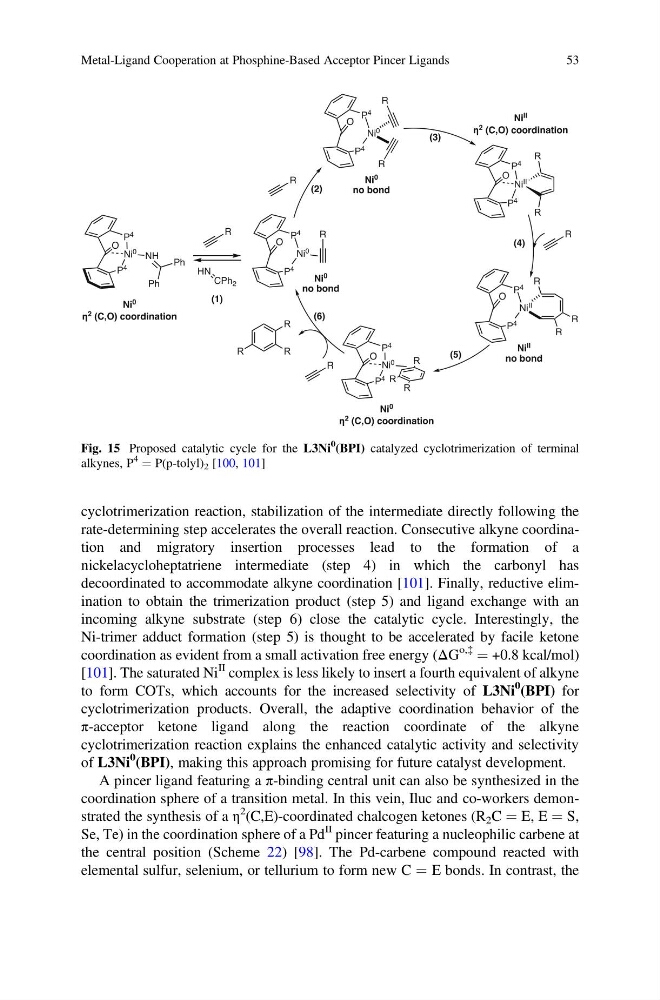
cyclotrimerization reaction, stabilization of the intermediate directly following the
rate-determining step accelerates the overall reaction. Consecutive alkyne coordination and migratory insertion processes lead to the formation of a
nickelacycloheptatriene intermediate (step 4) in which the carbonyl has
decoordinated to accommodate alkyne coordination [101]. Finally, reductive elimination to obtain the trimerization product (step 5) and ligand exchange with an
incoming alkyne substrate (step 6) close the catalytic cycle. Interestingly, the
Ni-trimer adduct formation (step 5) is thought to be accelerated by facile ketone
coordination as evident from a small activation free energy (ΔG
o,{
¼ +0.8 kcal/mol)
[101]. The saturated Ni
II complex is less likely to insert a fourth equivalent of alkyne
to form COTs, which accounts for the increased selectivity of L3Ni
0 (BPI) for
cyclotrimerization products. Overall, the adaptive coordination behavior of the
π-acceptor ketone ligand along the reaction coordinate of the alkyne
cyclotrimerization reaction explains the enhanced catalytic activity and selectivity
of L3Ni
0 (BPI), making this approach promising for future catalyst development.
A pincer ligand featuring a π-binding central unit can also be synthesized in the
coordination sphere of a transition metal. In this vein, Iluc and co-workers demonstrated the synthesis of a η
2 (C,E)-coordinated chalcogen ketones (R 2 C ¼ E, E ¼ S,
Se, Te) in the coordination sphere of a Pd
II pincer featuring a nucleophilic carbene at
the central position (Scheme 22) [98]. The Pd-carbene compound reacted with
elemental sulfur, selenium, or tellurium to form new C ¼ E bonds. In contrast, the
Fig. 15 Proposed catalytic cycle for the L3Ni
0
(BPI) catalyzed cyclotrimerization of terminal
alkynes, P
4 ¼ P(p-tolyl) 2 [100, 101]
Metal-Ligand Cooperation at Phosphine-Based Acceptor Pincer Ligands
53
rate-determining step accelerates the overall reaction. Consecutive alkyne coordination and migratory insertion processes lead to the formation of a
nickelacycloheptatriene intermediate (step 4) in which the carbonyl has
decoordinated to accommodate alkyne coordination [101]. Finally, reductive elimination to obtain the trimerization product (step 5) and ligand exchange with an
incoming alkyne substrate (step 6) close the catalytic cycle. Interestingly, the
Ni-trimer adduct formation (step 5) is thought to be accelerated by facile ketone
coordination as evident from a small activation free energy (ΔG
o,{
¼ +0.8 kcal/mol)
[101]. The saturated Ni
II complex is less likely to insert a fourth equivalent of alkyne
to form COTs, which accounts for the increased selectivity of L3Ni
0 (BPI) for
cyclotrimerization products. Overall, the adaptive coordination behavior of the
π-acceptor ketone ligand along the reaction coordinate of the alkyne
cyclotrimerization reaction explains the enhanced catalytic activity and selectivity
of L3Ni
0 (BPI), making this approach promising for future catalyst development.
A pincer ligand featuring a π-binding central unit can also be synthesized in the
coordination sphere of a transition metal. In this vein, Iluc and co-workers demonstrated the synthesis of a η
2 (C,E)-coordinated chalcogen ketones (R 2 C ¼ E, E ¼ S,
Se, Te) in the coordination sphere of a Pd
II pincer featuring a nucleophilic carbene at
the central position (Scheme 22) [98]. The Pd-carbene compound reacted with
elemental sulfur, selenium, or tellurium to form new C ¼ E bonds. In contrast, the
Fig. 15 Proposed catalytic cycle for the L3Ni
0
(BPI) catalyzed cyclotrimerization of terminal
alkynes, P
4 ¼ P(p-tolyl) 2 [100, 101]
Metal-Ligand Cooperation at Phosphine-Based Acceptor Pincer Ligands
53