

carbonyl
13 C NMR signal to 202.7 ppm indicates that the occupied site is readily
freed up to allow alkyne binding (step 1). This ligand exchange results in a Ni
0
alkyne complex, which is also the in situ observed resting state of the catalyst.
Geometry optimization of the bis(acetylene) Ni complex indicates that the ketone
moiety remains decoordinated during the second alkyne uptake (step 2). Remarkably, the oxidative coupling step (step 3) is facilitated by concomitant ketone
η
2 (C,O) coordination, which stabilizes the resulting Ni
II metallacyclopentadiene
intermediate. In the calculated trigonal-bipyramidal structure, the two P-atoms
occupy the axial positions, and elongation of the C–O bond indicates a strong
interaction of the Ni
II center with the η
2 (C,O)-coordinated ketone motif. This is
presumably a result of strong σ-donation by the C-atoms of the
metallacyclopentadiene into the d-orbital that backdonates into the π*(C,O) orbital,
which is parallel to the equatorial plane. As the oxidative coupling step is widely
acknowledged to be the rate-determining step of the strongly exothermic
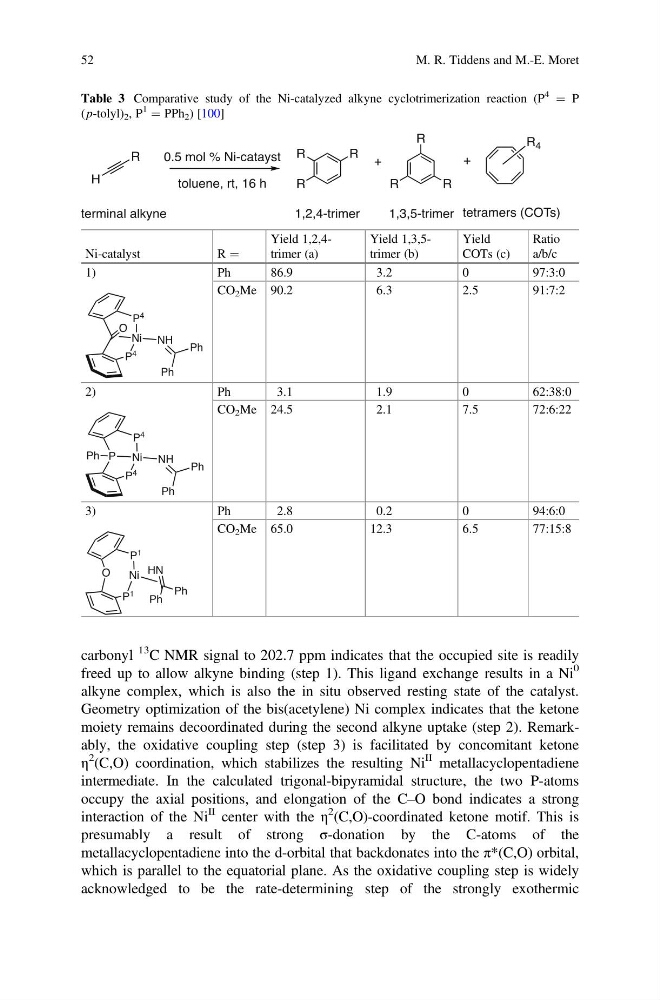
Table 3 Comparative study of the Ni-catalyzed alkyne cyclotrimerization reaction (P
4 ¼ P
(p-tolyl) 2 , P
1 ¼ PPh 2 ) [100]
Ni-catalyst
R ¼
Yield 1,2,4trimer (a)
Yield 1,3,5trimer (b)
Yield
COTs (c)
Ratio
a/b/c
1)
Ph
86.9
3.2
0
97:3:0
CO 2 Me 90.2
6.3
2.5
91:7:2
2)
Ph
3.1
1.9
0
62:38:0
CO 2 Me 24.5
2.1
7.5
72:6:22
3)
Ph
2.8
0.2
0
94:6:0
CO 2 Me 65.0
12.3
6.5
77:15:8
52
M. R. Tiddens and M.-E. Moret
13 C NMR signal to 202.7 ppm indicates that the occupied site is readily
freed up to allow alkyne binding (step 1). This ligand exchange results in a Ni
0
alkyne complex, which is also the in situ observed resting state of the catalyst.
Geometry optimization of the bis(acetylene) Ni complex indicates that the ketone
moiety remains decoordinated during the second alkyne uptake (step 2). Remarkably, the oxidative coupling step (step 3) is facilitated by concomitant ketone
η
2 (C,O) coordination, which stabilizes the resulting Ni
II metallacyclopentadiene
intermediate. In the calculated trigonal-bipyramidal structure, the two P-atoms
occupy the axial positions, and elongation of the C–O bond indicates a strong
interaction of the Ni
II center with the η
2 (C,O)-coordinated ketone motif. This is
presumably a result of strong σ-donation by the C-atoms of the
metallacyclopentadiene into the d-orbital that backdonates into the π*(C,O) orbital,
which is parallel to the equatorial plane. As the oxidative coupling step is widely
acknowledged to be the rate-determining step of the strongly exothermic
Table 3 Comparative study of the Ni-catalyzed alkyne cyclotrimerization reaction (P
4 ¼ P
(p-tolyl) 2 , P
1 ¼ PPh 2 ) [100]
Ni-catalyst
R ¼
Yield 1,2,4trimer (a)
Yield 1,3,5trimer (b)
Yield
COTs (c)
Ratio
a/b/c
1)
Ph
86.9
3.2
0
97:3:0
CO 2 Me 90.2
6.3
2.5
91:7:2
2)
Ph
3.1
1.9
0
62:38:0
CO 2 Me 24.5
2.1
7.5
72:6:22
3)
Ph
2.8
0.2
0
94:6:0
CO 2 Me 65.0
12.3
6.5
77:15:8
52
M. R. Tiddens and M.-E. Moret