

transfer from the Ni center to the ketone, supporting its description as an acceptor
moiety.
This coordination behavior of L3 is rather general for late first-row transition
metal centers. The ketone motif does not coordinate to electron-poor Fe
II , Co
II , and
Ni
II [96], but side-on coordination is detected in electron-rich transition metal
complexes of L3 (Ni
0 [95], Ni
I
, Fe
I
, Co
I [97], Pd
0 [98], Rh
I [99], and Ru
II [94]).
Interestingly, in isostructural Ni
I
, Co
I , and Fe
I complexes of L3, an increase in the
amount of charge transfer upon binding (longer C–O distance) correlates with a
longer M–C and a shorter M–O bond distance [96]. The opposite would be expected
from the increase of π-backdonation into the primarily carbon-centered π* orbital.
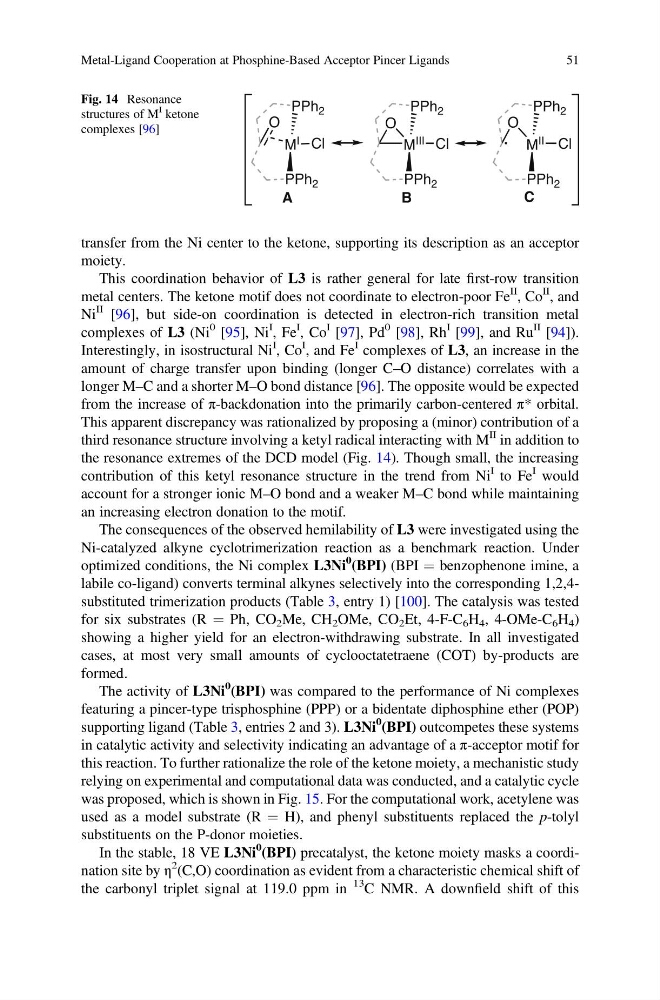
This apparent discrepancy was rationalized by proposing a (minor) contribution of a
third resonance structure involving a ketyl radical interacting with M
II in addition to
the resonance extremes of the DCD model (Fig. 14). Though small, the increasing
contribution of this ketyl resonance structure in the trend from Ni
I to Fe
I would
account for a stronger ionic M–O bond and a weaker M–C bond while maintaining
an increasing electron donation to the motif.
The consequences of the observed hemilability of L3 were investigated using the
Ni-catalyzed alkyne cyclotrimerization reaction as a benchmark reaction. Under
optimized conditions, the Ni complex L3Ni
0 (BPI) (BPI ¼ benzophenone imine, a
labile co-ligand) converts terminal alkynes selectively into the corresponding 1,2,4substituted trimerization products (Table 3, entry 1) [100]. The catalysis was tested
for six substrates (R ¼ Ph, CO 2 Me, CH 2 OMe, CO 2 Et, 4-F-C 6 H 4 , 4-OMe-C 6 H 4 )
showing a higher yield for an electron-withdrawing substrate. In all investigated
cases, at most very small amounts of cyclooctatetraene (COT) by-products are
formed.
The activity of L3Ni
0 (BPI) was compared to the performance of Ni complexes
featuring a pincer-type trisphosphine (PPP) or a bidentate diphosphine ether (POP)
supporting ligand (Table 3, entries 2 and 3). L3Ni
0 (BPI) outcompetes these systems
in catalytic activity and selectivity indicating an advantage of a π-acceptor motif for
this reaction. To further rationalize the role of the ketone moiety, a mechanistic study
relying on experimental and computational data was conducted, and a catalytic cycle
was proposed, which is shown in Fig. 15. For the computational work, acetylene was
used as a model substrate (R ¼ H), and phenyl substituents replaced the p-tolyl
substituents on the P-donor moieties.
In the stable, 18 VE L3Ni
0 (BPI) precatalyst, the ketone moiety masks a coordination site by η
2 (C,O) coordination as evident from a characteristic chemical shift of
the carbonyl triplet signal at 119.0 ppm in
13 C NMR. A downfield shift of this
Fig. 14 Resonance
structures of M
I ketone
complexes [96]
Metal-Ligand Cooperation at Phosphine-Based Acceptor Pincer Ligands
51
moiety.
This coordination behavior of L3 is rather general for late first-row transition
metal centers. The ketone motif does not coordinate to electron-poor Fe
II , Co
II , and
Ni
II [96], but side-on coordination is detected in electron-rich transition metal
complexes of L3 (Ni
0 [95], Ni
I
, Fe
I
, Co
I [97], Pd
0 [98], Rh
I [99], and Ru
II [94]).
Interestingly, in isostructural Ni
I
, Co
I , and Fe
I complexes of L3, an increase in the
amount of charge transfer upon binding (longer C–O distance) correlates with a
longer M–C and a shorter M–O bond distance [96]. The opposite would be expected
from the increase of π-backdonation into the primarily carbon-centered π* orbital.
This apparent discrepancy was rationalized by proposing a (minor) contribution of a
third resonance structure involving a ketyl radical interacting with M
II in addition to
the resonance extremes of the DCD model (Fig. 14). Though small, the increasing
contribution of this ketyl resonance structure in the trend from Ni
I to Fe
I would
account for a stronger ionic M–O bond and a weaker M–C bond while maintaining
an increasing electron donation to the motif.
The consequences of the observed hemilability of L3 were investigated using the
Ni-catalyzed alkyne cyclotrimerization reaction as a benchmark reaction. Under
optimized conditions, the Ni complex L3Ni
0 (BPI) (BPI ¼ benzophenone imine, a
labile co-ligand) converts terminal alkynes selectively into the corresponding 1,2,4substituted trimerization products (Table 3, entry 1) [100]. The catalysis was tested
for six substrates (R ¼ Ph, CO 2 Me, CH 2 OMe, CO 2 Et, 4-F-C 6 H 4 , 4-OMe-C 6 H 4 )
showing a higher yield for an electron-withdrawing substrate. In all investigated
cases, at most very small amounts of cyclooctatetraene (COT) by-products are
formed.
The activity of L3Ni
0 (BPI) was compared to the performance of Ni complexes
featuring a pincer-type trisphosphine (PPP) or a bidentate diphosphine ether (POP)
supporting ligand (Table 3, entries 2 and 3). L3Ni
0 (BPI) outcompetes these systems
in catalytic activity and selectivity indicating an advantage of a π-acceptor motif for
this reaction. To further rationalize the role of the ketone moiety, a mechanistic study
relying on experimental and computational data was conducted, and a catalytic cycle
was proposed, which is shown in Fig. 15. For the computational work, acetylene was
used as a model substrate (R ¼ H), and phenyl substituents replaced the p-tolyl
substituents on the P-donor moieties.
In the stable, 18 VE L3Ni
0 (BPI) precatalyst, the ketone moiety masks a coordination site by η
2 (C,O) coordination as evident from a characteristic chemical shift of
the carbonyl triplet signal at 119.0 ppm in
13 C NMR. A downfield shift of this
Fig. 14 Resonance
structures of M
I ketone
complexes [96]
Metal-Ligand Cooperation at Phosphine-Based Acceptor Pincer Ligands
51