

side-on coordination of the ketone motif was determined by X-ray crystallography,
and this carbonyl coordination to the catalytically active Ru
II species was suggested
to be essential for high yields and selectivity.
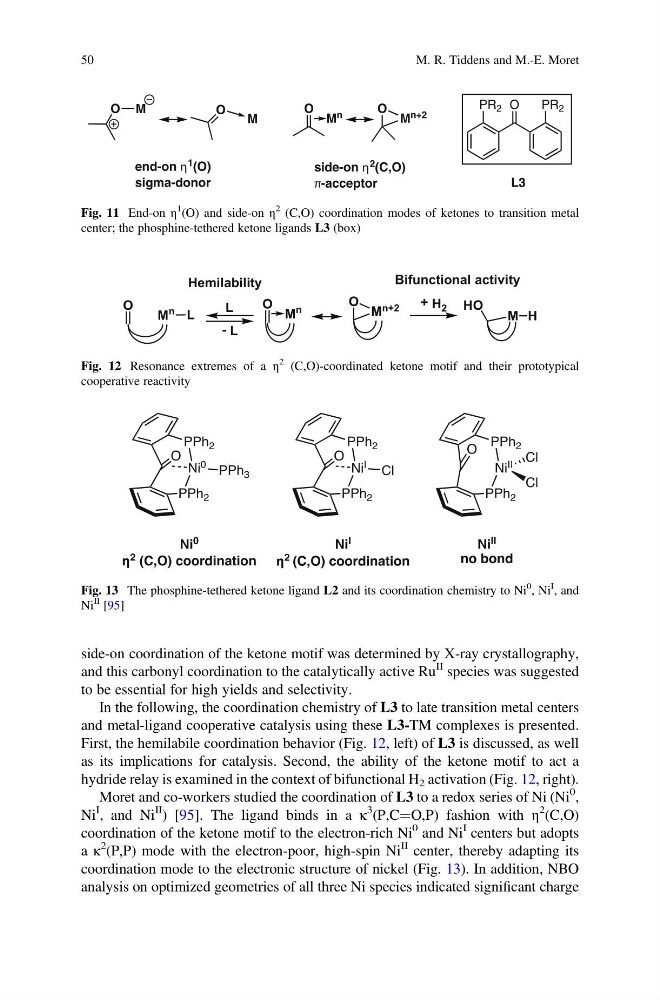
In the following, the coordination chemistry of L3 to late transition metal centers
and metal-ligand cooperative catalysis using these L3-TM complexes is presented.
First, the hemilabile coordination behavior (Fig. 12, left) of L3 is discussed, as well
as its implications for catalysis. Second, the ability of the ketone motif to act a
hydride relay is examined in the context of bifunctional H 2 activation (Fig. 12, right).
Moret and co-workers studied the coordination of L3 to a redox series of Ni (Ni
0 ,
Ni
I , and Ni
II ) [95]. The ligand binds in a κ
3 (P,C¼O,P) fashion with η
2 (C,O)
coordination of the ketone motif to the electron-rich Ni
0 and Ni
I centers but adopts
a κ
2 (P,P) mode with the electron-poor, high-spin Ni
II center, thereby adapting its
coordination mode to the electronic structure of nickel (Fig. 13). In addition, NBO
analysis on optimized geometries of all three Ni species indicated significant charge
PR 2 O
PR 2
L3
M
O
M n
O
M n+2
O
end-on η 1 (O)
sigma-donor
side-on η 2 (C,O)
π-acceptor
M
O
Fig. 11 End-on η
1
(O) and side-on η
2 (C,O) coordination modes of ketones to transition metal
center; the phosphine-tethered ketone ligands L3 (box)
M
n
O
L
L
Bifunctional activity
Hemilability
+ H 2
- L
M
n
O
M n+2
O
M
HO
H
Fig. 12 Resonance extremes of a η
2 (C,O)-coordinated ketone motif and their prototypical
cooperative reactivity
Fig. 13 The phosphine-tethered ketone ligand L2 and its coordination chemistry to Ni
0
, Ni
I
, and
Ni
II [95]
50
M. R. Tiddens and M.-E. Moret
and this carbonyl coordination to the catalytically active Ru
II species was suggested
to be essential for high yields and selectivity.
In the following, the coordination chemistry of L3 to late transition metal centers
and metal-ligand cooperative catalysis using these L3-TM complexes is presented.
First, the hemilabile coordination behavior (Fig. 12, left) of L3 is discussed, as well
as its implications for catalysis. Second, the ability of the ketone motif to act a
hydride relay is examined in the context of bifunctional H 2 activation (Fig. 12, right).
Moret and co-workers studied the coordination of L3 to a redox series of Ni (Ni
0 ,
Ni
I , and Ni
II ) [95]. The ligand binds in a κ
3 (P,C¼O,P) fashion with η
2 (C,O)
coordination of the ketone motif to the electron-rich Ni
0 and Ni
I centers but adopts
a κ
2 (P,P) mode with the electron-poor, high-spin Ni
II center, thereby adapting its
coordination mode to the electronic structure of nickel (Fig. 13). In addition, NBO
analysis on optimized geometries of all three Ni species indicated significant charge
PR 2 O
PR 2
L3
M
O
M n
O
M n+2
O
end-on η 1 (O)
sigma-donor
side-on η 2 (C,O)
π-acceptor
M
O
Fig. 11 End-on η
1
(O) and side-on η
2 (C,O) coordination modes of ketones to transition metal
center; the phosphine-tethered ketone ligands L3 (box)
M
n
O
L
L
Bifunctional activity
Hemilability
+ H 2
- L
M
n
O
M n+2
O
M
HO
H
Fig. 12 Resonance extremes of a η
2 (C,O)-coordinated ketone motif and their prototypical
cooperative reactivity
Fig. 13 The phosphine-tethered ketone ligand L2 and its coordination chemistry to Ni
0
, Ni
I
, and
Ni
II [95]
50
M. R. Tiddens and M.-E. Moret