

elimination/migratory insertion in which the olefin transiently stores a hydride
equivalent. In addition, metal-centered reactivity can be facilitated by (de)coordination of the olefin moiety. Such processes have the potential to become
part of catalytic cycles in further investigations. In the next section, the role of a
π-acceptor ketone motif in metal-ligand cooperative catalysis is highlighted.
3.3 Metal-Ligand Cooperative Catalysis Induced by Side-On
Coordination of a Ketone
Due to the electronegativity of oxygen, both the π(C, O) and the π*(C, O) orbital of a
ketone are lower in energy than those of an olefin. This can be anticipated to render
side-on bound ketones both weaker donors and stronger acceptors than olefins. In
addition, the lone pairs on the oxygen atom in the ketone motif offer an additional
position for reactivity and metal-ligand cooperativity. However, free ketones preferentially coordinate end-on η
1 (O) to most transition metal centers, while side-on
η
2 (C,O) coordination is required for a ketone motif to act as a π-acceptor ligand
(Fig. 11).
Incorporation of the ketone motif into a rigid pincer design featuring o-phenylene
linkers brings the motif into close proximity of the transition metal center in a
pre-oriented geometry favoring side-on binding. The phosphine-tethered ketone
ligand L3 (Fig. 11, box) was first reported by Ding and co-workers, who used its
Ru complexes in the catalytic hydrogenation of ketones [94]. While itself achiral, L3
was proposed to enhance enantioselectivity by mechanically transferring chiral
information from a chiral diamine ligand onto the Ru-bound substrate. In addition,
C3
C1
P1
C2
Pd1
Cl1
P2
C4
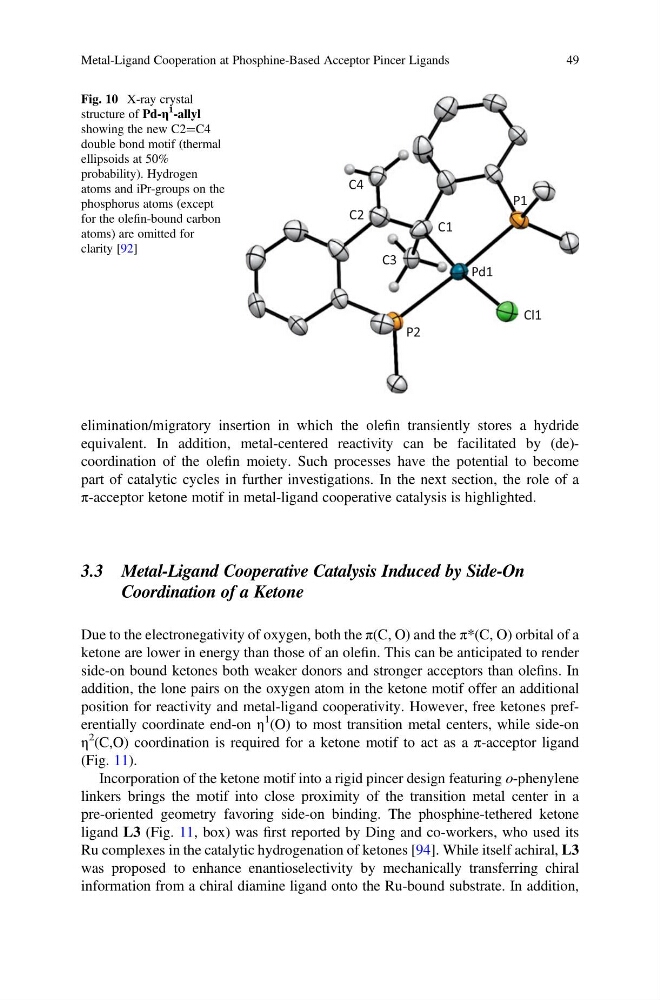
Fig. 10 X-ray crystal
structure of Pd-η
1
-allyl
showing the new C2¼C4
double bond motif (thermal
ellipsoids at 50%
probability). Hydrogen
atoms and iPr-groups on the
phosphorus atoms (except
for the olefin-bound carbon
atoms) are omitted for
clarity [92]
Metal-Ligand Cooperation at Phosphine-Based Acceptor Pincer Ligands
49
equivalent. In addition, metal-centered reactivity can be facilitated by (de)coordination of the olefin moiety. Such processes have the potential to become
part of catalytic cycles in further investigations. In the next section, the role of a
π-acceptor ketone motif in metal-ligand cooperative catalysis is highlighted.
3.3 Metal-Ligand Cooperative Catalysis Induced by Side-On
Coordination of a Ketone
Due to the electronegativity of oxygen, both the π(C, O) and the π*(C, O) orbital of a
ketone are lower in energy than those of an olefin. This can be anticipated to render
side-on bound ketones both weaker donors and stronger acceptors than olefins. In
addition, the lone pairs on the oxygen atom in the ketone motif offer an additional
position for reactivity and metal-ligand cooperativity. However, free ketones preferentially coordinate end-on η
1 (O) to most transition metal centers, while side-on
η
2 (C,O) coordination is required for a ketone motif to act as a π-acceptor ligand
(Fig. 11).
Incorporation of the ketone motif into a rigid pincer design featuring o-phenylene
linkers brings the motif into close proximity of the transition metal center in a
pre-oriented geometry favoring side-on binding. The phosphine-tethered ketone
ligand L3 (Fig. 11, box) was first reported by Ding and co-workers, who used its
Ru complexes in the catalytic hydrogenation of ketones [94]. While itself achiral, L3
was proposed to enhance enantioselectivity by mechanically transferring chiral
information from a chiral diamine ligand onto the Ru-bound substrate. In addition,
C3
C1
P1
C2
Pd1
Cl1
P2
C4
Fig. 10 X-ray crystal
structure of Pd-η
1
-allyl
showing the new C2¼C4
double bond motif (thermal
ellipsoids at 50%
probability). Hydrogen
atoms and iPr-groups on the
phosphorus atoms (except
for the olefin-bound carbon
atoms) are omitted for
clarity [92]
Metal-Ligand Cooperation at Phosphine-Based Acceptor Pincer Ligands
49