

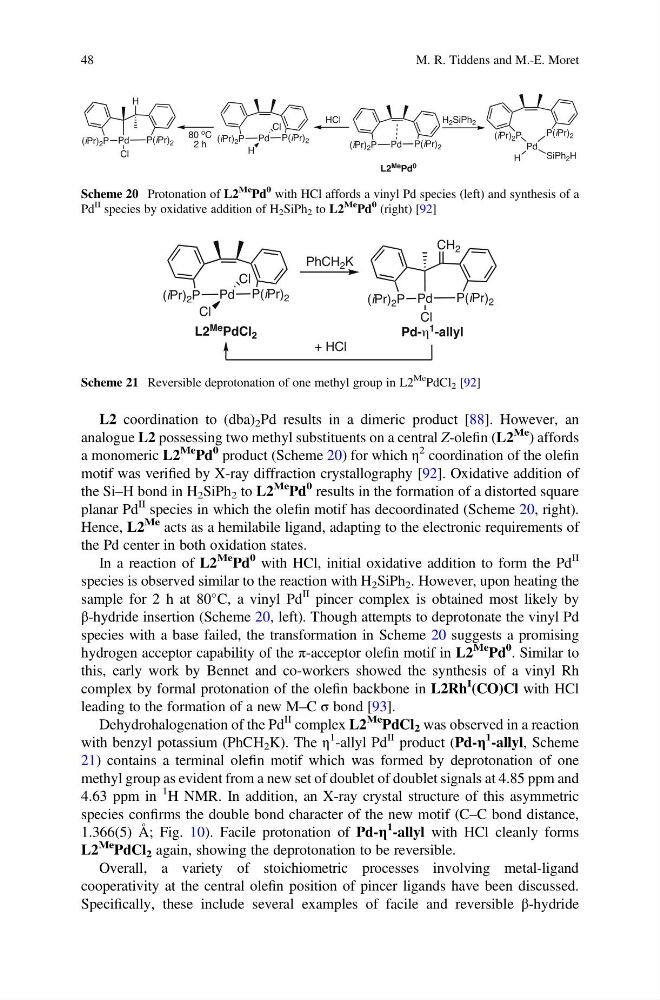
L2 coordination to (dba) 2 Pd results in a dimeric product [88]. However, an
analogue L2 possessing two methyl substituents on a central Z-olefin (L2
Me ) affords
a monomeric L2
Me
Pd
0 product (Scheme 20) for which η
2 coordination of the olefin
motif was verified by X-ray diffraction crystallography [92]. Oxidative addition of
the Si–H bond in H 2 SiPh 2 to L2
Me Pd
0 results in the formation of a distorted square
planar Pd
II species in which the olefin motif has decoordinated (Scheme 20, right).
Hence, L2
Me acts as a hemilabile ligand, adapting to the electronic requirements of
the Pd center in both oxidation states.
In a reaction of L2
Me
Pd
0 with HCl, initial oxidative addition to form the Pd
II
species is observed similar to the reaction with H 2 SiPh 2 . However, upon heating the
sample for 2 h at 80
C, a vinyl Pd
II pincer complex is obtained most likely by
β-hydride insertion (Scheme 20, left). Though attempts to deprotonate the vinyl Pd
species with a base failed, the transformation in Scheme 20 suggests a promising
hydrogen acceptor capability of the π-acceptor olefin motif in L2
Me Pd
0 . Similar to
this, early work by Bennet and co-workers showed the synthesis of a vinyl Rh
complex by formal protonation of the olefin backbone in L2Rh
I (CO)Cl with HCl
leading to the formation of a new M–C σ bond [93].
Dehydrohalogenation of the Pd
II complex L2
Me
PdCl 2 was observed in a reaction
with benzyl potassium (PhCH 2 K). The η
1 -allyl Pd
II product (Pd-η
1 -allyl, Scheme
21) contains a terminal olefin motif which was formed by deprotonation of one
methyl group as evident from a new set of doublet of doublet signals at 4.85 ppm and
4.63 ppm in
1 H NMR. In addition, an X-ray crystal structure of this asymmetric
species confirms the double bond character of the new motif (C–C bond distance,
1.366(5) Å; Fig. 10). Facile protonation of Pd-η
1 -allyl with HCl cleanly forms
L2
Me PdCl 2 again, showing the deprotonation to be reversible.
Overall, a variety of stoichiometric processes involving metal-ligand
cooperativity at the central olefin position of pincer ligands have been discussed.
Specifically, these include several examples of facile and reversible β-hydride
Scheme 20 Protonation of L2
Me Pd
0 with HCl affords a vinyl Pd species (left) and synthesis of a
Pd
II species by oxidative addition of H 2 SiPh 2 to L2
Me Pd
0 (right) [92]
Scheme 21 Reversible deprotonation of one methyl group in L2
Me
PdCl 2 [92]
48
M. R. Tiddens and M.-E. Moret
analogue L2 possessing two methyl substituents on a central Z-olefin (L2
Me ) affords
a monomeric L2
Me
Pd
0 product (Scheme 20) for which η
2 coordination of the olefin
motif was verified by X-ray diffraction crystallography [92]. Oxidative addition of
the Si–H bond in H 2 SiPh 2 to L2
Me Pd
0 results in the formation of a distorted square
planar Pd
II species in which the olefin motif has decoordinated (Scheme 20, right).
Hence, L2
Me acts as a hemilabile ligand, adapting to the electronic requirements of
the Pd center in both oxidation states.
In a reaction of L2
Me
Pd
0 with HCl, initial oxidative addition to form the Pd
II
species is observed similar to the reaction with H 2 SiPh 2 . However, upon heating the
sample for 2 h at 80
C, a vinyl Pd
II pincer complex is obtained most likely by
β-hydride insertion (Scheme 20, left). Though attempts to deprotonate the vinyl Pd
species with a base failed, the transformation in Scheme 20 suggests a promising
hydrogen acceptor capability of the π-acceptor olefin motif in L2
Me Pd
0 . Similar to
this, early work by Bennet and co-workers showed the synthesis of a vinyl Rh
complex by formal protonation of the olefin backbone in L2Rh
I (CO)Cl with HCl
leading to the formation of a new M–C σ bond [93].
Dehydrohalogenation of the Pd
II complex L2
Me
PdCl 2 was observed in a reaction
with benzyl potassium (PhCH 2 K). The η
1 -allyl Pd
II product (Pd-η
1 -allyl, Scheme
21) contains a terminal olefin motif which was formed by deprotonation of one
methyl group as evident from a new set of doublet of doublet signals at 4.85 ppm and
4.63 ppm in
1 H NMR. In addition, an X-ray crystal structure of this asymmetric
species confirms the double bond character of the new motif (C–C bond distance,
1.366(5) Å; Fig. 10). Facile protonation of Pd-η
1 -allyl with HCl cleanly forms
L2
Me PdCl 2 again, showing the deprotonation to be reversible.
Overall, a variety of stoichiometric processes involving metal-ligand
cooperativity at the central olefin position of pincer ligands have been discussed.
Specifically, these include several examples of facile and reversible β-hydride
Scheme 20 Protonation of L2
Me Pd
0 with HCl affords a vinyl Pd species (left) and synthesis of a
Pd
II species by oxidative addition of H 2 SiPh 2 to L2
Me Pd
0 (right) [92]
Scheme 21 Reversible deprotonation of one methyl group in L2
Me
PdCl 2 [92]
48
M. R. Tiddens and M.-E. Moret