

halide abstraction at L2Fe
II Cl 2 and L2Co
II Cl 2 with NaB(Ar
F ) 4 leads to a weak
olefin coordination (Scheme 17, right) best described as a π-adduct with weak
π-backdonation. Integration of an olefin in a chelating ligand such as L2 enables a
flexibility in coordination strength of the central motif that is usually not associated
with pincer ligands.
The distinction between weak and strong olefin coordination is based on M–C
bond distances and C¼C bond elongation. For instance, the C¼C bond length in free
L2 is 1.330(4) Å, weak η
2 (C,C) coordination of the motif in [L2Co
II Cl][B(Ar
F
) 4 ]
leads to an elongation of the bond to 1.397(6) Å, and strong coordination as in
L2Co
I Cl elongates the C¼C bond even more to 1.442(5) Å. Therefore, L2 functions
as an adaptive π-acceptor ligand since it stabilizes transition metal centers in
different oxidation states by means of withdrawing electron density to various
extents.
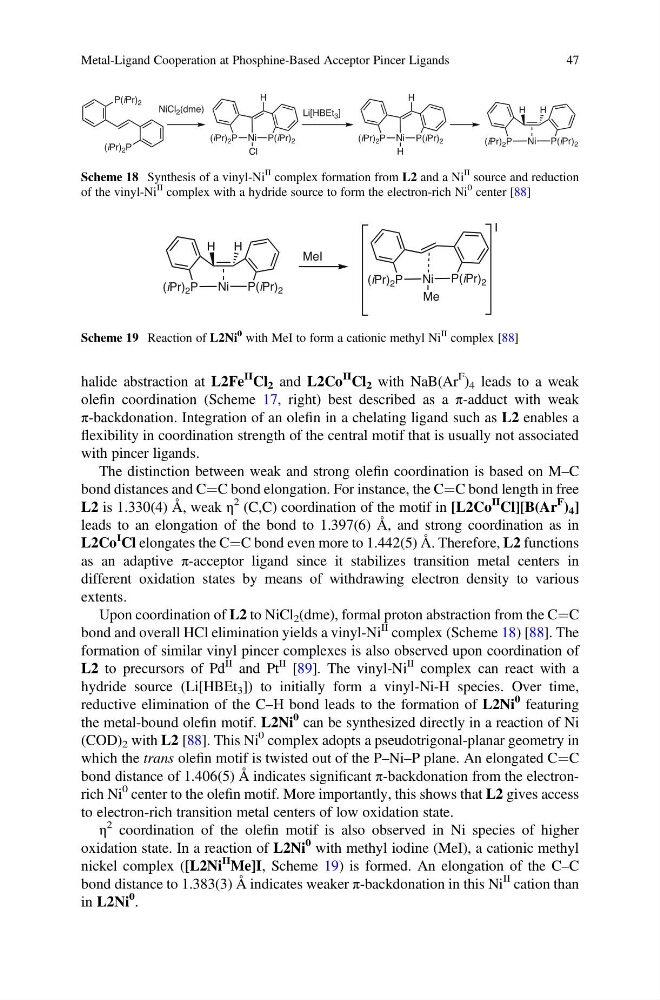
Upon coordination of L2 to NiCl 2 (dme), formal proton abstraction from the C¼C
bond and overall HCl elimination yields a vinyl-Ni
II complex (Scheme 18) [88]. The
formation of similar vinyl pincer complexes is also observed upon coordination of
L2 to precursors of Pd
II and Pt
II [89]. The vinyl-Ni
II complex can react with a
hydride source (Li[HBEt 3 ]) to initially form a vinyl-Ni-H species. Over time,
reductive elimination of the C–H bond leads to the formation of L2Ni
0 featuring
the metal-bound olefin motif. L2Ni
0 can be synthesized directly in a reaction of Ni
(COD) 2 with L2 [88]. This Ni
0 complex adopts a pseudotrigonal-planar geometry in
which the trans olefin motif is twisted out of the P–Ni–P plane. An elongated C¼C
bond distance of 1.406(5) Å indicates significant π-backdonation from the electronrich Ni
0 center to the olefin motif. More importantly, this shows that L2 gives access
to electron-rich transition metal centers of low oxidation state.
η
2 coordination of the olefin motif is also observed in Ni species of higher
oxidation state. In a reaction of L2Ni
0 with methyl iodine (MeI), a cationic methyl
nickel complex ([L2Ni
II
Me]I, Scheme 19) is formed. An elongation of the C–C
bond distance to 1.383(3) Å indicates weaker π-backdonation in this Ni
II cation than
in L2Ni
0 .
Scheme 18 Synthesis of a vinyl-Ni
II complex formation from L2 and a Ni
II source and reduction
of the vinyl-Ni
II complex with a hydride source to form the electron-rich Ni
0 center [88]
Scheme 19 Reaction of L2Ni
0 with MeI to form a cationic methyl Ni
II complex [88]
Metal-Ligand Cooperation at Phosphine-Based Acceptor Pincer Ligands
47
II Cl 2 and L2Co
II Cl 2 with NaB(Ar
F ) 4 leads to a weak
olefin coordination (Scheme 17, right) best described as a π-adduct with weak
π-backdonation. Integration of an olefin in a chelating ligand such as L2 enables a
flexibility in coordination strength of the central motif that is usually not associated
with pincer ligands.
The distinction between weak and strong olefin coordination is based on M–C
bond distances and C¼C bond elongation. For instance, the C¼C bond length in free
L2 is 1.330(4) Å, weak η
2 (C,C) coordination of the motif in [L2Co
II Cl][B(Ar
F
) 4 ]
leads to an elongation of the bond to 1.397(6) Å, and strong coordination as in
L2Co
I Cl elongates the C¼C bond even more to 1.442(5) Å. Therefore, L2 functions
as an adaptive π-acceptor ligand since it stabilizes transition metal centers in
different oxidation states by means of withdrawing electron density to various
extents.
Upon coordination of L2 to NiCl 2 (dme), formal proton abstraction from the C¼C
bond and overall HCl elimination yields a vinyl-Ni
II complex (Scheme 18) [88]. The
formation of similar vinyl pincer complexes is also observed upon coordination of
L2 to precursors of Pd
II and Pt
II [89]. The vinyl-Ni
II complex can react with a
hydride source (Li[HBEt 3 ]) to initially form a vinyl-Ni-H species. Over time,
reductive elimination of the C–H bond leads to the formation of L2Ni
0 featuring
the metal-bound olefin motif. L2Ni
0 can be synthesized directly in a reaction of Ni
(COD) 2 with L2 [88]. This Ni
0 complex adopts a pseudotrigonal-planar geometry in
which the trans olefin motif is twisted out of the P–Ni–P plane. An elongated C¼C
bond distance of 1.406(5) Å indicates significant π-backdonation from the electronrich Ni
0 center to the olefin motif. More importantly, this shows that L2 gives access
to electron-rich transition metal centers of low oxidation state.
η
2 coordination of the olefin motif is also observed in Ni species of higher
oxidation state. In a reaction of L2Ni
0 with methyl iodine (MeI), a cationic methyl
nickel complex ([L2Ni
II
Me]I, Scheme 19) is formed. An elongation of the C–C
bond distance to 1.383(3) Å indicates weaker π-backdonation in this Ni
II cation than
in L2Ni
0 .
Scheme 18 Synthesis of a vinyl-Ni
II complex formation from L2 and a Ni
II source and reduction
of the vinyl-Ni
II complex with a hydride source to form the electron-rich Ni
0 center [88]
Scheme 19 Reaction of L2Ni
0 with MeI to form a cationic methyl Ni
II complex [88]
Metal-Ligand Cooperation at Phosphine-Based Acceptor Pincer Ligands
47