

The discussed examples show that a π-acceptor olefin ligand in the central
position of a pincer ligand can reversibly accept a hydride ligand from the metal it
is bound to, opening up possibilities for bifunctional substrate activation as depicted
in Fig. 9 (right). The utility of an olefin as a hemilabile moiety (Fig. 9, left) is more
apparent in the chemistry of a related ligand family in which the central olefin is
connected to the phenylene linkers in a 1,2 fashion instead of the 1,1-connectivity
discussed so far. A systematic analysis of the coordination of such ligands to
different transition metal centers in different oxidation states was conducted by
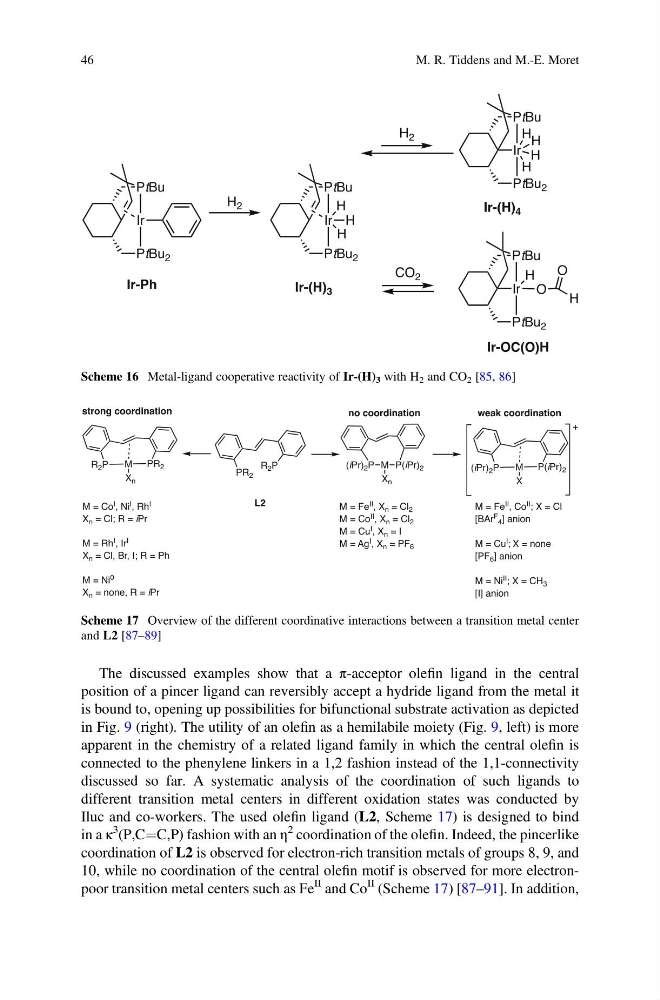
Iluc and co-workers. The used olefin ligand (L2, Scheme 17) is designed to bind
in a κ
3 (P,C¼C,P) fashion with an η
2 coordination of the olefin. Indeed, the pincerlike
coordination of L2 is observed for electron-rich transition metals of groups 8, 9, and
10, while no coordination of the central olefin motif is observed for more electronpoor transition metal centers such as Fe
II and Co
II (Scheme 17) [87–91]. In addition,
Scheme 16 Metal-ligand cooperative reactivity of Ir-(H) 3 with H 2 and CO 2 [85, 86]
Scheme 17 Overview of the different coordinative interactions between a transition metal center
and L2 [87–89]
46
M. R. Tiddens and M.-E. Moret
position of a pincer ligand can reversibly accept a hydride ligand from the metal it
is bound to, opening up possibilities for bifunctional substrate activation as depicted
in Fig. 9 (right). The utility of an olefin as a hemilabile moiety (Fig. 9, left) is more
apparent in the chemistry of a related ligand family in which the central olefin is
connected to the phenylene linkers in a 1,2 fashion instead of the 1,1-connectivity
discussed so far. A systematic analysis of the coordination of such ligands to
different transition metal centers in different oxidation states was conducted by
Iluc and co-workers. The used olefin ligand (L2, Scheme 17) is designed to bind
in a κ
3 (P,C¼C,P) fashion with an η
2 coordination of the olefin. Indeed, the pincerlike
coordination of L2 is observed for electron-rich transition metals of groups 8, 9, and
10, while no coordination of the central olefin motif is observed for more electronpoor transition metal centers such as Fe
II and Co
II (Scheme 17) [87–91]. In addition,
Scheme 16 Metal-ligand cooperative reactivity of Ir-(H) 3 with H 2 and CO 2 [85, 86]
Scheme 17 Overview of the different coordinative interactions between a transition metal center
and L2 [87–89]
46
M. R. Tiddens and M.-E. Moret