

Rh-alkyl to Rh-olefin. This equilibrium is a remarkable example of direct trans
migration via a concerted, highly organized transition state. The insertion is thought
to be possible due to the unique geometry of Rh-olefin, in which the square planar
geometry is distorted in order to bend the olefin towards the trans-hydride already in
the ground state. Overall, this system demonstrates that facile and reversible
β-hydride elimination/insertion is possible even with the natural trans configuration
imposed by the pincer structure and shows the potential of π-complexes to act as a
transient hydride storage moiety in cooperative processes.
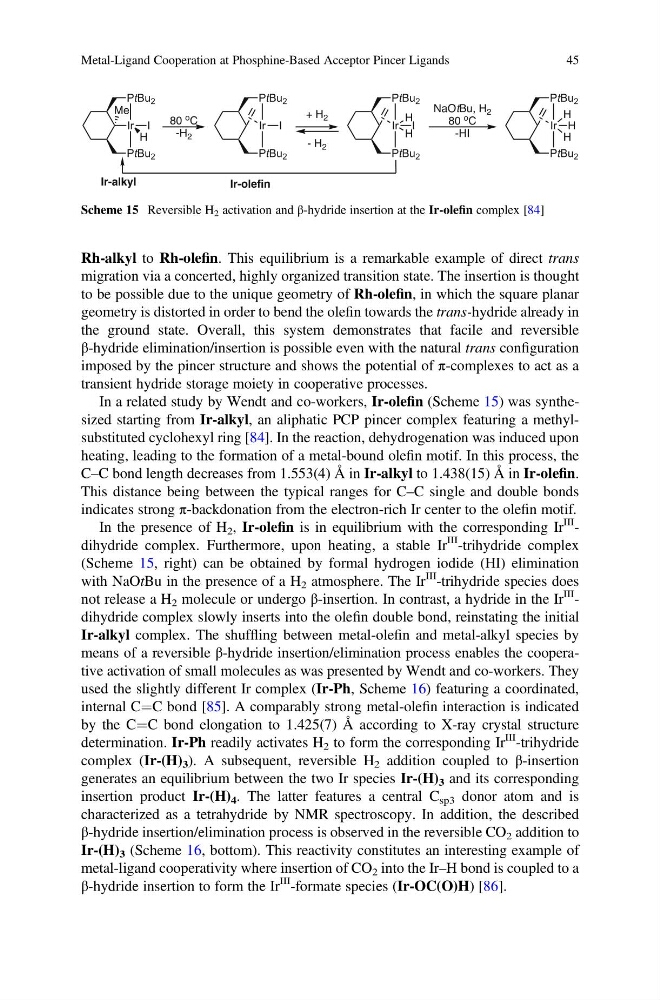
In a related study by Wendt and co-workers, Ir-olefin (Scheme 15) was synthesized starting from Ir-alkyl, an aliphatic PCP pincer complex featuring a methylsubstituted cyclohexyl ring [84]. In the reaction, dehydrogenation was induced upon
heating, leading to the formation of a metal-bound olefin motif. In this process, the
C–C bond length decreases from 1.553(4) Å in Ir-alkyl to 1.438(15) Å in Ir-olefin.
This distance being between the typical ranges for C–C single and double bonds
indicates strong π-backdonation from the electron-rich Ir center to the olefin motif.
In the presence of H 2 , Ir-olefin is in equilibrium with the corresponding Ir
III -
dihydride complex. Furthermore, upon heating, a stable Ir
III -trihydride complex
(Scheme 15, right) can be obtained by formal hydrogen iodide (HI) elimination
with NaOtBu in the presence of a H 2 atmosphere. The Ir
III -trihydride species does
not release a H 2 molecule or undergo β-insertion. In contrast, a hydride in the Ir
III -
dihydride complex slowly inserts into the olefin double bond, reinstating the initial
Ir-alkyl complex. The shuffling between metal-olefin and metal-alkyl species by
means of a reversible β-hydride insertion/elimination process enables the cooperative activation of small molecules as was presented by Wendt and co-workers. They
used the slightly different Ir complex (Ir-Ph, Scheme 16) featuring a coordinated,
internal C¼C bond [85]. A comparably strong metal-olefin interaction is indicated
by the C¼C bond elongation to 1.425(7) Å according to X-ray crystal structure
determination. Ir-Ph readily activates H 2 to form the corresponding Ir
III -trihydride
complex (Ir-(H) 3 ). A subsequent, reversible H 2 addition coupled to β-insertion
generates an equilibrium between the two Ir species Ir-(H) 3 and its corresponding
insertion product Ir-(H) 4 . The latter features a central C sp3 donor atom and is
characterized as a tetrahydride by NMR spectroscopy. In addition, the described
β-hydride insertion/elimination process is observed in the reversible CO 2 addition to
Ir-(H) 3 (Scheme 16, bottom). This reactivity constitutes an interesting example of
metal-ligand cooperativity where insertion of CO 2 into the Ir–H bond is coupled to a
β-hydride insertion to form the Ir
III -formate species (Ir-OC(O)H) [86].
Scheme 15 Reversible H 2 activation and β-hydride insertion at the Ir-olefin complex [84]
Metal-Ligand Cooperation at Phosphine-Based Acceptor Pincer Ligands
45
migration via a concerted, highly organized transition state. The insertion is thought
to be possible due to the unique geometry of Rh-olefin, in which the square planar
geometry is distorted in order to bend the olefin towards the trans-hydride already in
the ground state. Overall, this system demonstrates that facile and reversible
β-hydride elimination/insertion is possible even with the natural trans configuration
imposed by the pincer structure and shows the potential of π-complexes to act as a
transient hydride storage moiety in cooperative processes.
In a related study by Wendt and co-workers, Ir-olefin (Scheme 15) was synthesized starting from Ir-alkyl, an aliphatic PCP pincer complex featuring a methylsubstituted cyclohexyl ring [84]. In the reaction, dehydrogenation was induced upon
heating, leading to the formation of a metal-bound olefin motif. In this process, the
C–C bond length decreases from 1.553(4) Å in Ir-alkyl to 1.438(15) Å in Ir-olefin.
This distance being between the typical ranges for C–C single and double bonds
indicates strong π-backdonation from the electron-rich Ir center to the olefin motif.
In the presence of H 2 , Ir-olefin is in equilibrium with the corresponding Ir
III -
dihydride complex. Furthermore, upon heating, a stable Ir
III -trihydride complex
(Scheme 15, right) can be obtained by formal hydrogen iodide (HI) elimination
with NaOtBu in the presence of a H 2 atmosphere. The Ir
III -trihydride species does
not release a H 2 molecule or undergo β-insertion. In contrast, a hydride in the Ir
III -
dihydride complex slowly inserts into the olefin double bond, reinstating the initial
Ir-alkyl complex. The shuffling between metal-olefin and metal-alkyl species by
means of a reversible β-hydride insertion/elimination process enables the cooperative activation of small molecules as was presented by Wendt and co-workers. They
used the slightly different Ir complex (Ir-Ph, Scheme 16) featuring a coordinated,
internal C¼C bond [85]. A comparably strong metal-olefin interaction is indicated
by the C¼C bond elongation to 1.425(7) Å according to X-ray crystal structure
determination. Ir-Ph readily activates H 2 to form the corresponding Ir
III -trihydride
complex (Ir-(H) 3 ). A subsequent, reversible H 2 addition coupled to β-insertion
generates an equilibrium between the two Ir species Ir-(H) 3 and its corresponding
insertion product Ir-(H) 4 . The latter features a central C sp3 donor atom and is
characterized as a tetrahydride by NMR spectroscopy. In addition, the described
β-hydride insertion/elimination process is observed in the reversible CO 2 addition to
Ir-(H) 3 (Scheme 16, bottom). This reactivity constitutes an interesting example of
metal-ligand cooperativity where insertion of CO 2 into the Ir–H bond is coupled to a
β-hydride insertion to form the Ir
III -formate species (Ir-OC(O)H) [86].
Scheme 15 Reversible H 2 activation and β-hydride insertion at the Ir-olefin complex [84]
Metal-Ligand Cooperation at Phosphine-Based Acceptor Pincer Ligands
45