

X-ray crystallography suggests a strong interaction between Pd
0 and the bound
olefin as an elongated C¼C bond length of 1.398(3) Å vs 1.34 Å (for a typical C¼C
bond) is observed, indicating significant π-backdonation.
The Pd-olefin complex was also identified as the product of a side reaction of a
Pd-bound nucleophilic carbene incorporated in a PCP pincer structure with CH 2 Cl 2 ,
in which a formal CH 2 -group transfer to the nucleophilic carbon atom occurs. A
perhaps less unexpected connection between a metal-bound olefin motif and a
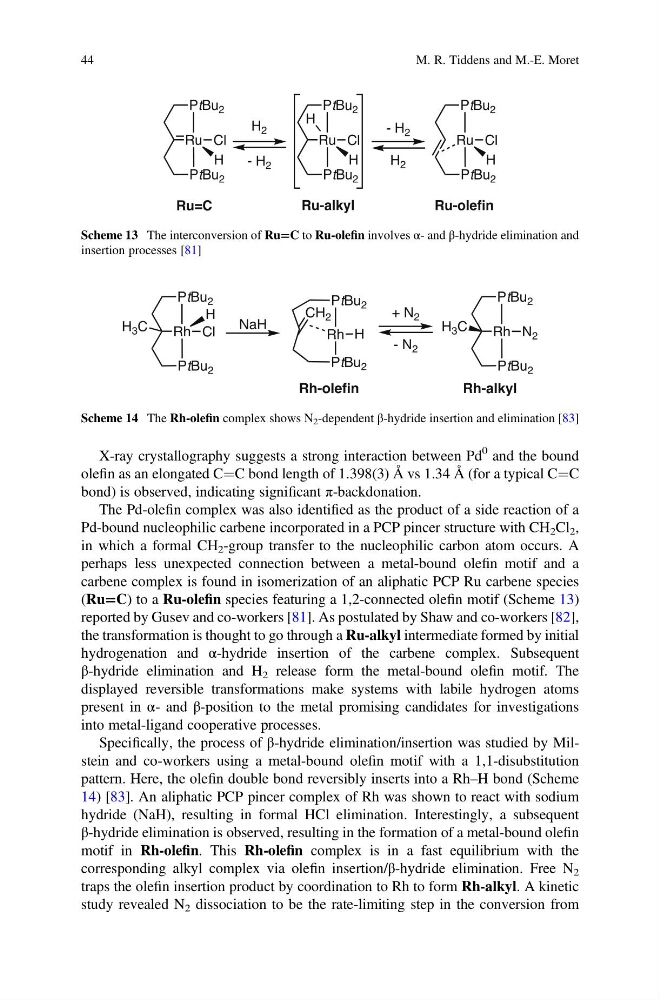
carbene complex is found in isomerization of an aliphatic PCP Ru carbene species
(Ru=C) to a Ru-olefin species featuring a 1,2-connected olefin motif (Scheme 13)
reported by Gusev and co-workers [81]. As postulated by Shaw and co-workers [82],
the transformation is thought to go through a Ru-alkyl intermediate formed by initial
hydrogenation and α-hydride insertion of the carbene complex. Subsequent
β-hydride elimination and H 2 release form the metal-bound olefin motif. The
displayed reversible transformations make systems with labile hydrogen atoms
present in α- and β-position to the metal promising candidates for investigations
into metal-ligand cooperative processes.
Specifically, the process of β-hydride elimination/insertion was studied by Milstein and co-workers using a metal-bound olefin motif with a 1,1-disubstitution
pattern. Here, the olefin double bond reversibly inserts into a Rh–H bond (Scheme
14) [83]. An aliphatic PCP pincer complex of Rh was shown to react with sodium
hydride (NaH), resulting in formal HCl elimination. Interestingly, a subsequent
β-hydride elimination is observed, resulting in the formation of a metal-bound olefin
motif in Rh-olefin. This Rh-olefin complex is in a fast equilibrium with the
corresponding alkyl complex via olefin insertion/β-hydride elimination. Free N 2
traps the olefin insertion product by coordination to Rh to form Rh-alkyl. A kinetic
study revealed N 2 dissociation to be the rate-limiting step in the conversion from
Scheme 13 The interconversion of Ru=C to Ru-olefin involves α- and β-hydride elimination and
insertion processes [81]
Scheme 14 The Rh-olefin complex shows N 2 -dependent β-hydride insertion and elimination [83]
44
M. R. Tiddens and M.-E. Moret
0 and the bound
olefin as an elongated C¼C bond length of 1.398(3) Å vs 1.34 Å (for a typical C¼C
bond) is observed, indicating significant π-backdonation.
The Pd-olefin complex was also identified as the product of a side reaction of a
Pd-bound nucleophilic carbene incorporated in a PCP pincer structure with CH 2 Cl 2 ,
in which a formal CH 2 -group transfer to the nucleophilic carbon atom occurs. A
perhaps less unexpected connection between a metal-bound olefin motif and a
carbene complex is found in isomerization of an aliphatic PCP Ru carbene species
(Ru=C) to a Ru-olefin species featuring a 1,2-connected olefin motif (Scheme 13)
reported by Gusev and co-workers [81]. As postulated by Shaw and co-workers [82],
the transformation is thought to go through a Ru-alkyl intermediate formed by initial
hydrogenation and α-hydride insertion of the carbene complex. Subsequent
β-hydride elimination and H 2 release form the metal-bound olefin motif. The
displayed reversible transformations make systems with labile hydrogen atoms
present in α- and β-position to the metal promising candidates for investigations
into metal-ligand cooperative processes.
Specifically, the process of β-hydride elimination/insertion was studied by Milstein and co-workers using a metal-bound olefin motif with a 1,1-disubstitution
pattern. Here, the olefin double bond reversibly inserts into a Rh–H bond (Scheme
14) [83]. An aliphatic PCP pincer complex of Rh was shown to react with sodium
hydride (NaH), resulting in formal HCl elimination. Interestingly, a subsequent
β-hydride elimination is observed, resulting in the formation of a metal-bound olefin
motif in Rh-olefin. This Rh-olefin complex is in a fast equilibrium with the
corresponding alkyl complex via olefin insertion/β-hydride elimination. Free N 2
traps the olefin insertion product by coordination to Rh to form Rh-alkyl. A kinetic
study revealed N 2 dissociation to be the rate-limiting step in the conversion from
Scheme 13 The interconversion of Ru=C to Ru-olefin involves α- and β-hydride elimination and
insertion processes [81]
Scheme 14 The Rh-olefin complex shows N 2 -dependent β-hydride insertion and elimination [83]
44
M. R. Tiddens and M.-E. Moret