

3.2 Anchored Olefin-Metal Complexes: First Steps Towards
Metal-Ligand Cooperativity
In general, metal-bound olefins insert readily into a M–Y bond resulting in a metalalkyl species. Thereby the motif formally accepts either a nucleophilic or an electrophilic fragment (Y ¼ Nu
À or E
+
). Such steps are often part of a catalytic cycle in
which the olefin is one of the substrates and subsequently leaves the coordination
sphere of the metal as a product molecule. They could potentially also be applied in
the context of metal-ligand cooperative catalysis, if the reactive olefin were anchored
to the metal in a pincer-type ligand design and thus forced to remain in the
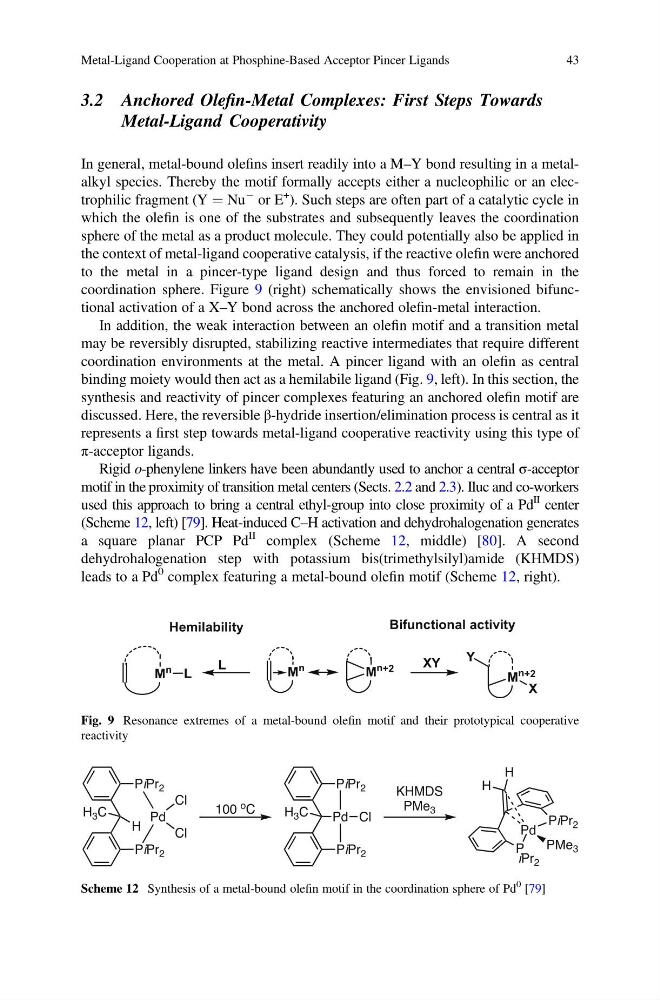
coordination sphere. Figure 9 (right) schematically shows the envisioned bifunctional activation of a X–Y bond across the anchored olefin-metal interaction.
In addition, the weak interaction between an olefin motif and a transition metal
may be reversibly disrupted, stabilizing reactive intermediates that require different
coordination environments at the metal. A pincer ligand with an olefin as central
binding moiety would then act as a hemilabile ligand (Fig. 9, left). In this section, the
synthesis and reactivity of pincer complexes featuring an anchored olefin motif are
discussed. Here, the reversible β-hydride insertion/elimination process is central as it
represents a first step towards metal-ligand cooperative reactivity using this type of
π-acceptor ligands.
Rigid o-phenylene linkers have been abundantly used to anchor a central σ-acceptor
motif in the proximity of transition metal centers (Sects. 2.2 and 2.3). Iluc and co-workers
used this approach to bring a central ethyl-group into close proximity of a Pd
II center
(Scheme 12, left) [79]. Heat-induced C–H activation and dehydrohalogenation generates
a square planar PCP Pd
II complex (Scheme 12, middle) [80]. A second
dehydrohalogenation step with potassium bis(trimethylsilyl)amide (KHMDS)
leads to a Pd
0 complex featuring a metal-bound olefin motif (Scheme 12, right).
M
n+2
XY
Y
X
M
n L
L
Bifunctional activity
Hemilability
M
n
M
n+2
Fig. 9 Resonance extremes of a metal-bound olefin motif and their prototypical cooperative
reactivity
Scheme 12 Synthesis of a metal-bound olefin motif in the coordination sphere of Pd
0 [79]
Metal-Ligand Cooperation at Phosphine-Based Acceptor Pincer Ligands
43
Metal-Ligand Cooperativity
In general, metal-bound olefins insert readily into a M–Y bond resulting in a metalalkyl species. Thereby the motif formally accepts either a nucleophilic or an electrophilic fragment (Y ¼ Nu
À or E
+
). Such steps are often part of a catalytic cycle in
which the olefin is one of the substrates and subsequently leaves the coordination
sphere of the metal as a product molecule. They could potentially also be applied in
the context of metal-ligand cooperative catalysis, if the reactive olefin were anchored
to the metal in a pincer-type ligand design and thus forced to remain in the
coordination sphere. Figure 9 (right) schematically shows the envisioned bifunctional activation of a X–Y bond across the anchored olefin-metal interaction.
In addition, the weak interaction between an olefin motif and a transition metal
may be reversibly disrupted, stabilizing reactive intermediates that require different
coordination environments at the metal. A pincer ligand with an olefin as central
binding moiety would then act as a hemilabile ligand (Fig. 9, left). In this section, the
synthesis and reactivity of pincer complexes featuring an anchored olefin motif are
discussed. Here, the reversible β-hydride insertion/elimination process is central as it
represents a first step towards metal-ligand cooperative reactivity using this type of
π-acceptor ligands.
Rigid o-phenylene linkers have been abundantly used to anchor a central σ-acceptor
motif in the proximity of transition metal centers (Sects. 2.2 and 2.3). Iluc and co-workers
used this approach to bring a central ethyl-group into close proximity of a Pd
II center
(Scheme 12, left) [79]. Heat-induced C–H activation and dehydrohalogenation generates
a square planar PCP Pd
II complex (Scheme 12, middle) [80]. A second
dehydrohalogenation step with potassium bis(trimethylsilyl)amide (KHMDS)
leads to a Pd
0 complex featuring a metal-bound olefin motif (Scheme 12, right).
M
n+2
XY
Y
X
M
n L
L
Bifunctional activity
Hemilability
M
n
M
n+2
Fig. 9 Resonance extremes of a metal-bound olefin motif and their prototypical cooperative
reactivity
Scheme 12 Synthesis of a metal-bound olefin motif in the coordination sphere of Pd
0 [79]
Metal-Ligand Cooperation at Phosphine-Based Acceptor Pincer Ligands
43