

was applied to the catalytic hydrosilylation of benzaldehydes, alkyl aldehydes and
aryl and alkyl ketones, where L1Co
0 (N 2 ) generally outcompetes the structurally
related Ni system [67].
3 π-Acceptor Ligands
3.1 Dewar-Chatt-Duncanson Model
It is remarkable that, while Zeises’ salt K[PtCl 3 (C 2 H 4 )]ÁH 2 O was reported in 1827 as
the first organometallic complex [77, 78], it took more than 100 years to explain its
olefin coordination. This complication originated from the lack of a binding model to
fully interpret the observed data. The Dewar-Chatt-Duncanson (DCD) bonding
model, which is widely used today to explain olefin coordination, was proposed in
the 1960s by Michael J. S. Dewar, Joseph Chatt, and Leonard A. Duncanson. This
model involves two important orbital interactions between the η
2 (C,C)-bound olefin
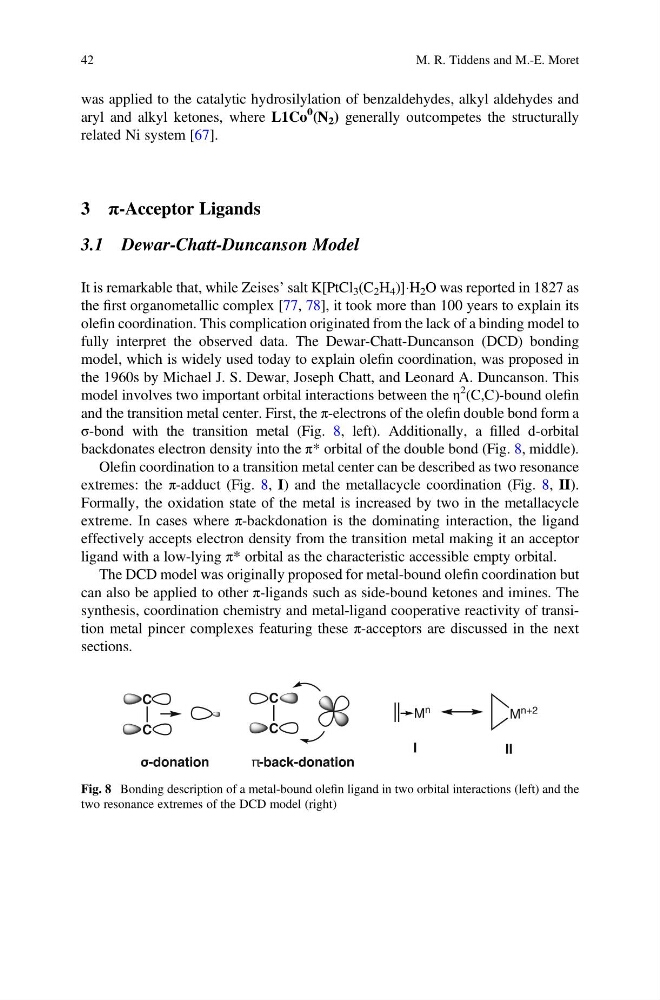
and the transition metal center. First, the π-electrons of the olefin double bond form a
σ-bond with the transition metal (Fig. 8, left). Additionally, a filled d-orbital
backdonates electron density into the π* orbital of the double bond (Fig. 8, middle).
Olefin coordination to a transition metal center can be described as two resonance
extremes: the π-adduct (Fig. 8, I) and the metallacycle coordination (Fig. 8, II).
Formally, the oxidation state of the metal is increased by two in the metallacycle
extreme. In cases where π-backdonation is the dominating interaction, the ligand
effectively accepts electron density from the transition metal making it an acceptor
ligand with a low-lying π* orbital as the characteristic accessible empty orbital.
The DCD model was originally proposed for metal-bound olefin coordination but
can also be applied to other π-ligands such as side-bound ketones and imines. The
synthesis, coordination chemistry and metal-ligand cooperative reactivity of transition metal pincer complexes featuring these π-acceptors are discussed in the next
sections.
Fig. 8 Bonding description of a metal-bound olefin ligand in two orbital interactions (left) and the
two resonance extremes of the DCD model (right)
42
M. R. Tiddens and M.-E. Moret
aryl and alkyl ketones, where L1Co
0 (N 2 ) generally outcompetes the structurally
related Ni system [67].
3 π-Acceptor Ligands
3.1 Dewar-Chatt-Duncanson Model
It is remarkable that, while Zeises’ salt K[PtCl 3 (C 2 H 4 )]ÁH 2 O was reported in 1827 as
the first organometallic complex [77, 78], it took more than 100 years to explain its
olefin coordination. This complication originated from the lack of a binding model to
fully interpret the observed data. The Dewar-Chatt-Duncanson (DCD) bonding
model, which is widely used today to explain olefin coordination, was proposed in
the 1960s by Michael J. S. Dewar, Joseph Chatt, and Leonard A. Duncanson. This
model involves two important orbital interactions between the η
2 (C,C)-bound olefin
and the transition metal center. First, the π-electrons of the olefin double bond form a
σ-bond with the transition metal (Fig. 8, left). Additionally, a filled d-orbital
backdonates electron density into the π* orbital of the double bond (Fig. 8, middle).
Olefin coordination to a transition metal center can be described as two resonance
extremes: the π-adduct (Fig. 8, I) and the metallacycle coordination (Fig. 8, II).
Formally, the oxidation state of the metal is increased by two in the metallacycle
extreme. In cases where π-backdonation is the dominating interaction, the ligand
effectively accepts electron density from the transition metal making it an acceptor
ligand with a low-lying π* orbital as the characteristic accessible empty orbital.
The DCD model was originally proposed for metal-bound olefin coordination but
can also be applied to other π-ligands such as side-bound ketones and imines. The
synthesis, coordination chemistry and metal-ligand cooperative reactivity of transition metal pincer complexes featuring these π-acceptors are discussed in the next
sections.
Fig. 8 Bonding description of a metal-bound olefin ligand in two orbital interactions (left) and the
two resonance extremes of the DCD model (right)
42
M. R. Tiddens and M.-E. Moret