

iron and one phenylene linker. Facile H 2 activation by L1Fe(CO) 2 with 1 atm H 2
leads to the formation of a bridging B–H–Fe motif as well as a Fe–H bond (Scheme
10, left). X-ray analysis reveals cis-dihydride stereochemistry.
Double oxygen atom functionalization was observed in a reaction of L1Fe(CO) 2
with TMSOTf under strongly reducing conditions (excess potassium; Scheme 10).
The disilylation results in a structurally unique iron dicarbyne complex in which the
Fe!B interaction is replaced by a stabilizing (FeC carbyne )!B interaction. This
interpretation of the bonding situation is based on a relatively long Fe–B distance
(2.593(1) Å) and shorter C carbyne –B distance (1.862(1) Å) obtained from the X-ray
crystal structure. Additionally, the boron atom is pyramidalized (ΣB α ¼ 328
),
indicating borate character. Facile C–C bond formation is observed upon the addition of 1 atm H 2 to the iron dicarbyne species, affording the Z-olefin product
(Me 3 SiO)CH¼CH(OSiMe 3 ) and an unidentified paramagnetic Fe-containing product (Scheme 10, right).
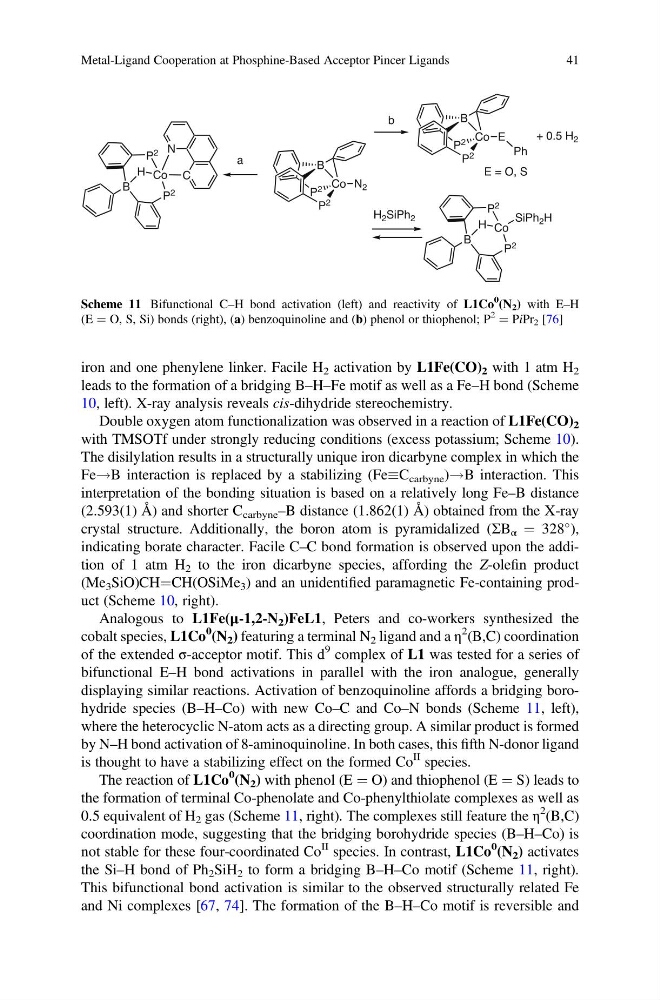
Analogous to L1Fe(μ-1,2-N 2 )FeL1, Peters and co-workers synthesized the
cobalt species, L1Co
0 (N 2 ) featuring a terminal N 2 ligand and a η
2 (B,C) coordination
of the extended σ-acceptor motif. This d
9 complex of L1 was tested for a series of
bifunctional E–H bond activations in parallel with the iron analogue, generally
displaying similar reactions. Activation of benzoquinoline affords a bridging borohydride species (B–H–Co) with new Co–C and Co–N bonds (Scheme 11, left),
where the heterocyclic N-atom acts as a directing group. A similar product is formed
by N–H bond activation of 8-aminoquinoline. In both cases, this fifth N-donor ligand
is thought to have a stabilizing effect on the formed Co
II species.
The reaction of L1Co
0 (N 2 ) with phenol (E ¼ O) and thiophenol (E ¼ S) leads to
the formation of terminal Co-phenolate and Co-phenylthiolate complexes as well as
0.5 equivalent of H 2 gas (Scheme 11, right). The complexes still feature the η
2 (B,C)
coordination mode, suggesting that the bridging borohydride species (B–H–Co) is
not stable for these four-coordinated Co
II species. In contrast, L1Co
0 (N 2 ) activates
the Si–H bond of Ph 2 SiH 2 to form a bridging B–H–Co motif (Scheme 11, right).
This bifunctional bond activation is similar to the observed structurally related Fe
and Ni complexes [67, 74]. The formation of the B–H–Co motif is reversible and
Scheme 11 Bifunctional C–H bond activation (left) and reactivity of L1Co
0
(N 2 ) with E–H
(E ¼ O, S, Si) bonds (right), (a) benzoquinoline and (b) phenol or thiophenol; P
2 ¼ PiPr 2 [76]
Metal-Ligand Cooperation at Phosphine-Based Acceptor Pincer Ligands
41
leads to the formation of a bridging B–H–Fe motif as well as a Fe–H bond (Scheme
10, left). X-ray analysis reveals cis-dihydride stereochemistry.
Double oxygen atom functionalization was observed in a reaction of L1Fe(CO) 2
with TMSOTf under strongly reducing conditions (excess potassium; Scheme 10).
The disilylation results in a structurally unique iron dicarbyne complex in which the
Fe!B interaction is replaced by a stabilizing (FeC carbyne )!B interaction. This
interpretation of the bonding situation is based on a relatively long Fe–B distance
(2.593(1) Å) and shorter C carbyne –B distance (1.862(1) Å) obtained from the X-ray
crystal structure. Additionally, the boron atom is pyramidalized (ΣB α ¼ 328
),
indicating borate character. Facile C–C bond formation is observed upon the addition of 1 atm H 2 to the iron dicarbyne species, affording the Z-olefin product
(Me 3 SiO)CH¼CH(OSiMe 3 ) and an unidentified paramagnetic Fe-containing product (Scheme 10, right).
Analogous to L1Fe(μ-1,2-N 2 )FeL1, Peters and co-workers synthesized the
cobalt species, L1Co
0 (N 2 ) featuring a terminal N 2 ligand and a η
2 (B,C) coordination
of the extended σ-acceptor motif. This d
9 complex of L1 was tested for a series of
bifunctional E–H bond activations in parallel with the iron analogue, generally
displaying similar reactions. Activation of benzoquinoline affords a bridging borohydride species (B–H–Co) with new Co–C and Co–N bonds (Scheme 11, left),
where the heterocyclic N-atom acts as a directing group. A similar product is formed
by N–H bond activation of 8-aminoquinoline. In both cases, this fifth N-donor ligand
is thought to have a stabilizing effect on the formed Co
II species.
The reaction of L1Co
0 (N 2 ) with phenol (E ¼ O) and thiophenol (E ¼ S) leads to
the formation of terminal Co-phenolate and Co-phenylthiolate complexes as well as
0.5 equivalent of H 2 gas (Scheme 11, right). The complexes still feature the η
2 (B,C)
coordination mode, suggesting that the bridging borohydride species (B–H–Co) is
not stable for these four-coordinated Co
II species. In contrast, L1Co
0 (N 2 ) activates
the Si–H bond of Ph 2 SiH 2 to form a bridging B–H–Co motif (Scheme 11, right).
This bifunctional bond activation is similar to the observed structurally related Fe
and Ni complexes [67, 74]. The formation of the B–H–Co motif is reversible and
Scheme 11 Bifunctional C–H bond activation (left) and reactivity of L1Co
0
(N 2 ) with E–H
(E ¼ O, S, Si) bonds (right), (a) benzoquinoline and (b) phenol or thiophenol; P
2 ¼ PiPr 2 [76]
Metal-Ligand Cooperation at Phosphine-Based Acceptor Pincer Ligands
41