

to the upfield shift of aryl resonances in
1 H NMR. In the dinuclear species, the
pseudotetrahedral Fe centers are inequivalent as Fe α coordinates L1 η
3 (B,C ipso ,
C ortho ), whereas the Fe β shows a η
2 (B,C ipso ) coordination. In solution, however,
the Fe centers are equivalent, leading to assumption that the η
3 (B,C,C) interaction is
highly flexible, which makes these Fe species ideal starting points of further studies
into metal-ligand cooperative reactivity.
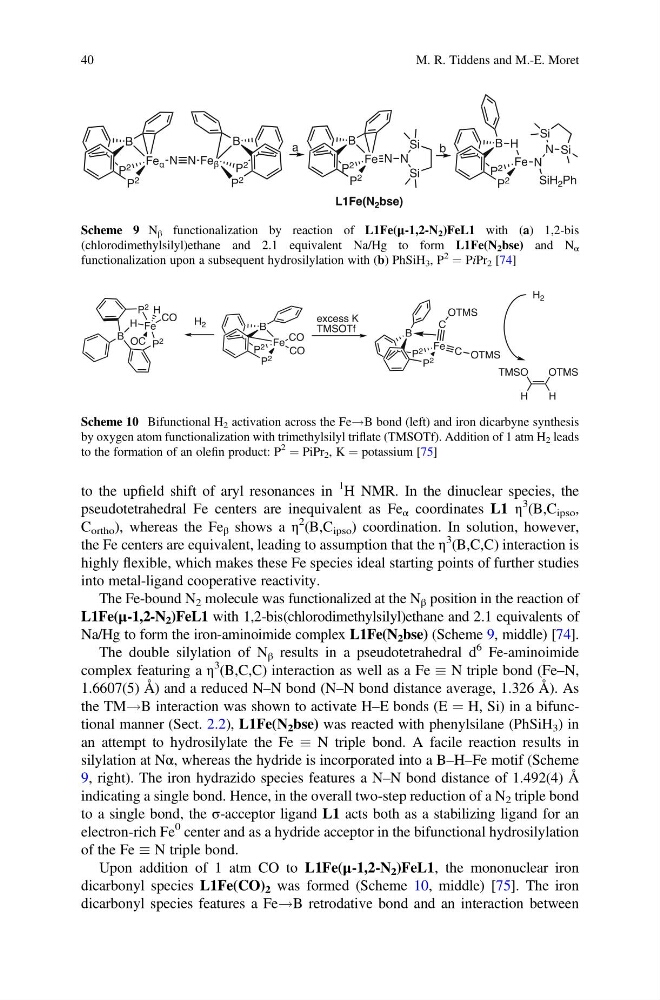
The Fe-bound N 2 molecule was functionalized at the N β position in the reaction of
L1Fe(μ-1,2-N 2 )FeL1 with 1,2-bis(chlorodimethylsilyl)ethane and 2.1 equivalents of
Na/Hg to form the iron-aminoimide complex L1Fe(N 2 bse) (Scheme 9, middle) [74].
The double silylation of N β results in a pseudotetrahedral d
6 Fe-aminoimide
complex featuring a η
3 (B,C,C) interaction as well as a Fe N triple bond (Fe–N,
1.6607(5) Å) and a reduced N–N bond (N–N bond distance average, 1.326 Å). As
the TM!B interaction was shown to activate H–E bonds (E ¼ H, Si) in a bifunctional manner (Sect. 2.2), L1Fe(N 2 bse) was reacted with phenylsilane (PhSiH 3 ) in
an attempt to hydrosilylate the Fe N triple bond. A facile reaction results in
silylation at Nα, whereas the hydride is incorporated into a B–H–Fe motif (Scheme
9, right). The iron hydrazido species features a N–N bond distance of 1.492(4) Å
indicating a single bond. Hence, in the overall two-step reduction of a N 2 triple bond
to a single bond, the σ-acceptor ligand L1 acts both as a stabilizing ligand for an
electron-rich Fe
0 center and as a hydride acceptor in the bifunctional hydrosilylation
of the Fe N triple bond.
Upon addition of 1 atm CO to L1Fe(μ-1,2-N 2 )FeL1, the mononuclear iron
dicarbonyl species L1Fe(CO) 2 was formed (Scheme 10, middle) [75]. The iron
dicarbonyl species features a Fe!B retrodative bond and an interaction between
Scheme 9 N β functionalization by reaction of L1Fe(μ-1,2-N 2 )FeL1 with (a) 1,2-bis
(chlorodimethylsilyl)ethane and 2.1 equivalent Na/Hg to form L1Fe(N 2 bse) and N α
functionalization upon a subsequent hydrosilylation with (b) PhSiH 3 , P
2 ¼ PiPr 2 [74]
Scheme 10 Bifunctional H 2 activation across the Fe!B bond (left) and iron dicarbyne synthesis
by oxygen atom functionalization with trimethylsilyl triflate (TMSOTf). Addition of 1 atm H 2 leads
to the formation of an olefin product: P
2 ¼ PiPr 2 , K ¼ potassium [75]
40
M. R. Tiddens and M.-E. Moret
1 H NMR. In the dinuclear species, the
pseudotetrahedral Fe centers are inequivalent as Fe α coordinates L1 η
3 (B,C ipso ,
C ortho ), whereas the Fe β shows a η
2 (B,C ipso ) coordination. In solution, however,
the Fe centers are equivalent, leading to assumption that the η
3 (B,C,C) interaction is
highly flexible, which makes these Fe species ideal starting points of further studies
into metal-ligand cooperative reactivity.
The Fe-bound N 2 molecule was functionalized at the N β position in the reaction of
L1Fe(μ-1,2-N 2 )FeL1 with 1,2-bis(chlorodimethylsilyl)ethane and 2.1 equivalents of
Na/Hg to form the iron-aminoimide complex L1Fe(N 2 bse) (Scheme 9, middle) [74].
The double silylation of N β results in a pseudotetrahedral d
6 Fe-aminoimide
complex featuring a η
3 (B,C,C) interaction as well as a Fe N triple bond (Fe–N,
1.6607(5) Å) and a reduced N–N bond (N–N bond distance average, 1.326 Å). As
the TM!B interaction was shown to activate H–E bonds (E ¼ H, Si) in a bifunctional manner (Sect. 2.2), L1Fe(N 2 bse) was reacted with phenylsilane (PhSiH 3 ) in
an attempt to hydrosilylate the Fe N triple bond. A facile reaction results in
silylation at Nα, whereas the hydride is incorporated into a B–H–Fe motif (Scheme
9, right). The iron hydrazido species features a N–N bond distance of 1.492(4) Å
indicating a single bond. Hence, in the overall two-step reduction of a N 2 triple bond
to a single bond, the σ-acceptor ligand L1 acts both as a stabilizing ligand for an
electron-rich Fe
0 center and as a hydride acceptor in the bifunctional hydrosilylation
of the Fe N triple bond.
Upon addition of 1 atm CO to L1Fe(μ-1,2-N 2 )FeL1, the mononuclear iron
dicarbonyl species L1Fe(CO) 2 was formed (Scheme 10, middle) [75]. The iron
dicarbonyl species features a Fe!B retrodative bond and an interaction between
Scheme 9 N β functionalization by reaction of L1Fe(μ-1,2-N 2 )FeL1 with (a) 1,2-bis
(chlorodimethylsilyl)ethane and 2.1 equivalent Na/Hg to form L1Fe(N 2 bse) and N α
functionalization upon a subsequent hydrosilylation with (b) PhSiH 3 , P
2 ¼ PiPr 2 [74]
Scheme 10 Bifunctional H 2 activation across the Fe!B bond (left) and iron dicarbyne synthesis
by oxygen atom functionalization with trimethylsilyl triflate (TMSOTf). Addition of 1 atm H 2 leads
to the formation of an olefin product: P
2 ¼ PiPr 2 , K ¼ potassium [75]
40
M. R. Tiddens and M.-E. Moret