

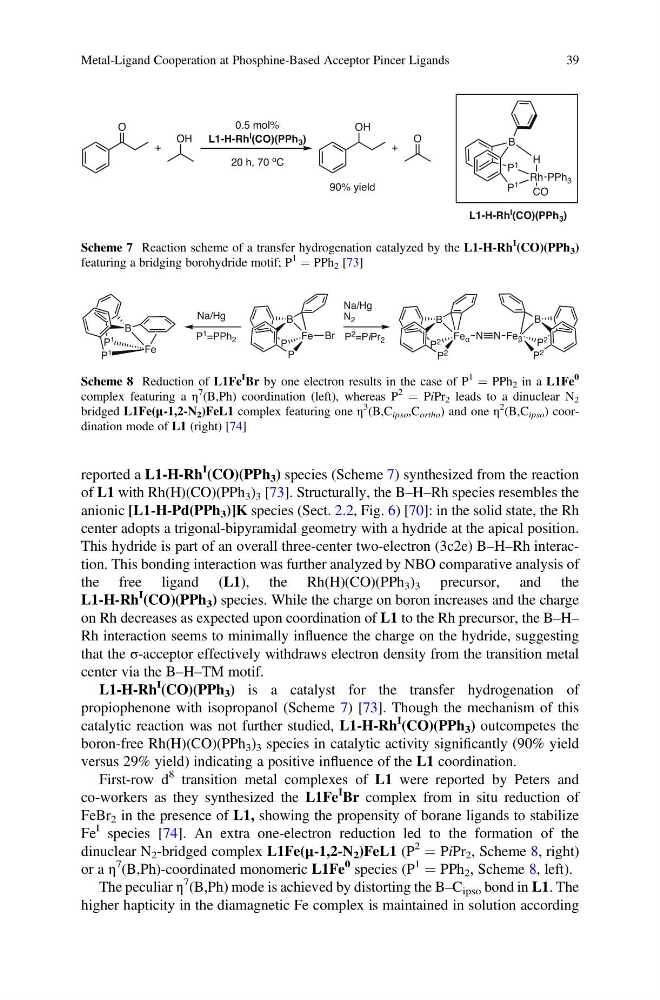
reported a L1-H-Rh
I (CO)(PPh 3 ) species (Scheme 7) synthesized from the reaction
of L1 with Rh(H)(CO)(PPh 3 ) 3 [73]. Structurally, the B–H–Rh species resembles the
anionic [L1-H-Pd(PPh 3 )]K species (Sect. 2.2, Fig. 6) [70]: in the solid state, the Rh
center adopts a trigonal-bipyramidal geometry with a hydride at the apical position.
This hydride is part of an overall three-center two-electron (3c2e) B–H–Rh interaction. This bonding interaction was further analyzed by NBO comparative analysis of
the free ligand (L1), the Rh(H)(CO)(PPh 3 ) 3 precursor, and the
L1-H-Rh
I
(CO)(PPh 3 ) species. While the charge on boron increases and the charge
on Rh decreases as expected upon coordination of L1 to the Rh precursor, the B–H–
Rh interaction seems to minimally influence the charge on the hydride, suggesting
that the σ-acceptor effectively withdraws electron density from the transition metal
center via the B–H–TM motif.
L1-H-Rh
I (CO)(PPh 3 ) is a catalyst for the transfer hydrogenation of
propiophenone with isopropanol (Scheme 7) [73]. Though the mechanism of this
catalytic reaction was not further studied, L1-H-Rh
I (CO)(PPh 3 ) outcompetes the
boron-free Rh(H)(CO)(PPh 3 ) 3 species in catalytic activity significantly (90% yield
versus 29% yield) indicating a positive influence of the L1 coordination.
First-row d
8 transition metal complexes of L1 were reported by Peters and
co-workers as they synthesized the L1Fe
I Br complex from in situ reduction of
FeBr 2 in the presence of L1, showing the propensity of borane ligands to stabilize
Fe
I species [74]. An extra one-electron reduction led to the formation of the
dinuclear N 2 -bridged complex L1Fe(μ-1,2-N 2 )FeL1 (P
2
¼ PiPr 2 , Scheme 8, right)
or a η
7 (B,Ph)-coordinated monomeric L1Fe
0 species (P
1
¼ PPh 2 , Scheme 8, left).
The peculiar η
7 (B,Ph) mode is achieved by distorting the B–C ipso bond in L1. The
higher hapticity in the diamagnetic Fe complex is maintained in solution according
O
OH
OH
O
B
H
Rh
P 1
P 1
CO
PPh 3
+
+
90% yield
20 h, 70 o C
0.5 mol%
L1-H-Rh I (CO)(PPh 3 )
L1-H-Rh I (CO)(PPh 3 )
Scheme 7 Reaction scheme of a transfer hydrogenation catalyzed by the L1-H-Rh
I
(CO)(PPh 3 )
featuring a bridging borohydride motif; P
1 ¼ PPh 2 [73]
Scheme 8 Reduction of L1Fe
I Br by one electron results in the case of P
1 ¼ PPh 2 in a L1Fe
0
complex featuring a η
7
(B,Ph) coordination (left), whereas P
2 ¼ PiPr 2 leads to a dinuclear N 2
bridged L1Fe(μ-1,2-N 2 )FeL1 complex featuring one η
3
(B,C ipso ,C ortho ) and one η
2
(B,C ipso ) coordination mode of L1 (right) [74]
Metal-Ligand Cooperation at Phosphine-Based Acceptor Pincer Ligands
39
I (CO)(PPh 3 ) species (Scheme 7) synthesized from the reaction
of L1 with Rh(H)(CO)(PPh 3 ) 3 [73]. Structurally, the B–H–Rh species resembles the
anionic [L1-H-Pd(PPh 3 )]K species (Sect. 2.2, Fig. 6) [70]: in the solid state, the Rh
center adopts a trigonal-bipyramidal geometry with a hydride at the apical position.
This hydride is part of an overall three-center two-electron (3c2e) B–H–Rh interaction. This bonding interaction was further analyzed by NBO comparative analysis of
the free ligand (L1), the Rh(H)(CO)(PPh 3 ) 3 precursor, and the
L1-H-Rh
I
(CO)(PPh 3 ) species. While the charge on boron increases and the charge
on Rh decreases as expected upon coordination of L1 to the Rh precursor, the B–H–
Rh interaction seems to minimally influence the charge on the hydride, suggesting
that the σ-acceptor effectively withdraws electron density from the transition metal
center via the B–H–TM motif.
L1-H-Rh
I (CO)(PPh 3 ) is a catalyst for the transfer hydrogenation of
propiophenone with isopropanol (Scheme 7) [73]. Though the mechanism of this
catalytic reaction was not further studied, L1-H-Rh
I (CO)(PPh 3 ) outcompetes the
boron-free Rh(H)(CO)(PPh 3 ) 3 species in catalytic activity significantly (90% yield
versus 29% yield) indicating a positive influence of the L1 coordination.
First-row d
8 transition metal complexes of L1 were reported by Peters and
co-workers as they synthesized the L1Fe
I Br complex from in situ reduction of
FeBr 2 in the presence of L1, showing the propensity of borane ligands to stabilize
Fe
I species [74]. An extra one-electron reduction led to the formation of the
dinuclear N 2 -bridged complex L1Fe(μ-1,2-N 2 )FeL1 (P
2
¼ PiPr 2 , Scheme 8, right)
or a η
7 (B,Ph)-coordinated monomeric L1Fe
0 species (P
1
¼ PPh 2 , Scheme 8, left).
The peculiar η
7 (B,Ph) mode is achieved by distorting the B–C ipso bond in L1. The
higher hapticity in the diamagnetic Fe complex is maintained in solution according
O
OH
OH
O
B
H
Rh
P 1
P 1
CO
PPh 3
+
+
90% yield
20 h, 70 o C
0.5 mol%
L1-H-Rh I (CO)(PPh 3 )
L1-H-Rh I (CO)(PPh 3 )
Scheme 7 Reaction scheme of a transfer hydrogenation catalyzed by the L1-H-Rh
I
(CO)(PPh 3 )
featuring a bridging borohydride motif; P
1 ¼ PPh 2 [73]
Scheme 8 Reduction of L1Fe
I Br by one electron results in the case of P
1 ¼ PPh 2 in a L1Fe
0
complex featuring a η
7
(B,Ph) coordination (left), whereas P
2 ¼ PiPr 2 leads to a dinuclear N 2
bridged L1Fe(μ-1,2-N 2 )FeL1 complex featuring one η
3
(B,C ipso ,C ortho ) and one η
2
(B,C ipso ) coordination mode of L1 (right) [74]
Metal-Ligand Cooperation at Phosphine-Based Acceptor Pincer Ligands
39