

how the coordination strength of the σ-acceptor borane to the transition metal center
is a continuum tuned by the intrinsic Lewis basicity of the metal center.
The Lewis acidity of the central boron atom in L1 is quenched by coordination to
a transition metal center as was experimentally shown by Britovsek and co-workers.
They attempted bifunctional C–O bond activation across a Rh!B interaction in the
reaction of square pyramidal [L1Rh
I (CO) 2 ][SbF 6 ] species with methyl acetate
[71]. In contrast with the related L1Pd
0 (2,6-lutidine) complex (Scheme 5, Sect.
2.2), [L1Rh
I (CO) 2 ][SbF 6 ] is unreactive towards neutral oxygen-containing substrates, which was attributed to the strong Rh!B interaction.
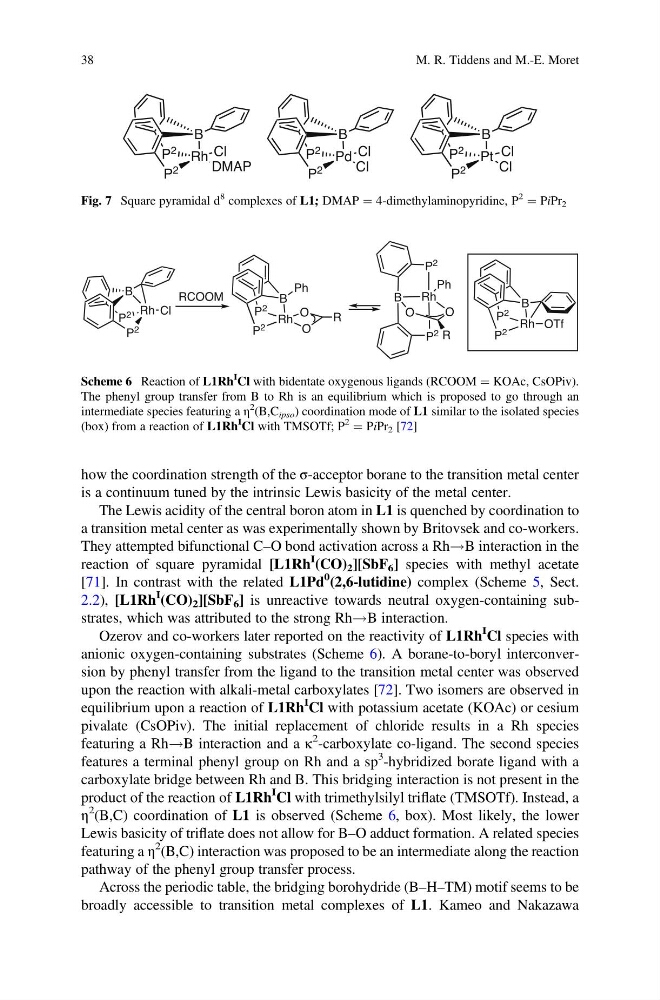
Ozerov and co-workers later reported on the reactivity of L1Rh
I Cl species with
anionic oxygen-containing substrates (Scheme 6). A borane-to-boryl interconversion by phenyl transfer from the ligand to the transition metal center was observed
upon the reaction with alkali-metal carboxylates [72]. Two isomers are observed in
equilibrium upon a reaction of L1Rh
I Cl with potassium acetate (KOAc) or cesium
pivalate (CsOPiv). The initial replacement of chloride results in a Rh species
featuring a Rh!B interaction and a κ
2 -carboxylate co-ligand. The second species
features a terminal phenyl group on Rh and a sp
3 -hybridized borate ligand with a
carboxylate bridge between Rh and B. This bridging interaction is not present in the
product of the reaction of L1Rh
I Cl with trimethylsilyl triflate (TMSOTf). Instead, a
η
2 (B,C) coordination of L1 is observed (Scheme 6, box). Most likely, the lower
Lewis basicity of triflate does not allow for B–O adduct formation. A related species
featuring a η
2 (B,C) interaction was proposed to be an intermediate along the reaction
pathway of the phenyl group transfer process.
Across the periodic table, the bridging borohydride (B–H–TM) motif seems to be
broadly accessible to transition metal complexes of L1. Kameo and Nakazawa
Ph
B
Rh
P 2
P 2
B
Rh
P 2
P 2
OTf
B
P 2
P 2
Rh
O
Ph
O
Rh
P 2
P 2
B
Cl
RCOOM
O
O
R
R
Scheme 6 Reaction of L1Rh
I
Cl with bidentate oxygenous ligands (RCOOM ¼ KOAc, CsOPiv).
The phenyl group transfer from B to Rh is an equilibrium which is proposed to go through an
intermediate species featuring a η
2
(B,C ipso ) coordination mode of L1 similar to the isolated species
(box) from a reaction of L1Rh
I
Cl with TMSOTf; P
2 ¼ PiPr 2 [72]
Fig. 7 Square pyramidal d
8 complexes of L1; DMAP ¼ 4-dimethylaminopyridine, P
2 ¼ PiPr 2
38
M. R. Tiddens and M.-E. Moret
is a continuum tuned by the intrinsic Lewis basicity of the metal center.
The Lewis acidity of the central boron atom in L1 is quenched by coordination to
a transition metal center as was experimentally shown by Britovsek and co-workers.
They attempted bifunctional C–O bond activation across a Rh!B interaction in the
reaction of square pyramidal [L1Rh
I (CO) 2 ][SbF 6 ] species with methyl acetate
[71]. In contrast with the related L1Pd
0 (2,6-lutidine) complex (Scheme 5, Sect.
2.2), [L1Rh
I (CO) 2 ][SbF 6 ] is unreactive towards neutral oxygen-containing substrates, which was attributed to the strong Rh!B interaction.
Ozerov and co-workers later reported on the reactivity of L1Rh
I Cl species with
anionic oxygen-containing substrates (Scheme 6). A borane-to-boryl interconversion by phenyl transfer from the ligand to the transition metal center was observed
upon the reaction with alkali-metal carboxylates [72]. Two isomers are observed in
equilibrium upon a reaction of L1Rh
I Cl with potassium acetate (KOAc) or cesium
pivalate (CsOPiv). The initial replacement of chloride results in a Rh species
featuring a Rh!B interaction and a κ
2 -carboxylate co-ligand. The second species
features a terminal phenyl group on Rh and a sp
3 -hybridized borate ligand with a
carboxylate bridge between Rh and B. This bridging interaction is not present in the
product of the reaction of L1Rh
I Cl with trimethylsilyl triflate (TMSOTf). Instead, a
η
2 (B,C) coordination of L1 is observed (Scheme 6, box). Most likely, the lower
Lewis basicity of triflate does not allow for B–O adduct formation. A related species
featuring a η
2 (B,C) interaction was proposed to be an intermediate along the reaction
pathway of the phenyl group transfer process.
Across the periodic table, the bridging borohydride (B–H–TM) motif seems to be
broadly accessible to transition metal complexes of L1. Kameo and Nakazawa
Ph
B
Rh
P 2
P 2
B
Rh
P 2
P 2
OTf
B
P 2
P 2
Rh
O
Ph
O
Rh
P 2
P 2
B
Cl
RCOOM
O
O
R
R
Scheme 6 Reaction of L1Rh
I
Cl with bidentate oxygenous ligands (RCOOM ¼ KOAc, CsOPiv).
The phenyl group transfer from B to Rh is an equilibrium which is proposed to go through an
intermediate species featuring a η
2
(B,C ipso ) coordination mode of L1 similar to the isolated species
(box) from a reaction of L1Rh
I
Cl with TMSOTf; P
2 ¼ PiPr 2 [72]
Fig. 7 Square pyramidal d
8 complexes of L1; DMAP ¼ 4-dimethylaminopyridine, P
2 ¼ PiPr 2
38
M. R. Tiddens and M.-E. Moret