

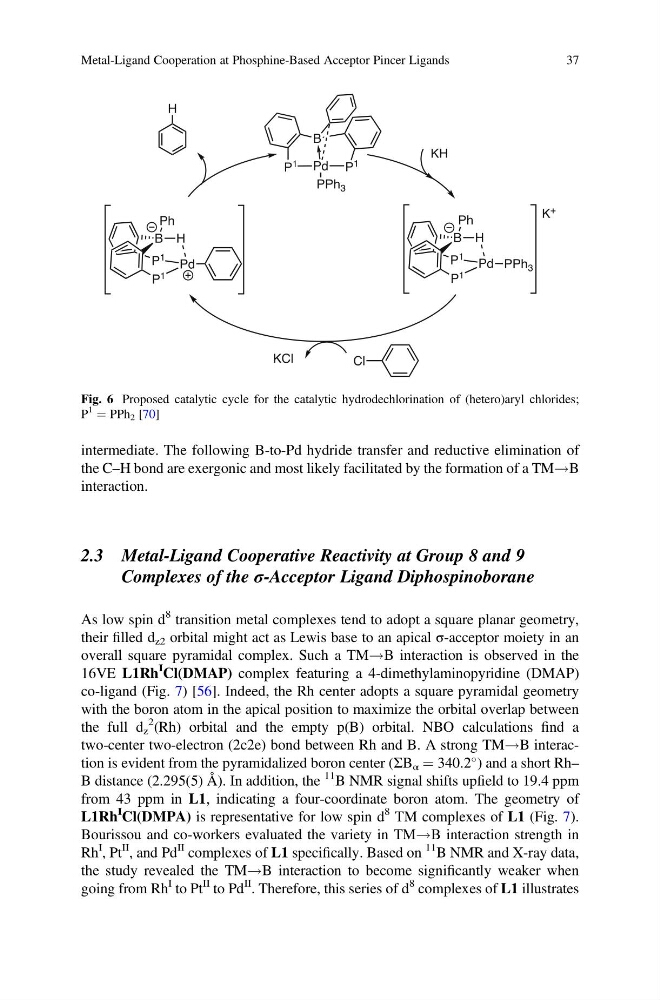
intermediate. The following B-to-Pd hydride transfer and reductive elimination of
the C–H bond are exergonic and most likely facilitated by the formation of a TM!B
interaction.
2.3 Metal-Ligand Cooperative Reactivity at Group 8 and 9
Complexes of the σ-Acceptor Ligand Diphospinoborane
As low spin d
8 transition metal complexes tend to adopt a square planar geometry,
their filled d z2 orbital might act as Lewis base to an apical σ-acceptor moiety in an
overall square pyramidal complex. Such a TM!B interaction is observed in the
16VE L1Rh
I
Cl(DMAP) complex featuring a 4-dimethylaminopyridine (DMAP)
co-ligand (Fig. 7) [56]. Indeed, the Rh center adopts a square pyramidal geometry
with the boron atom in the apical position to maximize the orbital overlap between
the full d z
2 (Rh) orbital and the empty p(B) orbital. NBO calculations find a
two-center two-electron (2c2e) bond between Rh and B. A strong TM!B interaction is evident from the pyramidalized boron center (ΣB α ¼ 340.2
) and a short Rh–
B distance (2.295(5) Å). In addition, the
11 B NMR signal shifts upfield to 19.4 ppm
from 43 ppm in L1, indicating a four-coordinate boron atom. The geometry of
L1Rh
I Cl(DMPA) is representative for low spin d
8 TM complexes of L1 (Fig. 7).
Bourissou and co-workers evaluated the variety in TM!B interaction strength in
Rh
I , Pt
II , and Pd
II complexes of L1 specifically. Based on
11 B NMR and X-ray data,
the study revealed the TM!B interaction to become significantly weaker when
going from Rh
I to Pt
II to Pd
II . Therefore, this series of d
8 complexes of L1 illustrates
Fig. 6 Proposed catalytic cycle for the catalytic hydrodechlorination of (hetero)aryl chlorides;
P
1 ¼ PPh 2 [70]
Metal-Ligand Cooperation at Phosphine-Based Acceptor Pincer Ligands
37
the C–H bond are exergonic and most likely facilitated by the formation of a TM!B
interaction.
2.3 Metal-Ligand Cooperative Reactivity at Group 8 and 9
Complexes of the σ-Acceptor Ligand Diphospinoborane
As low spin d
8 transition metal complexes tend to adopt a square planar geometry,
their filled d z2 orbital might act as Lewis base to an apical σ-acceptor moiety in an
overall square pyramidal complex. Such a TM!B interaction is observed in the
16VE L1Rh
I
Cl(DMAP) complex featuring a 4-dimethylaminopyridine (DMAP)
co-ligand (Fig. 7) [56]. Indeed, the Rh center adopts a square pyramidal geometry
with the boron atom in the apical position to maximize the orbital overlap between
the full d z
2 (Rh) orbital and the empty p(B) orbital. NBO calculations find a
two-center two-electron (2c2e) bond between Rh and B. A strong TM!B interaction is evident from the pyramidalized boron center (ΣB α ¼ 340.2
) and a short Rh–
B distance (2.295(5) Å). In addition, the
11 B NMR signal shifts upfield to 19.4 ppm
from 43 ppm in L1, indicating a four-coordinate boron atom. The geometry of
L1Rh
I Cl(DMPA) is representative for low spin d
8 TM complexes of L1 (Fig. 7).
Bourissou and co-workers evaluated the variety in TM!B interaction strength in
Rh
I , Pt
II , and Pd
II complexes of L1 specifically. Based on
11 B NMR and X-ray data,
the study revealed the TM!B interaction to become significantly weaker when
going from Rh
I to Pt
II to Pd
II . Therefore, this series of d
8 complexes of L1 illustrates
Fig. 6 Proposed catalytic cycle for the catalytic hydrodechlorination of (hetero)aryl chlorides;
P
1 ¼ PPh 2 [70]
Metal-Ligand Cooperation at Phosphine-Based Acceptor Pincer Ligands
37