

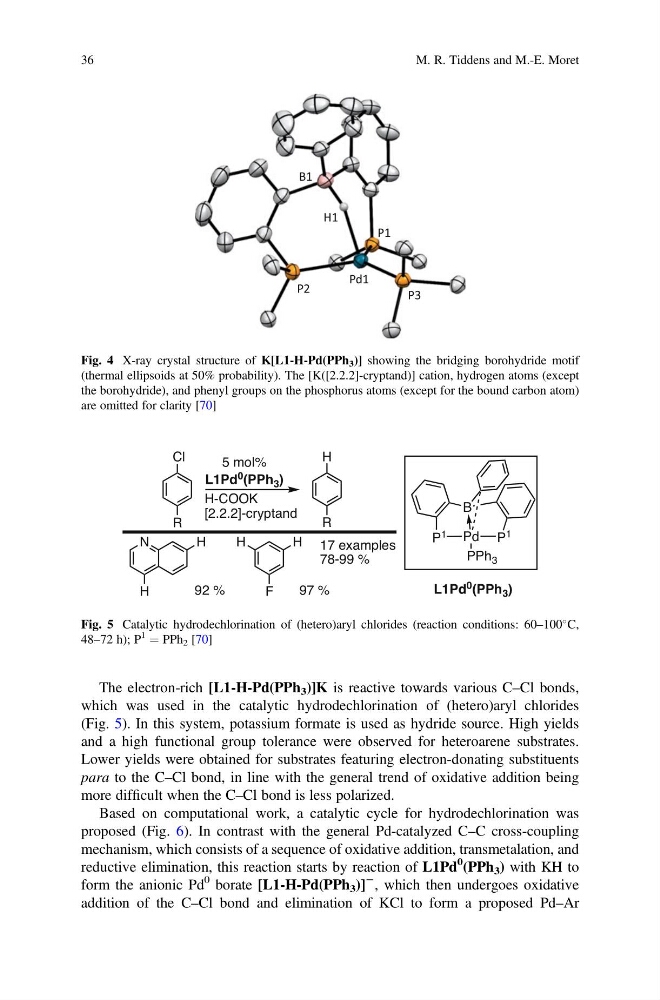
The electron-rich [L1-H-Pd(PPh 3 )]K is reactive towards various C–Cl bonds,
which was used in the catalytic hydrodechlorination of (hetero)aryl chlorides
(Fig. 5). In this system, potassium formate is used as hydride source. High yields
and a high functional group tolerance were observed for heteroarene substrates.
Lower yields were obtained for substrates featuring electron-donating substituents
para to the C–Cl bond, in line with the general trend of oxidative addition being
more difficult when the C–Cl bond is less polarized.
Based on computational work, a catalytic cycle for hydrodechlorination was
proposed (Fig. 6). In contrast with the general Pd-catalyzed C–C cross-coupling
mechanism, which consists of a sequence of oxidative addition, transmetalation, and
reductive elimination, this reaction starts by reaction of L1Pd
0 (PPh 3 ) with KH to
form the anionic Pd
0 borate [L1-H-Pd(PPh 3 )]
2 , which then undergoes oxidative
addition of the C–Cl bond and elimination of KCl to form a proposed Pd–Ar
H1
P3
P2
B1
P1
Pd1
Fig. 4 X-ray crystal structure of K[L1-H-Pd(PPh 3 )] showing the bridging borohydride motif
(thermal ellipsoids at 50% probability). The [K([2.2.2]-cryptand)] cation, hydrogen atoms (except
the borohydride), and phenyl groups on the phosphorus atoms (except for the bound carbon atom)
are omitted for clarity [70]
17 examples
78-99 %
97 %
92 %
Cl
H
R
R
N
H
H
F
H
H
H-COOK
[2.2.2]-cryptand
5 mol%
L1Pd 0 (PPh 3 )
L1Pd 0 (PPh 3 )
B
P 1
P 1
Pd
PPh 3
Fig. 5 Catalytic hydrodechlorination of (hetero)aryl chlorides (reaction conditions: 60–100
C,
48–72 h); P
1 ¼ PPh 2 [70]
36
M. R. Tiddens and M.-E. Moret
which was used in the catalytic hydrodechlorination of (hetero)aryl chlorides
(Fig. 5). In this system, potassium formate is used as hydride source. High yields
and a high functional group tolerance were observed for heteroarene substrates.
Lower yields were obtained for substrates featuring electron-donating substituents
para to the C–Cl bond, in line with the general trend of oxidative addition being
more difficult when the C–Cl bond is less polarized.
Based on computational work, a catalytic cycle for hydrodechlorination was
proposed (Fig. 6). In contrast with the general Pd-catalyzed C–C cross-coupling
mechanism, which consists of a sequence of oxidative addition, transmetalation, and
reductive elimination, this reaction starts by reaction of L1Pd
0 (PPh 3 ) with KH to
form the anionic Pd
0 borate [L1-H-Pd(PPh 3 )]
2 , which then undergoes oxidative
addition of the C–Cl bond and elimination of KCl to form a proposed Pd–Ar
H1
P3
P2
B1
P1
Pd1
Fig. 4 X-ray crystal structure of K[L1-H-Pd(PPh 3 )] showing the bridging borohydride motif
(thermal ellipsoids at 50% probability). The [K([2.2.2]-cryptand)] cation, hydrogen atoms (except
the borohydride), and phenyl groups on the phosphorus atoms (except for the bound carbon atom)
are omitted for clarity [70]
17 examples
78-99 %
97 %
92 %
Cl
H
R
R
N
H
H
F
H
H
H-COOK
[2.2.2]-cryptand
5 mol%
L1Pd 0 (PPh 3 )
L1Pd 0 (PPh 3 )
B
P 1
P 1
Pd
PPh 3
Fig. 5 Catalytic hydrodechlorination of (hetero)aryl chlorides (reaction conditions: 60–100
C,
48–72 h); P
1 ¼ PPh 2 [70]
36
M. R. Tiddens and M.-E. Moret