

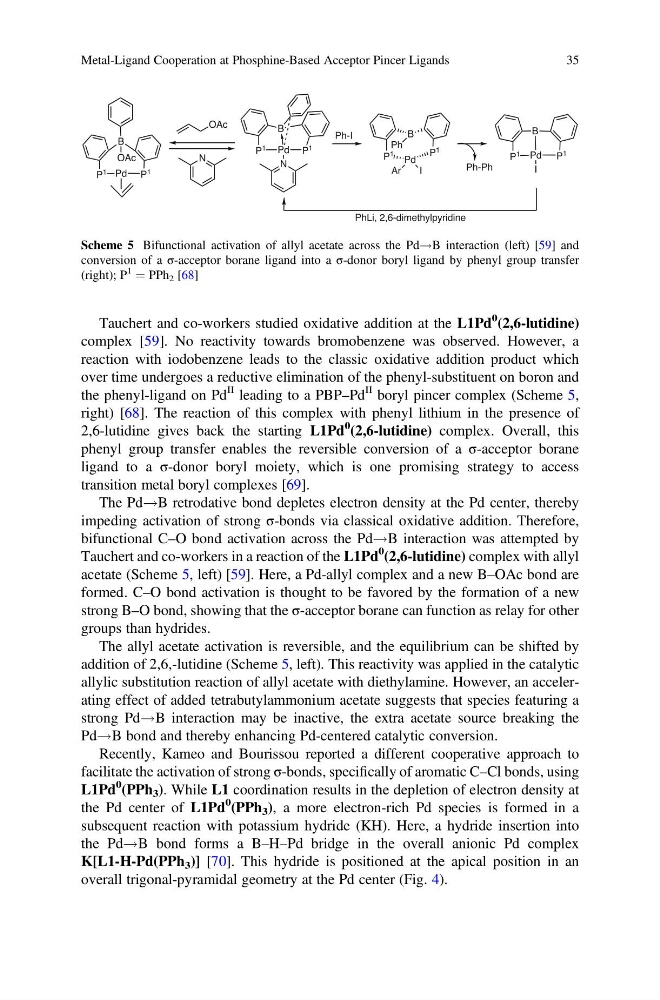
Tauchert and co-workers studied oxidative addition at the L1Pd
0 (2,6-lutidine)
complex [59]. No reactivity towards bromobenzene was observed. However, a
reaction with iodobenzene leads to the classic oxidative addition product which
over time undergoes a reductive elimination of the phenyl-substituent on boron and
the phenyl-ligand on Pd
II leading to a PBP–Pd
II boryl pincer complex (Scheme 5,
right) [68]. The reaction of this complex with phenyl lithium in the presence of
2,6-lutidine gives back the starting L1Pd
0 (2,6-lutidine) complex. Overall, this
phenyl group transfer enables the reversible conversion of a σ-acceptor borane
ligand to a σ-donor boryl moiety, which is one promising strategy to access
transition metal boryl complexes [69].
The Pd!B retrodative bond depletes electron density at the Pd center, thereby
impeding activation of strong σ-bonds via classical oxidative addition. Therefore,
bifunctional C–O bond activation across the Pd!B interaction was attempted by
Tauchert and co-workers in a reaction of the L1Pd
0 (2,6-lutidine) complex with allyl
acetate (Scheme 5, left) [59]. Here, a Pd-allyl complex and a new B–OAc bond are
formed. C–O bond activation is thought to be favored by the formation of a new
strong B–O bond, showing that the σ-acceptor borane can function as relay for other
groups than hydrides.
The allyl acetate activation is reversible, and the equilibrium can be shifted by
addition of 2,6,-lutidine (Scheme 5, left). This reactivity was applied in the catalytic
allylic substitution reaction of allyl acetate with diethylamine. However, an accelerating effect of added tetrabutylammonium acetate suggests that species featuring a
strong Pd!B interaction may be inactive, the extra acetate source breaking the
Pd!B bond and thereby enhancing Pd-centered catalytic conversion.
Recently, Kameo and Bourissou reported a different cooperative approach to
facilitate the activation of strong σ-bonds, specifically of aromatic C–Cl bonds, using
L1Pd
0 (PPh 3 ). While L1 coordination results in the depletion of electron density at
the Pd center of L1Pd
0 (PPh 3 ), a more electron-rich Pd species is formed in a
subsequent reaction with potassium hydride (KH). Here, a hydride insertion into
the Pd!B bond forms a B–H–Pd bridge in the overall anionic Pd complex
K[L1-H-Pd(PPh 3 )] [70]. This hydride is positioned at the apical position in an
overall trigonal-pyramidal geometry at the Pd center (Fig. 4).
Scheme 5 Bifunctional activation of allyl acetate across the Pd!B interaction (left) [59] and
conversion of a σ-acceptor borane ligand into a σ-donor boryl ligand by phenyl group transfer
(right); P
1 ¼ PPh 2 [68]
Metal-Ligand Cooperation at Phosphine-Based Acceptor Pincer Ligands
35
0 (2,6-lutidine)
complex [59]. No reactivity towards bromobenzene was observed. However, a
reaction with iodobenzene leads to the classic oxidative addition product which
over time undergoes a reductive elimination of the phenyl-substituent on boron and
the phenyl-ligand on Pd
II leading to a PBP–Pd
II boryl pincer complex (Scheme 5,
right) [68]. The reaction of this complex with phenyl lithium in the presence of
2,6-lutidine gives back the starting L1Pd
0 (2,6-lutidine) complex. Overall, this
phenyl group transfer enables the reversible conversion of a σ-acceptor borane
ligand to a σ-donor boryl moiety, which is one promising strategy to access
transition metal boryl complexes [69].
The Pd!B retrodative bond depletes electron density at the Pd center, thereby
impeding activation of strong σ-bonds via classical oxidative addition. Therefore,
bifunctional C–O bond activation across the Pd!B interaction was attempted by
Tauchert and co-workers in a reaction of the L1Pd
0 (2,6-lutidine) complex with allyl
acetate (Scheme 5, left) [59]. Here, a Pd-allyl complex and a new B–OAc bond are
formed. C–O bond activation is thought to be favored by the formation of a new
strong B–O bond, showing that the σ-acceptor borane can function as relay for other
groups than hydrides.
The allyl acetate activation is reversible, and the equilibrium can be shifted by
addition of 2,6,-lutidine (Scheme 5, left). This reactivity was applied in the catalytic
allylic substitution reaction of allyl acetate with diethylamine. However, an accelerating effect of added tetrabutylammonium acetate suggests that species featuring a
strong Pd!B interaction may be inactive, the extra acetate source breaking the
Pd!B bond and thereby enhancing Pd-centered catalytic conversion.
Recently, Kameo and Bourissou reported a different cooperative approach to
facilitate the activation of strong σ-bonds, specifically of aromatic C–Cl bonds, using
L1Pd
0 (PPh 3 ). While L1 coordination results in the depletion of electron density at
the Pd center of L1Pd
0 (PPh 3 ), a more electron-rich Pd species is formed in a
subsequent reaction with potassium hydride (KH). Here, a hydride insertion into
the Pd!B bond forms a B–H–Pd bridge in the overall anionic Pd complex
K[L1-H-Pd(PPh 3 )] [70]. This hydride is positioned at the apical position in an
overall trigonal-pyramidal geometry at the Pd center (Fig. 4).
Scheme 5 Bifunctional activation of allyl acetate across the Pd!B interaction (left) [59] and
conversion of a σ-acceptor borane ligand into a σ-donor boryl ligand by phenyl group transfer
(right); P
1 ¼ PPh 2 [68]
Metal-Ligand Cooperation at Phosphine-Based Acceptor Pincer Ligands
35