

energy penalty seems to be associated with breaking the Ni!B interaction in this
process.
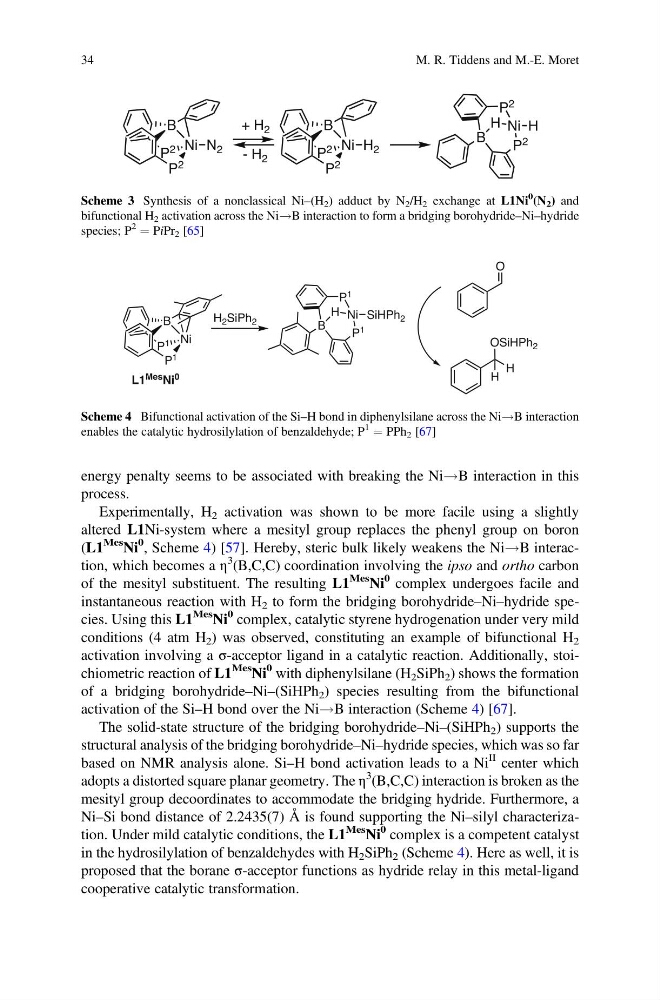
Experimentally, H 2 activation was shown to be more facile using a slightly
altered L1Ni-system where a mesityl group replaces the phenyl group on boron
(L1
Mes Ni
0 , Scheme 4) [57]. Hereby, steric bulk likely weakens the Ni!B interaction, which becomes a η
3 (B,C,C) coordination involving the ipso and ortho carbon
of the mesityl substituent. The resulting L1
Mes Ni
0 complex undergoes facile and
instantaneous reaction with H 2 to form the bridging borohydride–Ni–hydride species. Using this L1
Mes Ni
0 complex, catalytic styrene hydrogenation under very mild
conditions (4 atm H 2 ) was observed, constituting an example of bifunctional H 2
activation involving a σ-acceptor ligand in a catalytic reaction. Additionally, stoichiometric reaction of L1
Mes Ni
0 with diphenylsilane (H 2 SiPh 2 ) shows the formation
of a bridging borohydride–Ni–(SiHPh 2 ) species resulting from the bifunctional
activation of the Si–H bond over the Ni!B interaction (Scheme 4) [67].
The solid-state structure of the bridging borohydride–Ni–(SiHPh 2 ) supports the
structural analysis of the bridging borohydride–Ni–hydride species, which was so far
based on NMR analysis alone. Si–H bond activation leads to a Ni
II center which
adopts a distorted square planar geometry. The η
3 (B,C,C) interaction is broken as the
mesityl group decoordinates to accommodate the bridging hydride. Furthermore, a
Ni–Si bond distance of 2.2435(7) Å is found supporting the Ni–silyl characterization. Under mild catalytic conditions, the L1
Mes Ni
0 complex is a competent catalyst
in the hydrosilylation of benzaldehydes with H 2 SiPh 2 (Scheme 4). Here as well, it is
proposed that the borane σ-acceptor functions as hydride relay in this metal-ligand
cooperative catalytic transformation.
Scheme 3 Synthesis of a nonclassical Ni–(H 2 ) adduct by N 2 /H 2 exchange at L1Ni
0
(N 2 ) and
bifunctional H 2 activation across the Ni!B interaction to form a bridging borohydride–Ni–hydride
species; P
2 ¼ PiPr 2 [65]
Scheme 4 Bifunctional activation of the Si–H bond in diphenylsilane across the Ni!B interaction
enables the catalytic hydrosilylation of benzaldehyde; P
1 ¼ PPh 2 [67]
34
M. R. Tiddens and M.-E. Moret
process.
Experimentally, H 2 activation was shown to be more facile using a slightly
altered L1Ni-system where a mesityl group replaces the phenyl group on boron
(L1
Mes Ni
0 , Scheme 4) [57]. Hereby, steric bulk likely weakens the Ni!B interaction, which becomes a η
3 (B,C,C) coordination involving the ipso and ortho carbon
of the mesityl substituent. The resulting L1
Mes Ni
0 complex undergoes facile and
instantaneous reaction with H 2 to form the bridging borohydride–Ni–hydride species. Using this L1
Mes Ni
0 complex, catalytic styrene hydrogenation under very mild
conditions (4 atm H 2 ) was observed, constituting an example of bifunctional H 2
activation involving a σ-acceptor ligand in a catalytic reaction. Additionally, stoichiometric reaction of L1
Mes Ni
0 with diphenylsilane (H 2 SiPh 2 ) shows the formation
of a bridging borohydride–Ni–(SiHPh 2 ) species resulting from the bifunctional
activation of the Si–H bond over the Ni!B interaction (Scheme 4) [67].
The solid-state structure of the bridging borohydride–Ni–(SiHPh 2 ) supports the
structural analysis of the bridging borohydride–Ni–hydride species, which was so far
based on NMR analysis alone. Si–H bond activation leads to a Ni
II center which
adopts a distorted square planar geometry. The η
3 (B,C,C) interaction is broken as the
mesityl group decoordinates to accommodate the bridging hydride. Furthermore, a
Ni–Si bond distance of 2.2435(7) Å is found supporting the Ni–silyl characterization. Under mild catalytic conditions, the L1
Mes Ni
0 complex is a competent catalyst
in the hydrosilylation of benzaldehydes with H 2 SiPh 2 (Scheme 4). Here as well, it is
proposed that the borane σ-acceptor functions as hydride relay in this metal-ligand
cooperative catalytic transformation.
Scheme 3 Synthesis of a nonclassical Ni–(H 2 ) adduct by N 2 /H 2 exchange at L1Ni
0
(N 2 ) and
bifunctional H 2 activation across the Ni!B interaction to form a bridging borohydride–Ni–hydride
species; P
2 ¼ PiPr 2 [65]
Scheme 4 Bifunctional activation of the Si–H bond in diphenylsilane across the Ni!B interaction
enables the catalytic hydrosilylation of benzaldehyde; P
1 ¼ PPh 2 [67]
34
M. R. Tiddens and M.-E. Moret